
Complete Guide to Turtle Behavior: What Your Turtle Is Trying to Tell You
Turtle behavior can seem mysterious at first, especially for new turtle owners. While most of the types of turtles may appear quiet and calm, they are constantly communicating through their actions.
From basking under a heat lamp to swimming across the tank or digging around the substrate, every movement your turtle makes can reveal something about its health, environment, and overall comfort.
Learning to understand turtle behavior is an important part of pet turtle care especially for beginners. By observing how your turtle acts each day, you can recognize when it is comfortable, stressed, hungry, or simply responding to changes in its surroundings. As pet turtles Red eared sliders are quite popular and we have a complete guide to everything that you need to know about RES and their behaviors.
In this guide, we will explore some of the most common turtle behaviors and explain what they usually mean. Understanding these behaviors will help you care for your turtle more confidently and create a healthier environment where it can thrive.
Why Understanding Turtle Behavior Is Important
Many turtle owners feel confused when their turtle suddenly starts behaving differently. One day the turtle is basking regularly and swimming around the tank, and the next day it might hide more often or stop eating, you can check our complete guide to feeding to understand what turtles eat. When this happens, it is easy to assume that something is wrong, but very often the answer can be found by simply understanding normal turtle behavior.
Turtles communicate through their actions. They cannot make sounds the way dogs or cats do, and they do not have facial expressions that clearly show what they are feeling. Instead, their behavior tells the story. The way a turtle swims, hides, basks, or even stares at its surroundings can reveal a lot about how comfortable it feels in its environment.
For turtle owners, learning to observe these behaviors is extremely valuable. When you understand what normal turtle behavior looks like, you can quickly notice when something changes. A turtle that suddenly refuses to bask might be reacting to a problem with the basking area, to create the perfect on your own you can read our step by step guide to creating your own DIY basking platform. A turtle that hides constantly may be feeling stressed or adjusting to a new environment. These small behavioral changes are often the first signs that something in the tank setup needs attention.
Behavior can also tell you whether your turtle’s habitat is suitable. Turtles rely heavily on environmental conditions such as water temperature, lighting, water quality, and available swimming space. If any of these conditions are not ideal, the turtle will often show it through changes in behavior. For example, a turtle that swims frantically against the glass might be reacting to stress or trying to explore beyond the tank. A turtle that rarely comes out to bask might not be receiving enough warmth or proper lighting.
Understanding turtle behavior also helps you build a better connection with your pet. Over time, many turtles begin to recognize routines. They may swim toward the front of the tank when they see their owner approaching, especially during feeding time. While turtles are not affectionate animals in the same way as mammals, these small interactions show that they are comfortable and aware of their surroundings.
Most importantly, observing behavior helps turtle owners provide better care. By paying attention to how your turtle acts each day, you can identify potential problems early and make adjustments before they affect your turtle’s health. Simple observations such as how often your turtle basks, how actively it swims, and how eagerly it eats can provide valuable clues about its overall well being.
In the end, understanding turtle behavior is not complicated. It simply requires patience and observation. The more time you spend watching your turtle, the easier it becomes to recognize what is normal and what might need attention. Over time, these observations will help you create a healthier and more comfortable environment for your turtle.
Common Turtle Behavior Explained
Turtles may seem quiet and simple at first glance, but if you watch them closely you will notice that they are constantly doing something. Every movement, whether it is swimming across the tank, climbing onto a basking dock, or digging in the substrate, can reveal something about how the turtle is feeling.
Many behaviors that surprise new turtle owners are actually completely normal. Turtles follow instincts that come from their natural environment, and even when they live in a tank those instincts still guide how they act. Understanding these common behaviors can help you avoid unnecessary worry and also help you notice when something might be wrong.
For example, a turtle that spends time basking under a heat lamp is doing something essential for its health. Basking helps turtles regulate their body temperature and keep their shells dry. On the other hand, a turtle that constantly swims against the glass might be trying to explore its surroundings or reacting to stress in the tank.
Some behaviors are connected to basic needs such as food, warmth, and safety. A turtle that eagerly swims toward you when you approach the tank is often expecting food. A turtle that hides behind decorations may simply be resting or feeling cautious. Female turtles may even dig in the tank when they are preparing to lay eggs.
It is also important to remember that each turtle has its own personality and routine. Some turtles are very active and curious, while others are calmer and spend more time resting. Over time you will start to recognize the patterns that are normal for your turtle.
In the sections below, we will look at several common turtle behaviors and explain what they usually mean. Understanding these behaviors will make it easier to recognize when your turtle is healthy, comfortable, and thriving in its environment.
Turtle Behavior: Basking
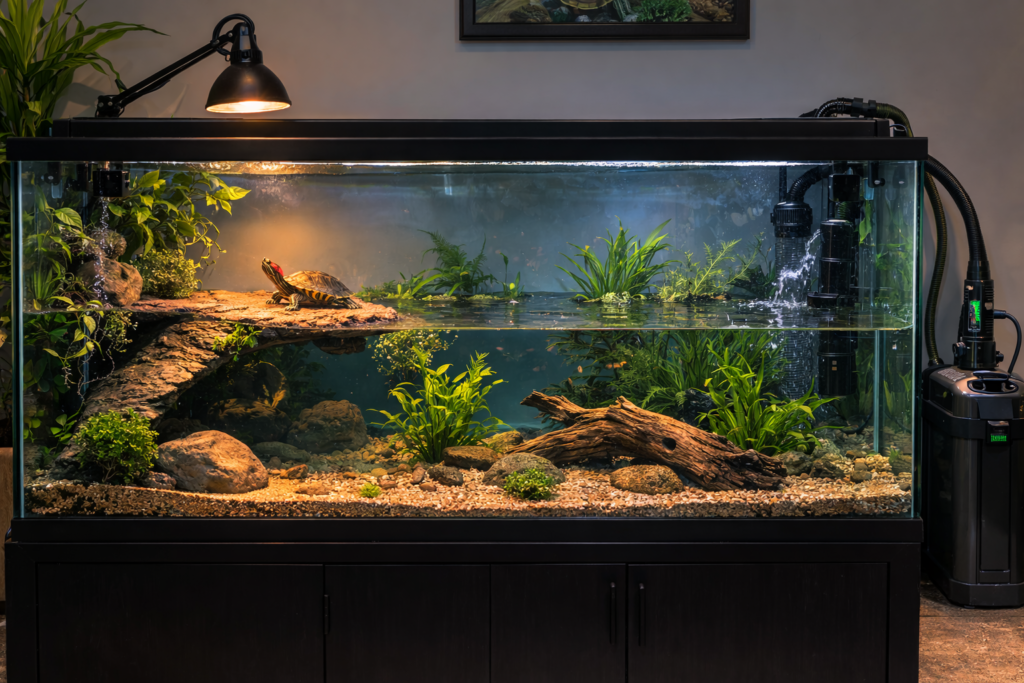
One of the most common and important behaviors you will notice in aquatic turtles is basking. Basking happens when a turtle climbs out of the water and rests on a dry surface under a heat source or sunlight.
At first, many turtle owners feel concerned when they see their turtle sitting still for a long time on the basking platform. In reality, this is completely normal and is actually a very healthy behavior.
Turtles are cold blooded animals, which means they rely on external heat sources to regulate their body temperature. When a turtle basks, it absorbs warmth from the heat lamp or sunlight. This helps the turtle warm its body, improve digestion, and stay active.
Basking also plays an important role in maintaining a turtle’s shell health. When turtles spend time out of the water, their shells are able to dry properly. This helps prevent the growth of harmful bacteria and fungi that can lead to shell infections.
Another important reason turtles bask is to absorb ultraviolet light. In captivity, turtles receive this light from UVB lamps that are placed above the basking area. UVB light allows turtles to produce vitamin D3, which helps them absorb calcium and maintain strong bones and shells.
Healthy turtles usually bask several times throughout the day. Some turtles may stay on the basking platform for just a few minutes, while others may remain there for much longer. This can vary depending on the turtle’s personality, the temperature of the basking area, and how comfortable the turtle feels in its environment.
It is also common for turtles to quickly jump back into the water when they notice movement nearby. In the wild, turtles are naturally cautious animals, so sudden movements can make them feel threatened. If this happens, the turtle will often return to basking once it feels safe again.
If your turtle rarely or never basks, it may be a sign that something in the tank setup needs adjustment. In many cases, turtles avoid the basking area because the temperature is not warm enough, the platform is difficult to climb onto, or the lighting is not positioned correctly.
By providing a comfortable basking platform with proper heat and UVB lighting, you encourage natural basking behavior and support your turtle’s overall health.
Turtle Behavior: Swimming
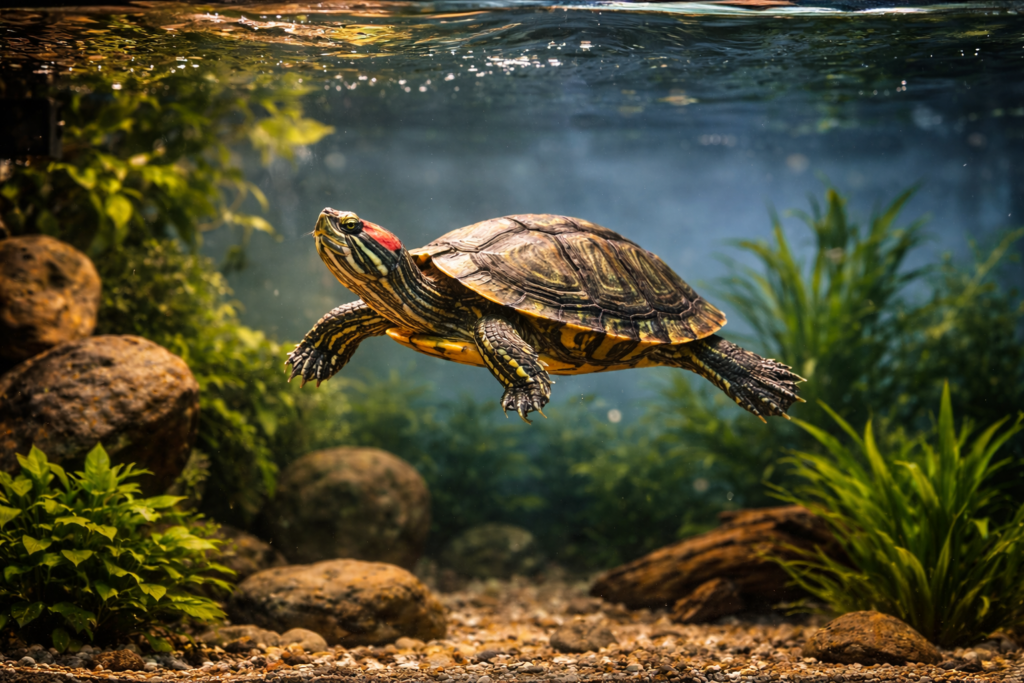
Swimming is one of the most natural and frequent behaviors you will see in aquatic turtles. Since turtles spend most of their lives in water, swimming is how they explore their environment, search for food, and stay active.
Healthy turtles usually swim around their tank regularly throughout the day. You may notice your turtle gliding smoothly through the water, exploring decorations, or occasionally resting on the bottom of the tank. These behaviors are completely normal and often show that the turtle feels comfortable in its environment.
Many turtles also become very active when they notice their owner approaching the tank. This is usually because they associate people with feeding time. When this happens, the turtle may swim quickly toward the front of the tank or follow your movements from side to side. For many turtle owners, this is one of the most entertaining and enjoyable behaviors to observe.
At times, turtles may also swim rapidly or repeatedly across the tank. In some cases, this is simply a sign that the turtle has a lot of energy or is exploring its surroundings. Young turtles especially tend to be more active and curious.
However, there are situations where unusual swimming behavior may signal that something in the environment needs attention. For example, some turtles repeatedly swim against the glass walls of the tank. This behavior is often called glass surfing. It can happen when turtles see their reflection, become curious about movement outside the tank, or feel stressed by their environment.
Tank size can also influence swimming behavior. If the enclosure is too small, turtles may try to explore beyond the glass walls. This can make it appear as if the turtle is trying to escape the tank.
Water conditions can also affect how turtles swim. Poor water quality, incorrect temperatures, or sudden changes in the environment may make turtles behave differently. In these situations, the turtle may swim more aggressively or appear restless.
Most of the time, active swimming is simply a sign of a healthy and curious turtle. By observing how your turtle moves in the water each day, you can quickly recognize patterns that are normal for your pet. If those patterns suddenly change, it may be a good idea to check the tank setup and make sure the environment is comfortable and stable.
Turtle Behavior: Digging
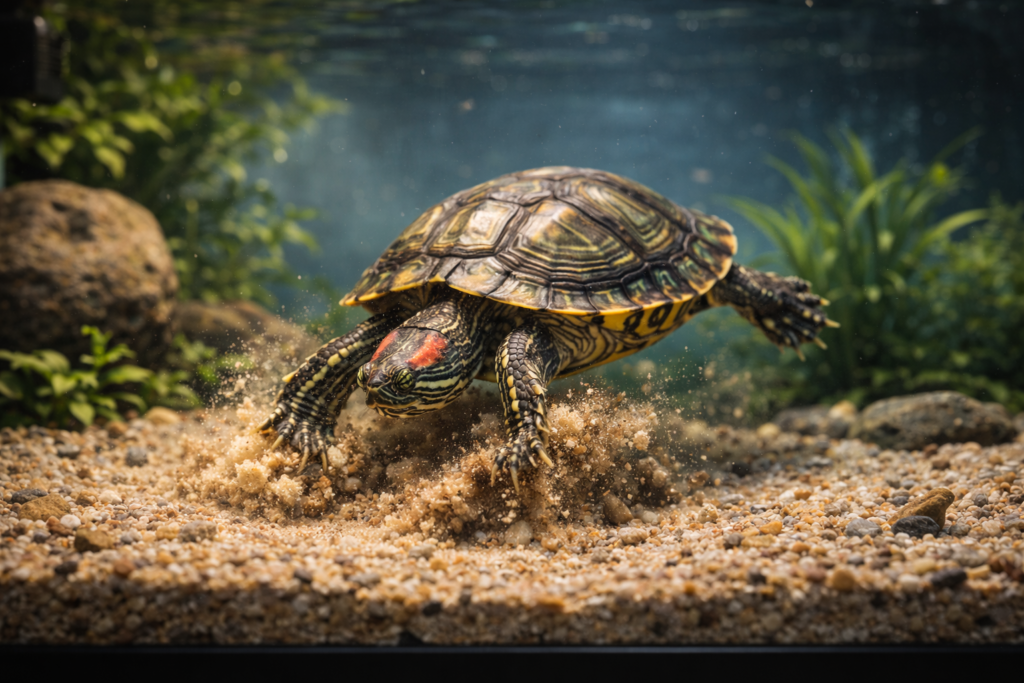
Another behavior that often surprises turtle owners is digging. You might notice your turtle scratching at the bottom of the tank, pushing around substrate, or repeatedly moving objects such as rocks or decorations.
At first, this behavior can seem unusual, but in many cases it is completely normal.
In the wild, turtles often dig in sand, mud, or loose soil while searching for food. They may also dig when exploring their surroundings or creating a comfortable resting spot. Even in captivity, these natural instincts remain strong, which is why turtles sometimes dig at the bottom of their tanks.
Some turtles also dig simply out of curiosity. If the tank contains sand or small gravel, turtles may move it around while exploring. This behavior can look messy, but it is often just part of how turtles interact with their environment.
Female turtles may show digging behavior for another reason. When a female turtle is preparing to lay eggs, she may begin searching for a suitable nesting spot. This instinct can appear even if there is no male turtle present. In these cases, the turtle may repeatedly dig or attempt to leave the water in search of a place to nest.
Digging can also happen when turtles are bored or do not have enough enrichment in their tank. Turtles are naturally curious animals, and they benefit from having objects to explore such as rocks, plants, or driftwood. When the environment is too simple, turtles may dig or push objects around as a way to stay occupied.
In most cases, occasional digging is nothing to worry about. It is simply a natural behavior that reflects a turtle’s instinct to explore and interact with its surroundings.
However, if digging becomes constant or aggressive, it may be worth checking the tank environment. Making sure the turtle has enough space, proper lighting, and a comfortable basking area can help reduce stress related behaviors.
By observing when and how your turtle digs, you can better understand what it may be trying to do and whether the behavior is part of its normal routine.
Turtle Behavior: Staring
Many turtle owners eventually notice something interesting about their pet. The turtle seems to sit quietly and stare at them through the glass. Sometimes it will even swim toward the front of the tank and watch their movements closely.
At first, this behavior can feel a little mysterious. Some people even wonder if their turtle recognizes them or is trying to communicate.
In most cases, staring behavior is connected to food. Turtles are very good at learning patterns, especially when it comes to feeding time. If your turtle sees you regularly bringing food to the tank, it will begin to associate your presence with a meal. Over time, the turtle may swim toward the glass or watch you carefully whenever you enter the room.
This behavior is a simple form of recognition. While turtles do not bond with people in the same way that mammals do, they can learn routines and respond to familiar situations. When your turtle sees you approaching the tank, it may already expect that food is coming.
Curiosity also plays a role in this behavior. Turtles are naturally observant animals. Movement outside the tank can catch their attention, and they may watch what is happening around them simply because they are curious.
Some turtles also become more active when they see people nearby. They may swim back and forth, stretch their neck toward the glass, or follow movement around the room. For many turtle owners, this becomes one of the most enjoyable parts of keeping a turtle because it feels like the turtle is interacting with them.
It is important to remember that turtles are still cautious animals by nature. Sudden movements or loud noises may cause them to quickly retreat or dive back into the water. This is a natural survival instinct that helps protect them in the wild.
Overall, a turtle staring at you is usually nothing to worry about. In most cases, it simply means the turtle recognizes that you are part of its daily routine and may be hoping that feeding time is coming soon.
Turtle Behavior: Hiding
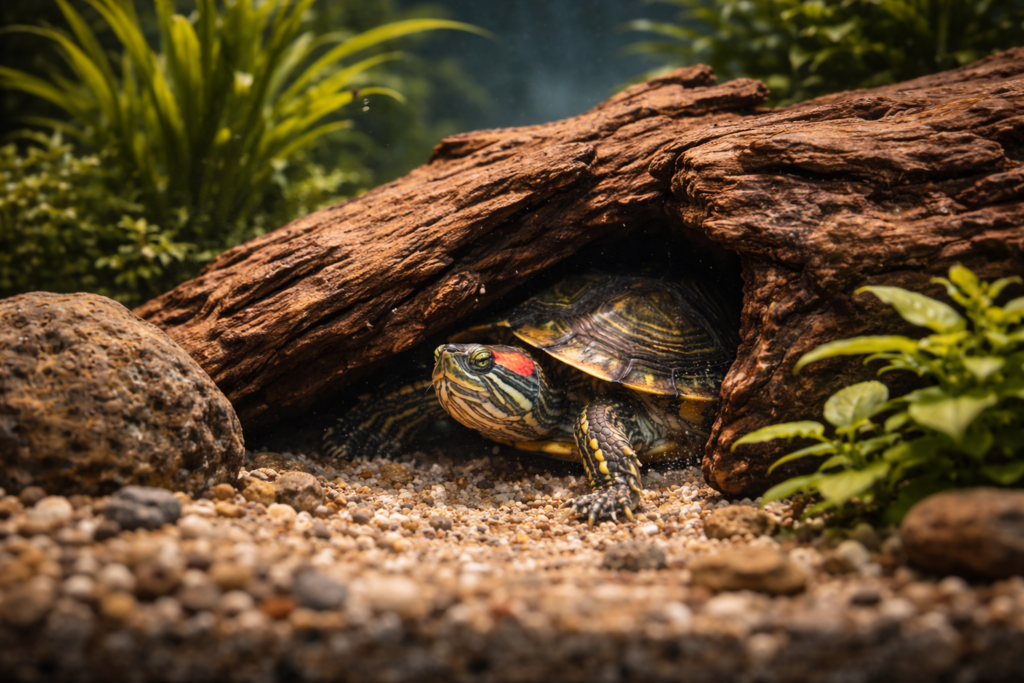
Hiding is another behavior that turtle owners notice from time to time. You might see your turtle resting behind decorations, staying under a basking platform, or settling quietly in a corner of the tank.
For many owners, this can be worrying at first. When a turtle suddenly hides more than usual, it may look like something is wrong. However, hiding is actually a very natural behavior for turtles.
In the wild, turtles often rely on hiding to stay safe. They may tuck themselves under rocks, plants, or submerged logs to avoid predators and rest in a protected area. Even when turtles live in a tank, these instincts remain strong.
New turtles especially tend to hide more often. When a turtle is placed in a new environment, it needs time to adjust. During this period, it may feel cautious and choose to stay hidden while it becomes familiar with its surroundings. This adjustment phase can last several days or sometimes even a few weeks.
Hiding can also happen when a turtle wants to rest. Just like many animals, turtles have periods of activity and periods of quiet rest. During these quieter moments, they may choose a sheltered spot in the tank where they feel comfortable.
Tank design can also influence hiding behavior. Aquariums that include decorations such as plants, rocks, driftwood, or caves often give turtles a sense of security. Having a few places to hide can actually help turtles feel more relaxed in their environment.
However, if a turtle hides constantly and shows other unusual behaviors such as refusing food or avoiding the basking area, it may be worth checking the tank conditions. Water temperature, lighting, water quality, and overall tank size can all influence how comfortable a turtle feels.
Most of the time, occasional hiding is simply part of normal turtle behavior. By providing a well designed habitat with safe hiding spots and proper environmental conditions, you can help your turtle feel secure and comfortable in its home.
Glass Surfing Behavior
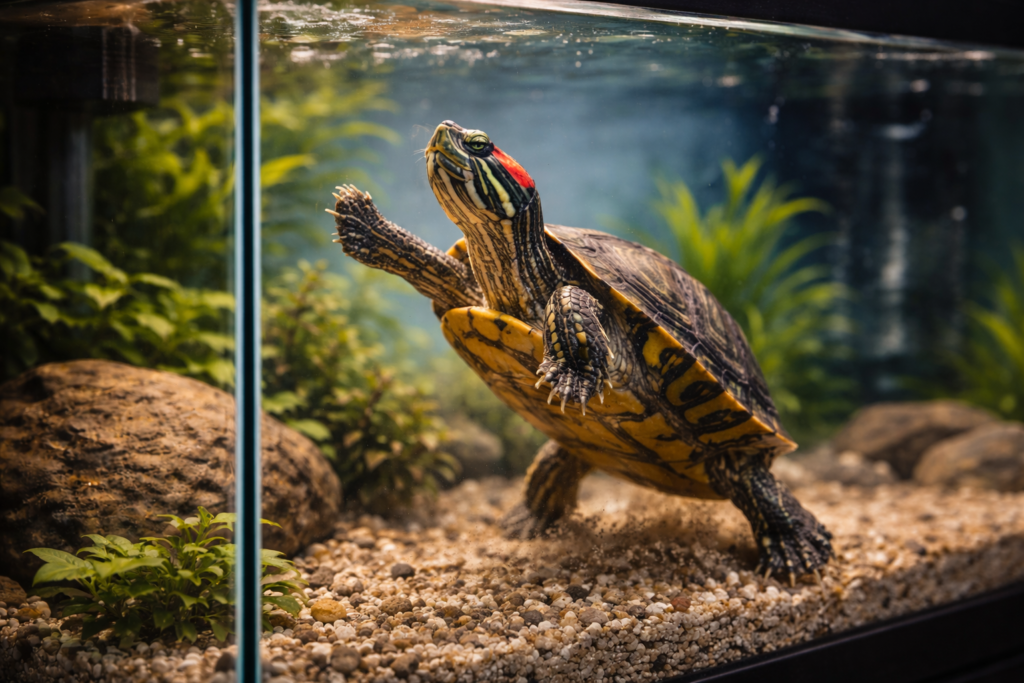
One behavior that often confuses turtle owners is when their turtle repeatedly swims against the glass walls of the tank. The turtle may paddle in the same direction again and again, stretch its neck toward the glass, or appear as if it is trying to climb out of the enclosure.
This behavior is commonly called glass surfing.
For new turtle owners, this can look alarming. It may seem like the turtle is stressed or desperately trying to escape. In reality, there can be several different reasons behind this behavior. Turtles simply do not understand the concept of glass. In the wild, turtles are used to open spaces where they can keep swimming forward. When they encounter a glass wall in an aquarium, they may continue swimming in that direction because they expect to move past it.
Reflections can also play a role. Sometimes turtles see their own reflection in the glass and react to it. They may interpret the reflection as another turtle or simply become curious about the movement they see.
Another common reason for glass surfing is curiosity. Turtles are naturally observant animals, and they often react to activity outside the tank. Movement in the room, people walking by, or changes in light can catch their attention and cause them to swim toward the glass.
However, glass surfing can sometimes be connected to environmental factors as well. If the tank is too small or lacks enrichment such as plants, rocks, or decorations, turtles may become restless and try to explore beyond the tank walls.
Water quality and temperature can also influence behavior. Poor water conditions or incorrect temperatures may cause turtles to act unusually or appear agitated.
Occasional glass surfing is usually nothing to worry about. Many turtles do it from time to time while exploring their environment.
If the behavior becomes constant or intense, it may be helpful to review the tank setup. Ensuring that your turtle has enough swimming space, proper lighting, clean water, and a comfortable basking area can often reduce this behavior.
By observing when glass surfing occurs, you can often identify what might be triggering it and make adjustments that help your turtle feel more comfortable in its environment.
Signs Your Turtle Is Comfortable
When a turtle feels safe and comfortable in its environment, its behavior usually becomes very consistent. Observing these patterns can help turtle owners understand that their pet is healthy and well adjusted to its habitat.
One of the most obvious signs of a comfortable turtle is regular basking. Turtles that climb onto their basking platform and spend time under the heat and UVB lights are usually responding to a properly set up environment. This behavior shows that the turtle feels secure enough to leave the water and rest in the open.
Active swimming is another positive sign. A healthy turtle will often explore its tank, swim around decorations, and move freely throughout the enclosure. This type of movement shows that the turtle has enough space and feels comfortable interacting with its surroundings.
A good appetite is also a strong indicator of comfort. Turtles that eagerly approach food or swim toward their owner during feeding time are usually relaxed and well adjusted. Consistent eating habits suggest that the turtle’s environment supports healthy digestion and normal daily activity.
Curiosity can also signal that a turtle is comfortable. Many turtles watch movement outside the tank or swim closer when they see their owner approaching. This behavior shows that the turtle is aware of its surroundings and feels confident enough to observe what is happening around it.
Another healthy behavior to watch for is normal shell shedding. As turtles grow, the outer layers of their shell may slowly peel away. This is a natural process and often happens when turtles are receiving proper basking conditions and good nutrition.
Comfortable turtles also tend to maintain regular daily routines. They may swim actively for a while, rest on the bottom of the tank, bask under the heat lamp, and then return to the water again. These repeated patterns often indicate that the turtle feels stable and secure in its environment.
By paying attention to these behaviors, turtle owners can better understand when their pet is thriving. Consistent activity, healthy feeding habits, and regular basking are all strong signs that a turtle is living in a suitable and comfortable habitat.
Signs Your Turtle May Be Stressed
Just like any other animal, turtles can experience stress when their environment is not comfortable or when something suddenly changes around them. Because turtles cannot communicate directly, their behavior is usually the first sign that something may be wrong.
One of the most common signs of stress is a sudden change in eating habits. If a turtle that normally eats eagerly begins to refuse food, it may be reacting to stress or discomfort in its environment. Temporary appetite loss can sometimes happen when a turtle is adjusting to a new tank, but if it continues for several days it may be worth investigating further.
Another sign of stress is constant hiding. While occasional hiding is normal, a turtle that spends most of its time avoiding open areas or staying hidden behind decorations may not feel safe in its environment. This can happen when the tank is placed in a very busy area of the house or when there are frequent disturbances near the tank.
Unusual swimming behavior can also signal stress. Some turtles begin swimming repeatedly against the glass or moving around the tank in a restless way. This behavior may appear as if the turtle is trying to escape the enclosure.
Refusing to bask can also indicate that something is wrong with the setup. If the basking platform is too difficult to climb, the temperature is too low, or the lighting is not positioned correctly, turtles may avoid the basking area altogether.
Changes in activity levels can also be important to notice. A turtle that suddenly becomes very inactive or spends long periods sitting at the bottom of the tank may be reacting to environmental conditions such as cold water or poor water quality.
In many cases, stress is related to conditions within the tank. Water temperature, basking temperature, lighting, tank size, and water cleanliness all play important roles in a turtle’s comfort. Even small changes in these conditions can affect how a turtle behaves.
If you notice several of these signs at the same time, it is a good idea to carefully review the tank setup. Ensuring that the water is clean, the temperatures are correct, and the basking area is comfortable can often resolve stress related behaviors.
Paying attention to these behavioral clues allows turtle owners to identify potential problems early and create a healthier and more stable environment for their pets.
How Environment Affects Turtle Behavior
A turtle’s behavior is closely connected to the environment it lives in. Unlike animals that can move freely in the wild, pet turtles depend entirely on the conditions inside their tank. Because of this, even small changes in the environment can affect how a turtle behaves.
One of the most important environmental factors is temperature. Turtles rely on external heat sources to regulate their body temperature. If the water is too cold, turtles may become sluggish and spend more time resting at the bottom of the tank. If the basking area is not warm enough, they may avoid climbing out of the water altogether.
Lighting also plays a major role in turtle behavior. Proper UVB lighting allows turtles to absorb calcium and maintain healthy shells and bones. Without adequate lighting, turtles may show reduced activity levels and may avoid basking.
Tank size is another important factor that influences behavior. Turtles need enough space to swim comfortably and explore their surroundings. When the tank is too small, turtles may become restless and begin swimming repeatedly against the glass. Providing enough swimming space allows turtles to move naturally and stay active.
Water quality can also have a strong impact on how turtles behave. Dirty or poorly filtered water can make turtles uncomfortable and may even lead to health problems, to prevent your beloved turtle from all these health issues please read our Complete guide to Turtle tank filtration. When water conditions are not ideal, turtles may become less active or behave unusually.
The layout of the tank also matters. Decorations such as rocks, driftwood, or aquatic plants can give turtles places to explore and rest. A tank that is too empty may make turtles feel exposed, while a well arranged habitat can encourage natural behaviors like swimming, basking, and resting. To learn about a proper turtle tank, please read our detailed guide on Turtle Tank size.
Diet also affects behavior. Turtles that receive a balanced diet with proper nutrients tend to be more active and healthy. Poor nutrition can lead to low energy levels and other health issues that may influence behavior.
When all of these environmental factors are properly balanced, turtles are much more likely to display natural and healthy behaviors. Observing how your turtle reacts to its environment can help you understand whether the tank setup is supporting its needs.
By creating a stable and comfortable habitat, you encourage your turtle to behave in ways that reflect good health and overall well being.
Final Thoughts
Understanding turtle behavior takes time, patience, and careful observation. At first, many turtle owners feel unsure about what their turtle’s actions mean. However, the more you watch your turtle, the easier it becomes to recognize the patterns that are part of its normal routine.
Every turtle develops its own habits. Some turtles are very active and spend a lot of time swimming around the tank, while others are calmer and enjoy resting for longer periods. Some bask frequently, while others prefer shorter basking sessions throughout the day. These differences are often part of the turtle’s individual personality.
What matters most is consistency. When your turtle is healthy and comfortable, its daily behaviors usually follow a predictable rhythm. It may swim around the tank, explore its surroundings, climb onto the basking platform, and return to the water again. Over time, these patterns become familiar and easy to recognize.
Changes in behavior can often be the first sign that something in the environment needs attention. A turtle that suddenly stops basking, hides constantly, or loses interest in food may be reacting to changes in temperature, lighting, water quality, or tank conditions.
By paying attention to these small behavioral clues, turtle owners can identify potential problems early and make adjustments that help their pet stay healthy.
Keeping a turtle is not just about providing food and a tank. It also involves learning how to understand the animal’s natural instincts and behaviors. When you take the time to observe how your turtle acts each day, you gain valuable insight into its health and comfort.
In the end, understanding turtle behavior helps you create a better environment where your turtle can live, explore, and thrive.
Frequently Asked Questions About Turtle Behavior
Why does my turtle stare at me?
Many turtles stare at their owners because they associate them with food. Over time, turtles learn feeding routines and may swim toward the glass or watch closely whenever they see someone approaching the tank. This behavior is usually a sign that the turtle expects to be fed.
Why is my turtle swimming so much?
Active swimming is usually a healthy sign. Turtles naturally swim around their environment to explore and stay active. However, if a turtle constantly swims against the glass or appears restless, it may be reacting to tank size, reflections in the glass, or environmental conditions that need adjustment.
Why is my turtle hiding all the time?
Hiding can happen when turtles feel cautious or want to rest. New turtles often hide more frequently while they adjust to a new environment. If hiding continues for a long time and the turtle also stops eating or basking, it may be helpful to check the tank setup and water conditions.
Why is my turtle digging in the tank?
Digging is a natural behavior for many turtles. In the wild, turtles dig while searching for food or exploring their surroundings. Female turtles may also dig when they are preparing to lay eggs. Occasional digging is usually normal and not a cause for concern.
Why is my turtle not basking?
If a turtle avoids the basking area, the problem is often related to the tank setup. The basking platform may not be warm enough, the lighting may be positioned incorrectly, or the turtle may feel stressed by movement around the tank. Adjusting the basking temperature and ensuring the area is easy to access often helps encourage basking.
Why is my turtle trying to escape the tank?
Turtles sometimes appear to be trying to escape when they repeatedly swim against the glass. This can happen when the tank is too small, when the turtle sees its reflection, or when it is curious about movement outside the tank. Providing enough swimming space and enrichment inside the tank can help reduce this behavior.