Best Turtle Food in 2026 (Tested & Reviewed by Turtle Owners)
Choosing turtle food can be surprisingly confusing. There are dozens of pellets, sticks, insect-based foods, treats, and formulas available, and the most expensive option isn’t automatically the best choice for your turtle.
The right food depends on your turtle’s species, age, size, life stage, and overall diet.
For most commonly kept omnivorous aquatic turtles, a good-quality commercial pellet can provide an important nutritional foundation. But pellets shouldn’t be viewed as the entire diet. Depending on the species and life stage, turtles may also need appropriate plant matter and dietary variety.
In this guide, we’ve compared seven popular turtle foods and broken down what each one does best, where it falls short, and which type of turtle owner should consider buying it.
Important: This guide focuses primarily on aquatic turtles. Terrestrial turtles and tortoises have different nutritional requirements and shouldn’t automatically be fed the same foods.
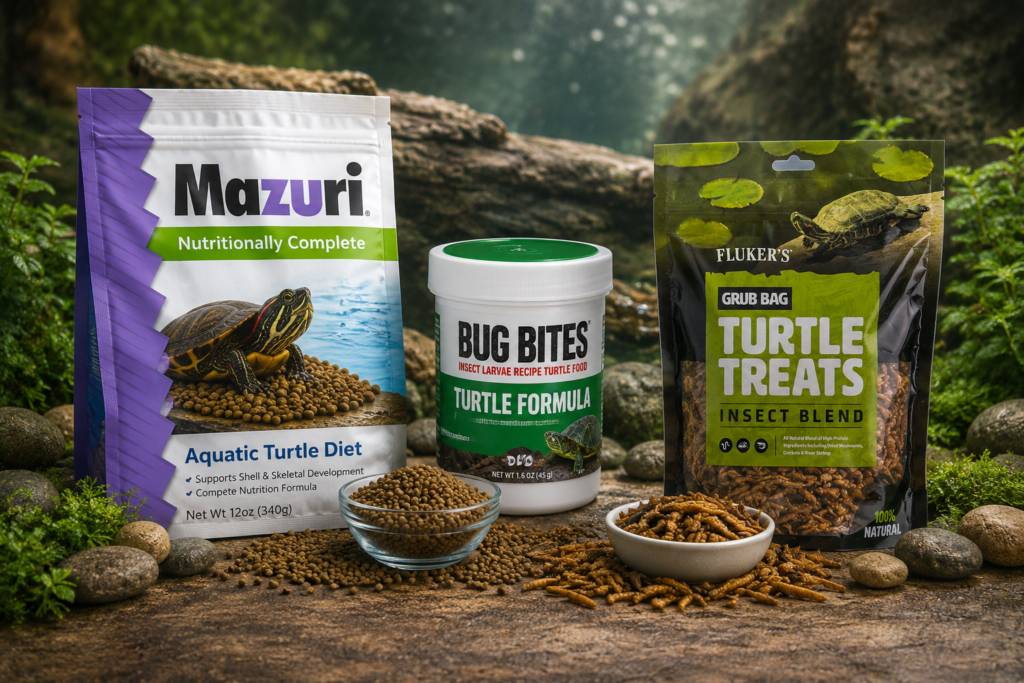
This article may contain affiliate links. As an Amazon Associate, I earn from qualifying purchases at no extra cost to you.
Feeding the right food is the quickest way to improve your turtle’s health and the fastest way to ruin water clarity if you get it wrong. The right diet helps shell growth, supports immunity, and reduces tank waste; the wrong one creates ammonia spikes, cloudy water, and extra maintenance. To understand your turtle’s diet preference, please read our detailed guide on what do turtles eat.
This guide compares the best turtle foods you selected, explains who should use each product, and gives feeding schedules and troubleshooting tips so you choose the right food once and keep buying from the same trusted products.
Quick buying tip: higher-quality foods usually cost more per ounce but produce less waste and save time on water changes.
Helpful Turtle Feeding Guides
Before choosing a turtle food, these guides can help you better understand your turtle’s nutritional needs:
Turtle Diet Basics
➡ What Do Turtles Eat? (Complete Feeding Guide)
➡ How Often Should You Feed a Turtle?
➡ Best Foods for Baby Turtles
➡ Can Turtles Eat Fruits and Vegetables?
Nutrition & Health
➡ Signs Your Turtle Is Not Getting Proper Nutrition
➡ Best Calcium Sources for Turtles
➡ Do Turtles Need Vitamin Supplements?
➡ Why Is My Turtle Always Hungry?
Habitat & Feeding Setup
➡ Best Turtle Tank Setup for Healthy Feeding
➡ How to Keep Turtle Tank Water Clean After Feeding
➡ Ultimate Guide to Choosing the Perfect Turtle Tank
Best Turtle Foods (Your Picks)
Best for Overall Nutrtion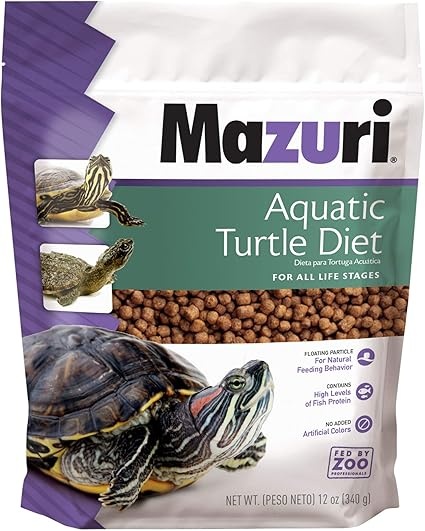 Mazuri Aquatic Turtle Diet (12 oz) |
Daily feeding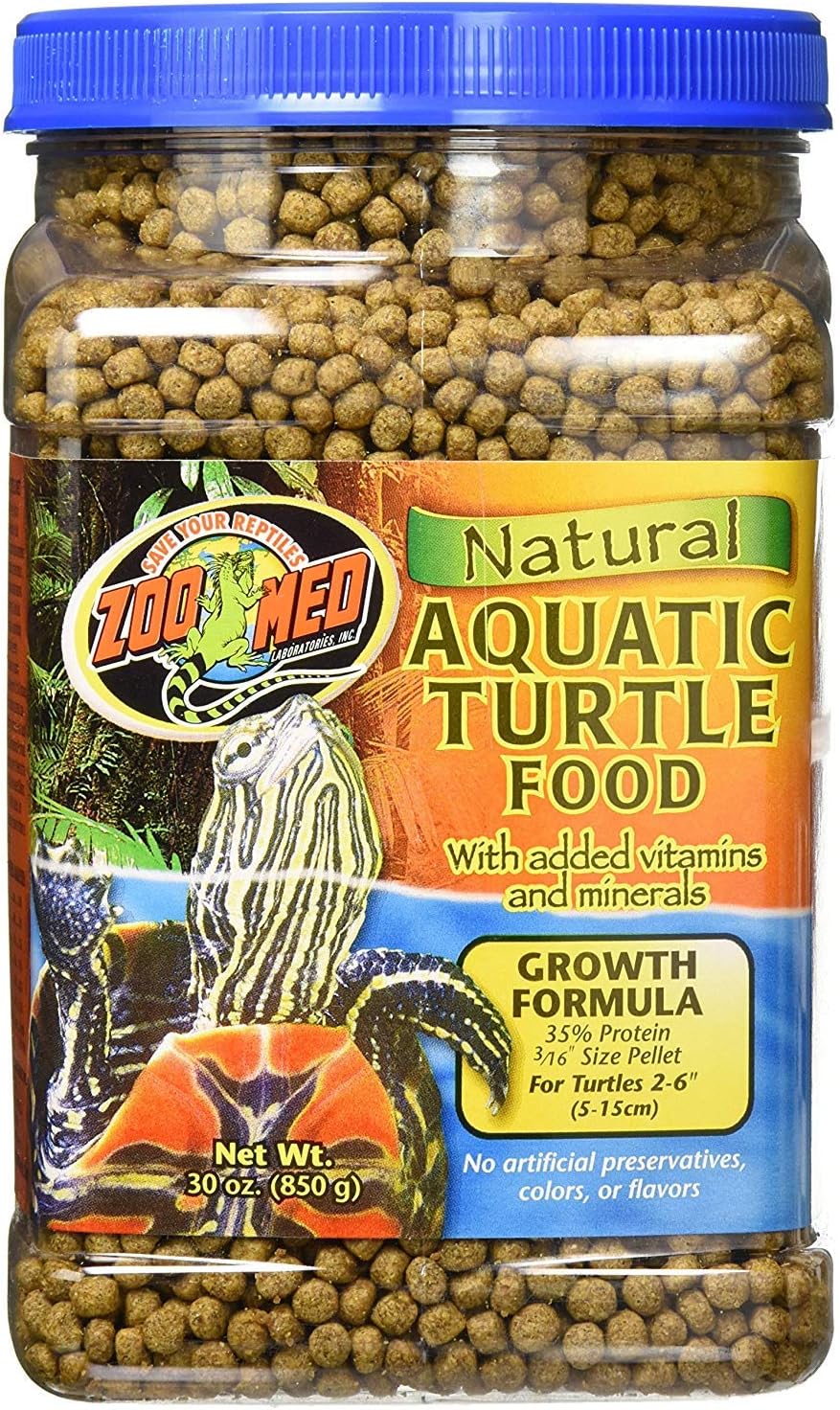 Zoo Med (various pellet options) |
Variety feeders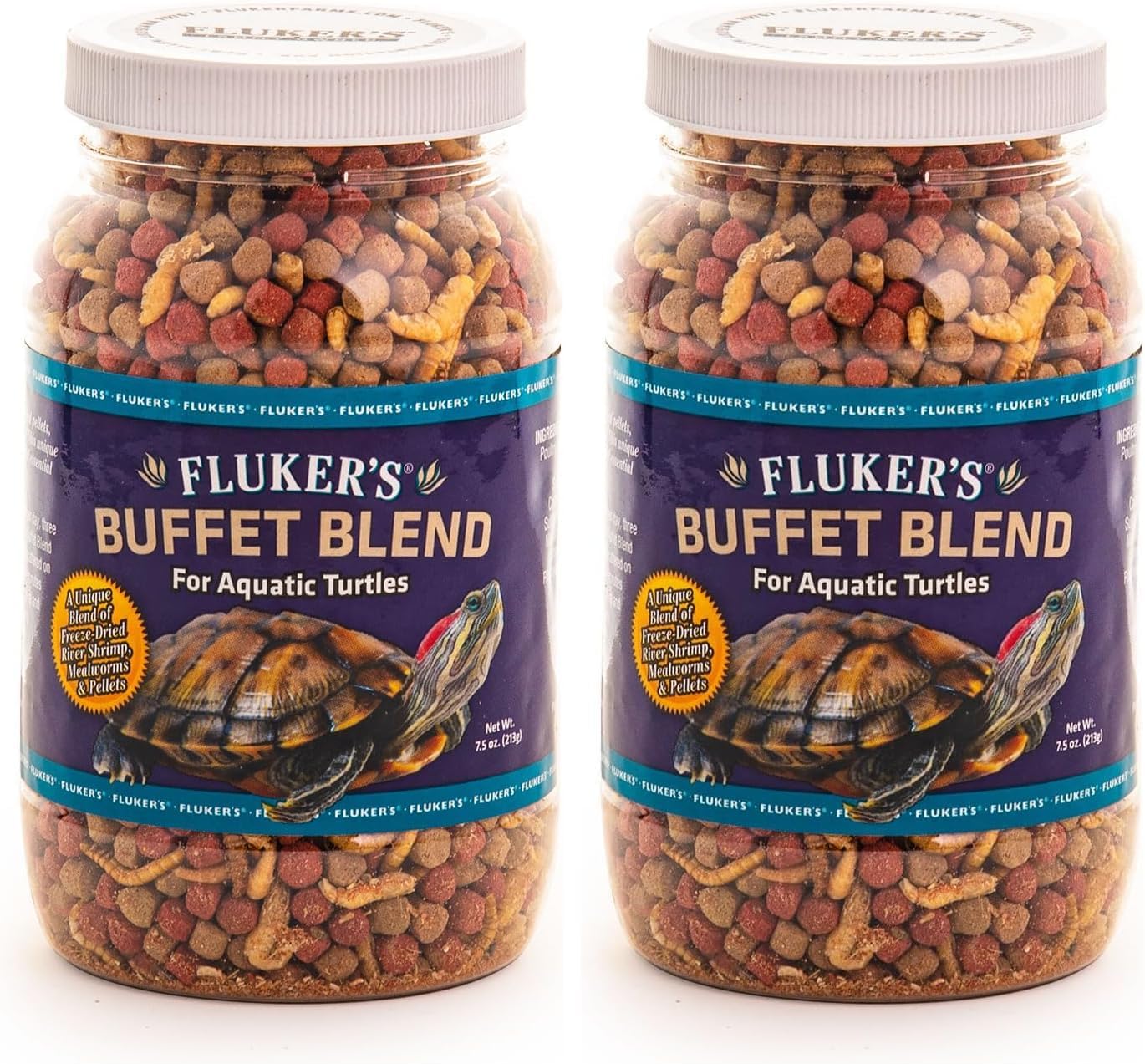 Fluker’s Buffet Blend / Fluker’s (7.5 oz) |
Growth & color enhancement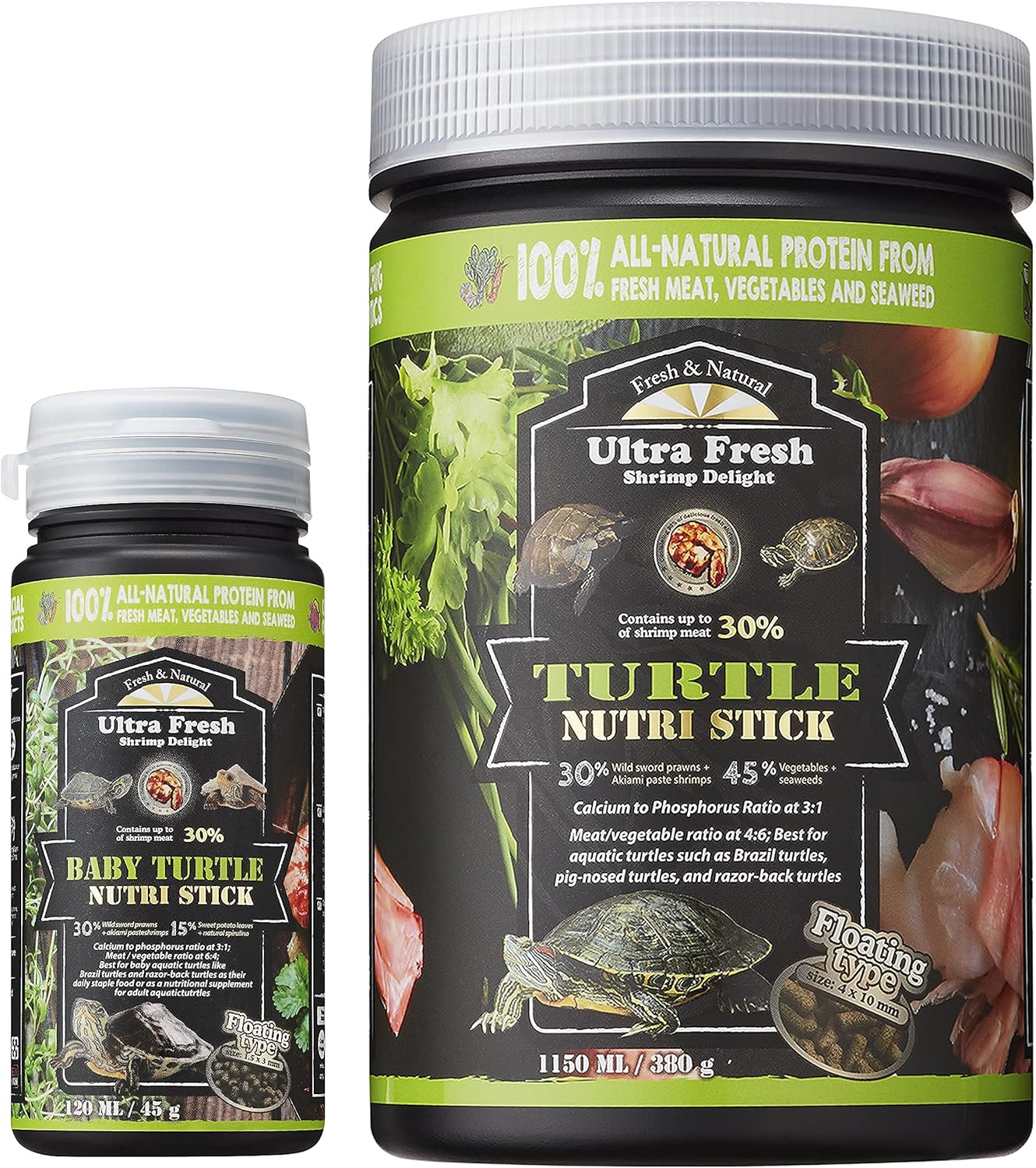 Ultra Fresh Turtle Nutri Stick |
Protein-rich diet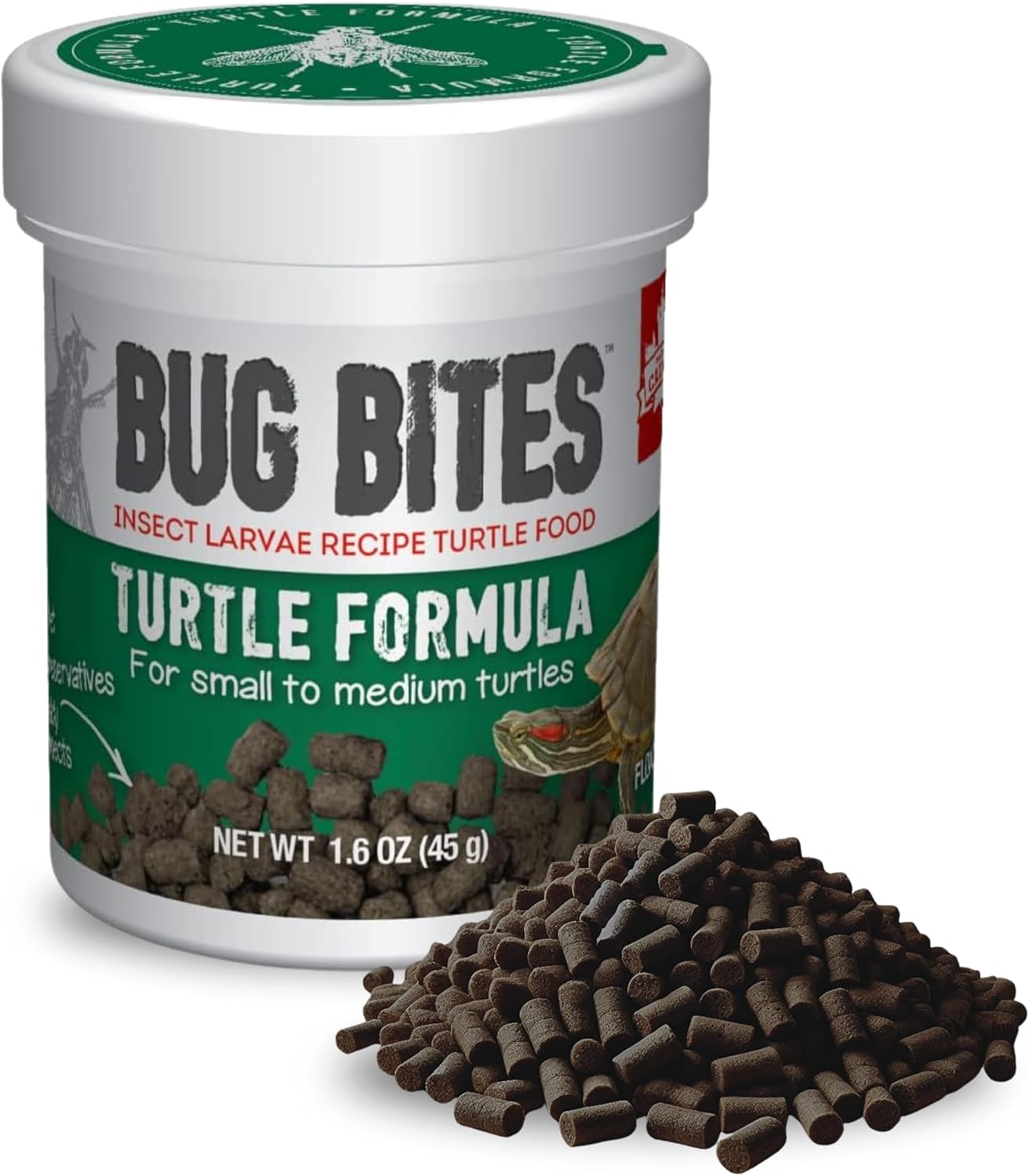 Fluval Bug Bites Turtle Food (1.5 oz) | |
|---|---|---|---|---|---|
| Best For | Overall Nutrition | Daily Staple Food | Beginners & Budget option | Variety & Picky Eaters | Growth & Color Enhancement |
| Life Stage | Juvenile & Adult | Juvenile & Adult | All Life Stages | All Life Stages | Mostly Juveniles |
| Suitable Species | RES, Painted, Musk, Map, Cooters & Most Aquatic Turtles | Most Aquatic Turtles (Omnivorous) | Most Aquatic Turtles (Omnivorous) | Most Aquatic Turtles (Omnivorous) | RES, Painted, Sliders & Most Small Turtles |
| Protein Level | High | Moderate | Moderate | Moderate | High |
| Floating/Sinking | Floating | Floating | Floating | Mixed (Floating & Sinking) | Floating |
| Main Ingredients | Fish Meal, Wheat Germ, Soybean Meal, Vitamins | Fish Meal, Wheat Flour, Soybean Meal | Fish Meal, Corn, Wheat Flour, Yeast | Fish Meal, Shrimp Meal, Dried Vegetables | Shrimp, Fish, Wheat Germ, Spirulina |
| Pros |
Complete nutrition Trusted by zoos Excellent for daily feeding Supports shell & immune health |
Good staple food Wide variety of sizes Balanced nutrition |
Affordable Easy to find Good for beginners Reliable brand |
Variety diet in one mix Encourages natural feeding behavior Good for picky eaters |
Great acceptance Enhances color Highly digestible |
| Cons |
Slightly more expensive Not ideal for turtles needing very high protein | Lower protein compared to Fluval or Mazuri |
Lower protein Filler ingredients in some formulas |
Not a complete diet alone Some turtles may pick preferred pieces |
Higher price Mainly for juveniles |
How We Evaluate Turtle Food
We don’t choose turtle food simply by looking at the brand name or the number of reviews a product has.
For each food, we look at several factors:
1. Nutritional profile
We look at the guaranteed analysis and ingredient list to understand the product’s protein, fat, fiber, calcium and other nutritional components.
2. Life-stage suitability
A food suitable for a rapidly growing juvenile isn’t necessarily the best choice for every adult turtle.
3. Species suitability
Different aquatic turtle species can have different dietary tendencies. We therefore avoid treating every turtle as if it has identical nutritional requirements.
4. Staple food vs. treat
Some products are designed to function as complete diets, while others are better used as supplemental foods, treats, or sources of variety.
5. Pellet size and feeding behavior
The size and form of the food matter. Smaller turtles may struggle with oversized pellets, while floating foods can make it easier to monitor how much a turtle actually eats.
6. Ingredient quality
We consider the primary ingredients and look for products that provide useful sources of animal and/or plant nutrition rather than judging a food solely by its protein percentage.
7. Practicality
A food can be nutritionally sound but still be a poor choice if it is difficult to portion, poorly suited to the turtle’s size, or unnecessarily expensive.
8. Value for money
Price matters, but the cheapest food isn’t necessarily the most economical choice if it leads to excessive uneaten food or isn’t appropriate for your turtle’s nutritional needs.
Our Top Turtle Foods, Reviewed Individually
This is where each product gets its own detailed review.
Rather than giving every product the same generic description, we’ve created a consistent buying framework so you can quickly understand why we recommend it, who should buy it, and who should skip it.
1) Mazuri Nutritionally Complete Aquatic Turtle Food (12 oz) — Best for Growth & Shell Health
A nutritionally complete floating pellet designed for freshwater aquatic turtles, with 40% minimum protein and added vitamins and minerals. Its 4 mm floating pellets make feeding easy to monitor and are suitable for juvenile and adult turtles.
Specifications | |
|---|---|
| Best For | Many freshwater aquatic turtles |
| Life Stage | Juvenile & Adult |
| Food Type | Floating pellet |
| Pellet Size | 4 mm round |
| Protein | 40% min. |
| Fat | 10% min. |
| Fiber | 5% max. |
| Calcium | 1.85–2.35% |
| Phosphorus | 1.0% min. |
| Vitamin E | 250 IU/kg min. |
| Formula | 5M87 |
Mazuri Aquatic Turtle Diet — Best Overall for Many Freshwater Turtles
If you want one dependable commercial pellet to build the staple portion of an aquatic turtle’s diet around, Mazuri Aquatic Turtle Diet is one of the strongest options to consider.
The formula is specifically designed for freshwater turtles and is marketed by Mazuri as a nutritionally complete diet that can be fed throughout the turtle’s life cycle. The current Formula 5M87 is a floating, round 4 mm pellet and contains fish meal, chicken meal, fish oil and other animal-derived ingredients alongside plant-based ingredients and added vitamins and minerals.
Why We Picked It
Mazuri stands out because it isn’t simply a generic fish-food pellet being marketed to turtle owners.
The manufacturer specifically formulates this product for freshwater turtles and lists several commonly kept species, including red-eared sliders, painted turtles, map turtles, pond turtles, mata mata turtles and snapping turtles.
It is also designed to float initially. That makes it easier to watch your turtle eat and estimate how much food is being consumed before the remaining pellets eventually sink. Mazuri says turtles typically feed on the floating pellets for around 15–20 minutes before basking and may return later to eat food that has sunk.
Nutritional Breakdown
Crude protein: 40% minimum
Crude fat: 10% minimum
Crude fiber: 5% maximum
Moisture: 12% maximum
Ash: 9.5% maximum
Calcium: 1.85–2.35%
Phosphorus: 1.0% minimum
Sodium: 0.55% maximum
Vitamin E: 250 IU/kg minimum
The 40% minimum protein level is substantial, but we wouldn’t use protein percentage alone to judge turtle food. The more useful point is that the product combines animal-derived ingredients with added vitamins and minerals and is formulated specifically as an aquatic turtle diet.
What Is In Mazuri Aquatic Turtle Diet?
The first-listed ingredient is fish meal, followed by ground corn, dehulled soybean meal, corn gluten meal and chicken meal. Fish oil and porcine meat and bone meal are also included. The formula contains added vitamin and mineral sources, including vitamins A, D3, E and C.
The ingredient list also shows that this isn’t a purely animal-protein food. It contains plant-derived ingredients such as corn and soybean ingredients, which is worth knowing when comparing it with more insect-focused or animal-protein-focused turtle foods.
What We Like
1. Specifically formulated for freshwater turtles
Rather than adapting a generic aquarium food, Mazuri has formulated this diet specifically for freshwater turtles and identifies several turtle species for which it is intended.
2. Nutritionally complete formulation
Mazuri states that the product is nutritionally complete and does not require additional vitamin or mineral supplementation when fed as directed.
3. Floating pellets make feeding easier to monitor
The pellets initially float, allowing you to see whether your turtle is actively eating and making it easier to remove excessive uneaten food.
4. Useful nutritional specifications
Mazuri publishes the guaranteed analysis, including protein, fat, fiber, calcium and phosphorus. That transparency makes it easier to compare this food with other commercial turtle diets.
5. Suitable across juvenile and adult stages
Mazuri describes this as a complete life-cycle diet and its current feeding directions specifically provide guidance for juvenile and adult turtles.
What We Don’t Like
1. The 4 mm pellet isn’t ideal for every turtle
A 4 mm round pellet may be appropriate for many turtles, but very small hatchlings may find it too large. Pellet size should always be matched to the turtle rather than assuming one size works for every animal.
2. The formula is relatively animal-protein focused
Fish meal and chicken meal are prominent ingredients, and Mazuri itself describes the food as having a high level of fish and animal protein. That makes it particularly interesting for species or life stages with greater animal-protein requirements, but it doesn’t mean the same diet should be used indiscriminately for every turtle species.
3. It shouldn’t be treated as a reason to ignore dietary variety
Even when a commercial pellet is nutritionally complete, turtle nutrition shouldn’t be reduced to buying one bag of pellets and feeding nothing else forever. Species and life stage still matter.
Who Should Buy It?
I’d consider Mazuri Aquatic Turtle Diet if you keep a:
- Red-eared slider
- Painted turtle
- Map turtle
- Pond turtle
- Mata mata turtle
- Snapping turtle
Mazuri specifically lists these freshwater turtles among the intended animals for the product.
It is particularly appealing if you want a straightforward staple pellet rather than trying to construct your turtle’s entire diet from multiple supplemental foods.
Who Should Skip It?
I’d look elsewhere if:
- Your turtle is too small for a 4 mm pellet.
- You’re keeping a species with substantially different dietary requirements.
- You’re specifically looking for an insect-based formula.
- You want a food designed primarily around plant matter.
- You’re looking for a supplemental treat rather than a staple diet.
How Should You Feed It?
Mazuri’s current instructions recommend feeding juvenile or adult turtles once per day, three to five times per week. The pellets should be scattered onto the water where they float. Mazuri says turtles generally feed on the floating food for 15–20 minutes and may return later for pellets that have sunk.
Importantly, Mazuri doesn’t give one universal pellet quantity. Instead, it recommends feeding only the amount the turtle will readily consume and notes that food intake varies with temperature and time of year.
That is a better approach than giving every turtle a fixed number of pellets regardless of size.
One Important Point About Water Quality
Floating food makes it easier to monitor feeding, but it doesn’t automatically prevent water pollution.
If your turtle routinely leaves food behind, reduce the amount being offered rather than allowing uneaten pellets to accumulate. Mazuri specifically warns that excess food can decompose and negatively affect water quality.
This is especially important for turtle keepers because aquatic turtles can produce a significant amount of waste, and overfeeding can make an already demanding filtration system work even harder.
Our Verdict
Mazuri Aquatic Turtle Diet earns our Best Overall position because it combines a turtle-specific formulation, complete nutritional profile, clear manufacturer feeding guidance and a practical floating pellet format.
It’s not automatically the perfect food for every turtle, and we wouldn’t recommend choosing it simply because it contains 40% protein.
But for many commonly kept freshwater aquatic turtles, particularly owners looking for a reliable staple pellet, Mazuri is an excellent starting point.
Our rating: 9.3/10
Best for: Many freshwater aquatic turtles
Food role: Staple
Biggest strength: Complete turtle-specific formulation
Biggest limitation: 4 mm pellet and relatively animal-protein-focused formula
2) Fluval Bug Bites Turtle Food — Best Natural/Insect-Based Pellet (Small → Medium turtles)
Insect-based formula that mimics natural diet; excellent for enticing picky eaters and adding variety.
An insect-forward floating turtle pellet made with black soldier fly larvae as the first ingredient, plus egg and salmon meal. It provides 38% minimum protein, 15% minimum fat, calcium, phosphorus, vitamins and vitamin D3. ([manufacturer information])
Specifications | |
|---|---|
| Best For | Insect-based nutrition |
| Life Stage | Juveniles & Adults* |
| Food Type | Floating pellet |
| Pellet Size | 5–7 mm |
| Protein | 38% min. |
| Fat | 15% min. |
| Fiber | 4.5% max. |
| Calcium | 1.5% min. |
| Phosphorus | 1.0% min. |
| Vitamin D3 | 500 IU/kg min. |
| Staple or Treat | Complete food |
| Main Protein | Black Soldier Fly Larvae |
| Made In | Canada |
Fluval Bug Bites Turtle Pellets — Best Insect-Based Option
If you’re looking for a turtle food that puts insects at the center of its formula, Fluval Bug Bites Turtle Pellets is one of the more interesting options on the market.
Unlike traditional turtle pellets that often start with fish meal or plant-based ingredients, this formula puts black soldier fly larvae first on the ingredient list, followed by dried egg products, wheat, barley and salmon meal.
That doesn’t automatically make it a better food than every conventional turtle pellet, but it does give turtle owners a genuine alternative if they want an insect-forward formula.
Why We Picked It
The biggest reason Fluval Bug Bites stands out is the ingredient profile.
Black soldier fly larvae are listed as the first ingredient, and Fluval says the formula contains up to 40% black soldier fly larvae. The product also includes dried egg products and salmon meal, giving it multiple animal-derived protein sources.
The pellets are also designed to float and measure approximately 5–7 mm, making them relatively easy to observe during feeding.
For turtle owners who specifically want an insect-based food rather than a traditional pellet formula, that combination makes Bug Bites particularly interesting.
Nutritional Breakdown
Crude protein: 38% minimum
Crude fat: 15% minimum
Crude fiber: 4.5% maximum
Moisture: 10% maximum
Ash: 7.5% maximum
Calcium: 1.5% minimum
Phosphorus: 1.0% minimum
Vitamin A: 5,000 IU/kg minimum
Vitamin D3: 500 IU/kg minimum
Vitamin E: 200 IU/kg minimum
Taurine: 0.05% minimum
The 38% protein level is substantial, but protein percentage shouldn’t be used by itself to determine whether one turtle food is nutritionally superior to another.
What’s more interesting here is where some of that protein comes from.
What’s in Fluval Bug Bites?
The current ingredient list starts with:
- Black soldier fly larvae
- Dried egg products
- Wheat
- Barley
- Salmon meal
- Flaxseed
- Dicalcium phosphate
- Dried kelp
- Yeast culture
- Calcium carbonate
The formula also contains added vitamins, minerals, amino acids and vitamin D3.
This gives the product a combination of insect, egg and fish-derived ingredients rather than relying on a single protein source.
What We Like
1. Black soldier fly larvae are the first ingredient
This is the defining feature of the formula.
If you’re specifically looking for a turtle food built around insects, it’s difficult to ignore a product where black soldier fly larvae appear first in the ingredient list.
2. Multiple animal-derived protein sources
The formula combines black soldier fly larvae with dried egg products and salmon meal.
That gives it a more varied animal-protein profile than an ingredient list built around one primary protein source.
3. Floating pellet design
The pellets float and are approximately 5–7 mm.
That makes it easier to watch your turtle eat and identify uneaten food rather than immediately losing the pellets somewhere in the tank.
4. Added vitamins and minerals
The formula contains added vitamins, minerals and amino acids, including vitamins A, D3 and E.
5. No artificial fillers, colors or preservatives
Fluval specifically states that the product contains no artificial fillers, colors or preservatives.
What We Don’t Like
1. The 5–7 mm pellet may be too large for very small turtles
This is one of the biggest practical limitations.
The pellet is noticeably larger than many small turtle foods, so hatchlings and very small juveniles may have difficulty eating it comfortably.
Don’t choose a food based only on the nutritional label. The turtle also needs to be able to physically consume it.
2. The 15% minimum fat content is relatively high
The guaranteed analysis lists a minimum crude fat level of 15%.
That doesn’t make the food automatically inappropriate, but it is another reason not to assume that feeding more is better simply because your turtle likes it.
Portion control still matters.
3. The formula isn’t purely insect-based
Although black soldier fly larvae are the first ingredient, the food also contains wheat, barley and other ingredients.
So “insect-based” is a better description than “all-insect.”
4. Manufacturer feeding information needs careful interpretation
There is an unusual issue with the current US product page: while the product is clearly presented as a turtle pellet, the displayed feeding instructions say to feed “fish” for two minutes, two or three times daily.
Because of that, I would not copy those instructions directly into a turtle feeding schedule on PetYourTurtle.
Instead, we should provide turtle-specific feeding guidance based on the turtle’s species, age and overall diet.
Best For
I’d consider Fluval Bug Bites particularly suitable for owners who:
- Want an insect-forward turtle food
- Prefer black soldier fly larvae as a major ingredient
- Want a floating pellet
- Have a turtle large enough to comfortably eat 5–7 mm pellets
- Want an alternative to conventional fish-meal-heavy turtle pellets
- Want to rotate between different quality commercial foods
Who Should Skip It?
I’d look for another option if:
- Your turtle is very small and cannot comfortably eat 5–7 mm pellets.
- You specifically want a smaller pellet.
- You’re looking for a food formulated around a different nutritional profile.
- Your turtle has species-specific dietary requirements that make this formula unsuitable.
- You’re choosing food solely because it has a high protein number.
How We Would Use It
We would treat Fluval Bug Bites as a quality commercial food option, not as permission to ignore the rest of the turtle’s diet.
For an omnivorous aquatic turtle, the overall diet should still take into account:
- Species
- Age
- Growth stage
- Plant matter requirements
- Other foods being offered
- Body condition
- Feeding frequency
The amount should be adjusted to the individual turtle rather than blindly following a fixed number of pellets.
Fluval Bug Bites vs. Mazuri
This is where Fluval becomes particularly interesting.
Mazuri Aquatic Turtle Diet is the more conventional choice: a turtle-specific floating pellet with a clearly published complete nutritional profile.
Fluval Bug Bites takes a different approach, putting black soldier fly larvae first and combining them with egg and salmon meal.
So I wouldn’t say:
“Fluval is healthier than Mazuri.”
I’d say:
Mazuri is our stronger all-around conventional staple pick, while Fluval Bug Bites is our preferred choice for turtle owners specifically looking for an insect-forward formula.
That distinction makes the review much more credible.
Does the Insect-Based Formula Make It Better?
Not necessarily.
Black soldier fly larvae are an interesting protein source, but the presence of an insect ingredient alone doesn’t prove that a food is nutritionally superior.
What makes this product worth considering is the combination of its ingredient profile, guaranteed analysis, added vitamins and minerals, and turtle-specific formulation.
The right question isn’t:
“Does it contain insects?”
It’s:
“Does this food fit my turtle’s species, life stage and overall diet?”
Fluval Bug Bites earns our Best Insect-Based Option position because it takes a genuinely different approach to turtle nutrition.
Black soldier fly larvae are the first ingredient, while egg products and salmon meal provide additional animal-derived protein sources. The floating 5–7 mm pellets are also practical for monitoring feeding.
Its biggest limitation is pellet size, particularly for very small turtles, and we wouldn’t recommend choosing it simply because it has a high protein content.
But if you’re looking for a commercial turtle food with insects at the center of the formula, Fluval Bug Bites deserves serious consideration.
Our rating: 9.0/10
Best for: Turtle owners wanting an insect-forward formula
Food role: Complete commercial food
Biggest strength: Black soldier fly larvae as the first ingredient
Biggest limitation: 5–7 mm pellet size
Prices change often — checking now avoids overpaying later.
3) Ultra Fresh — Turtle Nutri Stick, Wild Sword Prawn (3.35 oz) — Best for Picky Turtles & Gut Health
A floating aquatic turtle food made with wild sword prawns, Akiami shrimp, vegetables and seaweed. Its strong seafood-based ingredient profile and rapid-softening texture make it an interesting option for turtles that are difficult to feed. (AZOO)
Specifications | |
|---|---|
| Best For | Picky aquatic turtles |
| Life Stage | Adult & larger aquatic turtles |
| Food Type | Floating stick |
| Pellet Size | 4 × 10 mm |
| Protein | 41% min. |
| Fat | 2.6% min. |
| Fiber | 6.4% max. |
| Calcium | 3% max. |
| Phosphorus | 1% min. |
| Main Protein Sources | Sword prawns, Akiami shrimp, squid, fresh fish |
| Plant Ingredients | Sweet potato leaves, mulberry leaves, spirulina, seaweed |
| Added Nutrients | Vitamins A, D3, C, E & B vitamins |
| Probiotics | Yes |
| Staple or Treat | Complete aquatic turtle food |
Some turtles will eat almost anything you put in front of them. Others will inspect a new pellet, ignore it completely, and wait for something they actually want.
That’s where Ultra Fresh Turtle Nutri Stick becomes interesting.
Instead of relying primarily on the traditional pellet formula found in many aquatic turtle foods, Ultra Fresh puts wild sword prawns and Akiami shrimp at the center of the ingredient profile, along with squid, fresh fish, vegetables and seaweed. The manufacturer also describes the food as highly palatable and designed to soften quickly in water without immediately disintegrating.
That doesn’t automatically make it a better nutritional choice than Mazuri or Fluval Bug Bites. Its biggest advantage is different:
It’s a particularly interesting option when palatability is your priority.
Why We Picked It
The first thing that stands out is the ingredient list.
The formula begins with sword prawns and squid and also includes Akiami shrimp and fresh fish. It then adds plant ingredients such as sweet potato leaves, mulberry leaves, spirulina and Norwegian seaweed.
AZOO also describes the product as containing up to 30% wild sword prawns and Akiami paste shrimp, with vegetables and seaweed included as part of the formulation.
That seafood-heavy profile gives the food a very different appeal from a conventional pellet based primarily around fish meal, grains or plant-derived ingredients.
Nutritional Breakdown
According to AZOO Europe’s current guaranteed analysis:
Crude protein: 41% minimum
Crude fat: 2.6% minimum
Crude fiber: 6.4% maximum
Moisture: 3% minimum
Calcium: 3% maximum
Phosphorus: 1% minimum
Vitamin A: 25,200 IU/kg
Vitamin D3: 4,520 IU/kg
Vitamin C: 300 mg/kg
Vitamin E: 64 mg/kg
The 41% minimum protein level is similar to Mazuri’s 40% minimum and slightly higher than Fluval Bug Bites’ 38% minimum.
But that doesn’t mean Ultra Fresh is automatically “better.”
Protein percentage is only one part of a turtle food’s nutritional profile.
What’s in Ultra Fresh Turtle Nutri Stick?
The current ingredient list includes:
- Sword prawns
- Squid
- Sweet potato leaves
- Mulberry leaves
- Australian spirulina
- Garlic
- Ganoderma polysaccharides
- Fresh fish
- Akiami shrimp
- Jingou shrimp
- Norwegian seaweed
- Wheat germ
- Corn
- Soybean
- Yeast
- Minerals
- Vitamins
- Beta-carotene
- Essential amino acids including methionine and lysine
This is one of the more varied ingredient lists among the foods in our comparison.
What We Like
1. Strong seafood-based ingredient profile
Sword prawns, squid, shrimp and fresh fish give this food a distinctive animal-protein profile. That can make it particularly appealing to turtles that aren’t interested in bland or unfamiliar pellets.
2. Designed with palatability in mind
AZOO specifically describes the food as highly palatable and emphasizes the natural flavors of its fresh ingredients.
That makes the product particularly interesting for picky turtles.
3. Includes both animal and plant ingredients
The formula isn’t simply seafood.
It combines animal ingredients with sweet potato leaves, mulberry leaves, spirulina and seaweed, giving it a broader ingredient profile than a single-protein food.
4. Floating stick format
The 4 × 10 mm sticks float, which allows the keeper to observe feeding and remove leftovers more easily.
5. Added vitamins and probiotics
The formula includes vitamins A, D3, C, E and several B vitamins. AZOO also describes the food as being enhanced with intestinal probiotics.
What We Don’t Like
1. The sticks are relatively large
The standard Turtle Nutri Stick measures approximately 4 × 10 mm.
That makes it a poor choice for very small hatchlings.
If you have a baby turtle, Ultra Fresh also makes a separate Baby Turtle Nutri Stick with a much smaller 1.5 × 3 mm format.
2. The guaranteed analysis isn’t as straightforward as some competing foods
The manufacturer’s current European page lists calcium at a maximum of 3% and phosphorus at a minimum of 1%.
Some Ultra Fresh marketing materials and retailer listings instead describe the product using a 3:1 calcium-to-phosphorus ratio.
Because those descriptions aren’t presented consistently, we would rather report the actual guaranteed-analysis figures than turn the ratio into a stronger nutritional claim than the label supports.
3. It contains garlic
Garlic is included in the ingredient list.
We don’t think the presence of garlic alone is enough to declare the food unsafe, but it’s worth mentioning because turtle keepers may specifically want to know about every major ingredient in a product they are considering.
4. The manufacturer’s feeding instructions are poorly worded for turtles
The current AZOO Europe page says the food can be supplied two to three times daily but then refers to the amount that “fish” can consume in 30 minutes.
Because this is a turtle food, we wouldn’t copy that instruction directly into a turtle feeding schedule.
Instead, feeding frequency and portion size should be based on the turtle’s species, age, size, body condition and overall diet.
Best For
I’d consider Ultra Fresh Turtle Nutri Stick particularly interesting for:
- Picky aquatic turtles
- Turtles that refuse conventional pellets
- Owners looking for a seafood-forward food
- Larger juveniles and adult aquatic turtles that can comfortably eat the 4 × 10 mm sticks
- Owners who want a food containing both animal and plant ingredients
Who Should Skip It?
I’d look for another option if:
- Your turtle is too small for a 4 × 10 mm stick.
- You’re specifically looking for a small hatchling pellet.
- You want a very simple ingredient list.
- You prefer a conventional turtle pellet with straightforward manufacturer feeding instructions.
- Your turtle already eats an appropriate staple food readily and you don’t have a reason to change it.
Is It Actually Good for Picky Turtles?
This is where the product has its strongest case.
The formula is built around strongly flavored seafood ingredients, including sword prawns, squid, shrimp and fresh fish, and AZOO specifically markets it around palatability.
That doesn’t guarantee that every picky turtle will accept it.
Turtles have individual preferences, and a food that one turtle devours may be ignored by another.
But if your turtle has repeatedly rejected conventional pellets, a food with a very different smell, texture and ingredient profile is a reasonable option to try.
Does It Keep the Tank Cleaner?
This is one claim where we need to be careful.
AZOO says the sticks soften quickly in water without disintegrating and are designed to support rapid intake, which the company associates with less waste and odor.
However, we wouldn’t tell readers that this food will automatically “keep your tank clean.”
No food eliminates the need for proper feeding portions, filtration and water changes.
If your turtle leaves food behind, remove it rather than relying on the food’s formulation to solve the resulting water-quality problem.
Ultra Fresh vs. Mazuri
These two foods have very different selling points.
Mazuri Aquatic Turtle Diet is our broader conventional staple recommendation. It has a turtle-specific formulation, a 4 mm floating pellet and a clearly published guaranteed analysis.
Ultra Fresh Turtle Nutri Stick takes a more ingredient-driven approach, with sword prawns, shrimp, squid, fresh fish, vegetables and seaweed, plus probiotics and added vitamins.
So we wouldn’t say:
“Ultra Fresh is better than Mazuri.”
Instead:
Choose Mazuri if you want a straightforward conventional staple. Choose Ultra Fresh if palatability and a seafood-forward ingredient profile are your priorities.
Ultra Fresh vs. Fluval Bug Bites
This comparison is even more interesting.
Both foods emphasize animal-derived ingredients, but they take completely different approaches.
Fluval Bug Bites: insect-forward, with black soldier fly larvae as the first ingredient.
Ultra Fresh: seafood-forward, with sword prawns, shrimp, squid and fresh fish among the primary ingredients.
So if your turtle ignores insect-based food but loves seafood, Ultra Fresh may be the more logical experiment.
Our Verdict
Ultra Fresh Turtle Nutri Stick earns our Best for Picky Eaters position because it offers a genuinely different flavor and ingredient profile from many conventional turtle pellets.
Its combination of sword prawns, shrimp, squid, fresh fish, vegetables and seaweed makes it particularly interesting for turtles that have become difficult to feed. The floating 4 × 10 mm sticks also make feeding relatively easy to monitor.
We wouldn’t call it the universally “healthiest” turtle food, and we wouldn’t choose it solely because of its 41% protein level.
But if you’ve tried appropriate commercial turtle foods and your turtle consistently refuses them, Ultra Fresh is one of the more compelling foods to try next.
Our rating: 8.8/10
Best for: Picky aquatic turtles
Food role: Commercial aquatic turtle food
Biggest strength: Seafood-forward formula and palatability
Biggest limitation: 4 × 10 mm sticks are too large for very small turtles
4) Fluker’s Buffet Blend Aquatic Turtle Food (7.5 oz) — Best as a Mix-In / Variety Food
A floating aquatic turtle food that combines vitamin-fortified pellets with freeze-dried river shrimp and mealworms, giving turtles multiple textures and protein sources in one blend. It is formulated for juvenile and adult aquatic turtles.
Specifications | |
|---|---|
| Best For | Dietary variety |
| Life Stage | Juvenile & Adult |
| Food Type | Floating mixed food |
| Main Components | Pellets, river shrimp & mealworms |
| Protein | 38% min. |
| Fat | Not specified by manufacturer |
| Fiber | Not specified by manufacturer |
| Calcium | 2.5% min. |
| Phosphorus | 1.5% min. |
| Food Format | Pellets + freeze-dried prey |
| Staple or Treat | Complete food |
| Feeding Frequency | Once daily, 3–5 times per week |
| Feeding Method | Scatter on water surface |
Not every turtle needs a complicated diet, but some owners prefer having more than one type of food available rather than relying on a single uniform pellet.
That’s the main reason Fluker’s Buffet Blend Aquatic Turtle Food makes our top five.
Instead of containing only one type of pellet, the blend combines vitamin-fortified pellets, freeze-dried river shrimp and freeze-dried mealworms in the same container. Fluker’s describes it as a floating diet designed to provide essential proteins, fats, vitamins and minerals in a convenient format.
The result is a food that gives turtles different textures and prey ingredients without requiring the owner to buy and store several separate products.
Why We Picked It
The strongest feature of Buffet Blend is simple:
variety.
The food combines a nutritionally fortified pellet component with recognizable prey items—river shrimp and mealworms.
That makes it different from Mazuri, which is a more conventional uniform pellet, and from Fluval Bug Bites, which is built around black soldier fly larvae.
Fluker’s also specifically states that Buffet Blend can be fed to both juvenile and adult aquatic turtles, including sliders and cooters.
Nutritional Breakdown
According to Fluker’s current product information:
Crude protein: 38% minimum
Calcium: 2.5% minimum
Phosphorus: 1.5% minimum
Moisture: 6% maximum
Some retail listings currently display different guaranteed-analysis figures for particular package versions, including 40% minimum protein, 8.25% minimum fat, 2.5% maximum fiber, 4.5% minimum calcium and 1.0% minimum phosphate.
Because these figures don’t consistently match the current manufacturer page, we recommend checking the label of the exact product you’re purchasing rather than assuming every package has identical specifications.
What’s in Fluker’s Buffet Blend?
The current formula is built around three main components:
- Vitamin-fortified pellets
- Freeze-dried river shrimp
- Freeze-dried mealworms
A current retail ingredient listing also identifies ingredients such as corn, fish meal, poultry meal, corn gluten meal, calcium carbonate and dicalcium phosphate, along with added vitamins and minerals.
This is important because the product shouldn’t be thought of as simply “shrimp and mealworms.”
The pellet portion remains an important part of the food.
What We Like
1. Three different food components in one container
This is the product’s biggest advantage.
You get pellets, shrimp and mealworms without having to purchase three separate foods. Fluker’s specifically describes the combination as providing nutritional variety.
2. Good option for owners who want more variety
Some turtles readily accept different textures and prey items, and the inclusion of shrimp and mealworms can make the feeding experience more varied than a pellet-only diet.
3. Floating format
The blend is designed to float, allowing the keeper to watch the turtle feed and identify uneaten food. Fluker’s recommends scattering it across the water surface.
4. Suitable for juvenile and adult aquatic turtles
Fluker’s specifically states that the current Buffet Blend is suitable for both juvenile and adult aquatic turtles.
That makes it more versatile than a product restricted to one life stage.
5. Straightforward feeding instructions
Fluker’s recommends feeding once per day, three to five times per week, offering only what the turtle will consume in one feeding session.
That gives owners a practical starting point without requiring them to count a fixed number of pellets.
What We Don’t Like
1. You don’t control the exact ratio of pellets to shrimp and mealworms
This is one of the trade-offs of a premixed food.
If you want precise control over how much pellet food versus prey items your turtle receives, buying the components separately gives you more control.
With Buffet Blend, you are feeding the mixture as packaged.
2. The freeze-dried prey isn’t the same as fresh or live prey
River shrimp and mealworms add variety, but freeze-dried foods aren’t identical to fresh or live prey in texture and moisture content.
So we wouldn’t market this as a substitute for every form of dietary variety.
3. Some turtles may selectively eat the shrimp and mealworms
This is an important practical consideration.
A turtle may learn to pick out the parts it likes most and leave the rest.
If that happens consistently, you may end up with a diet that is less balanced than intended because your turtle is effectively sorting its food.
4. Overfeeding can still affect water quality
The fact that a food floats doesn’t mean it can’t contribute to dirty water.
Fluker’s feeding instructions specifically emphasize offering only the amount the turtle can consume.
That matters because the blend contains multiple components, and uneaten pieces can eventually break down in the aquarium.
Best For
I’d consider Buffet Blend particularly useful for:
- Owners who want more variety in one food
- Juvenile and adult aquatic turtles
- Common omnivorous freshwater turtles
- Turtles that enjoy shrimp and insect-based foods
- Owners who don’t want to purchase separate staple and prey foods
- Keepers looking for an alternative to a uniform pellet diet
Who Should Skip It?
I’d look elsewhere if:
- You want complete control over every component of your turtle’s diet.
- Your turtle consistently picks out only the shrimp or mealworms.
- You’re keeping a species with specialized dietary requirements.
- You have a very small hatchling that struggles with the included food pieces.
- You prefer a simple, uniform staple pellet.
Is Buffet Blend a Complete Turtle Food?
Fluker’s currently describes Buffet Blend as a complete diet and states that it provides essential nutrients. Its FAQ also says the food can be supplemented with fresh greens or treats.
We would interpret that carefully.
“Complete” refers to the formulation as a commercial food; it doesn’t mean every aquatic turtle should receive nothing except this product for its entire life.
Species, age and overall diet still matter.
How Should You Feed It?
Fluker’s current recommendation is:
Once per day, 3–5 times per week.
Scatter the food onto the water surface. Fluker’s says turtles will generally feed for around 15–20 minutes before basking, with remaining food sinking and potentially being consumed later.
The important part is not to treat 15–20 minutes as a requirement to keep adding food.
Instead, offer an appropriate amount and monitor what your turtle actually consumes.
If significant food remains, reduce the amount at the next feeding.
Does It Help With Picky Eaters?
Potentially—but this isn’t the reason I’d rank it above Ultra Fresh.
The shrimp and mealworms give Buffet Blend a stronger sensory variety than a plain pellet, and customer feedback frequently mentions turtles readily accepting the mixture. For example, recent Chewy reviews include owners reporting that their turtles particularly enjoy the shrimp, mealworms and pellets.
However, customer reviews are anecdotal and shouldn’t be treated as evidence that the food is nutritionally superior.
If your main problem is a turtle refusing food, I’d choose Ultra Fresh as our more targeted recommendation.
If your goal is more variety in the everyday diet, Buffet Blend makes more sense.
Buffet Blend vs. Mazuri
These products have very different philosophies.
Mazuri Aquatic Turtle Diet is a uniform, turtle-specific floating pellet designed to function as a straightforward staple.
Fluker’s Buffet Blend combines fortified pellets with freeze-dried shrimp and mealworms.
So:
Choose Mazuri if: you want a simple, consistent staple.
Choose Buffet Blend if: you want multiple food components in one container.
Neither should be called universally “healthier.”
Buffet Blend vs. Fluval Bug Bites
The difference here is also clear.
Fluval Bug Bites: insect-forward formula with black soldier fly larvae as the first ingredient.
Fluker’s Buffet Blend: mixed formula containing fortified pellets, river shrimp and mealworms.
If you specifically want insects as the defining protein source, Fluval is the better fit.
If you want multiple recognizable prey items plus pellets in one food, Buffet Blend is more attractive.
Buffet Blend vs. Ultra Fresh
This is probably the most important comparison for the reader.
Ultra Fresh: seafood-forward and particularly interesting for picky turtles.
Buffet Blend: a broader mixed-food approach with pellets, shrimp and mealworms.
I’d summarize it like this:
Picky eater → Ultra Fresh
Want variety → Buffet Blend
That makes the recommendations on this page feel purposeful rather than arbitrary.
What About Water Clarity?
Fluker’s current product information says the food is designed to float and that proper feeding helps prevent water clouding.
We would not turn that into a stronger claim such as:
“This food keeps your turtle tank clean.”
No turtle food can compensate for excessive feeding, uneaten food, inadequate filtration or poor maintenance.
The practical advantage is simply that floating food makes it easier to observe feeding and remove obvious leftovers.
Our Verdict
Fluker’s Buffet Blend earns our Best Variety position because it gives turtle owners three food components—fortified pellets, freeze-dried river shrimp and mealworms—in one convenient floating blend.
It isn’t our first choice for someone who wants the simplest possible staple pellet, and it isn’t our first choice specifically for a picky turtle.
But for owners who want more texture and prey variety without buying multiple separate foods, Buffet Blend is a compelling option.
Our rating: 8.6/10
Best for: Dietary variety
Food role: Commercial staple/complete food
Biggest strength: Pellets + shrimp + mealworms in one blend
Biggest limitation: Less control over the ratio of each component
5) Zoo Med Natural Aquatic Turtle Food — Best Life-Stage Selection
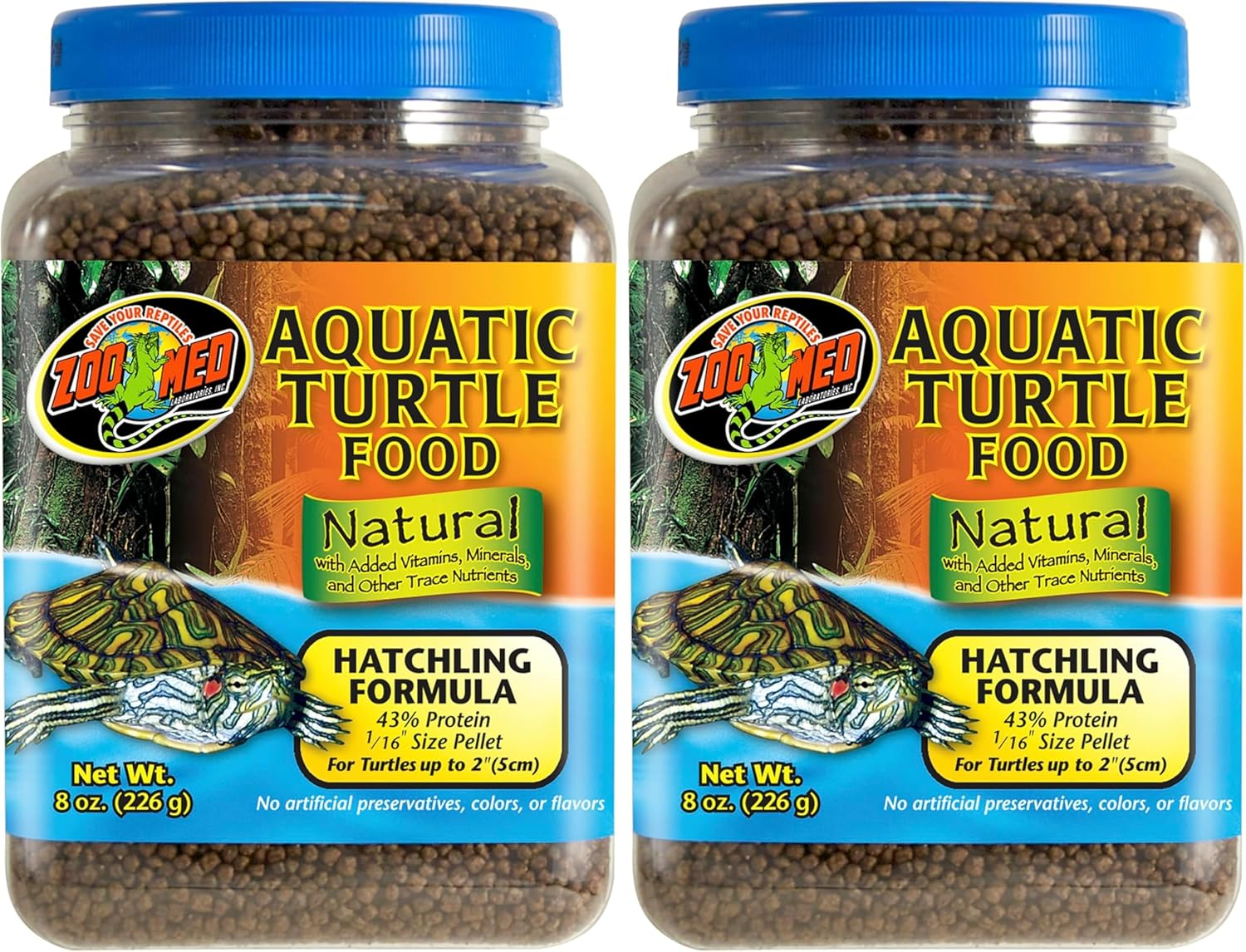
Zoo Med’s Natural Aquatic Turtle Food range uses three formulas – Hatchling, Growth and Maintenance with different pellet sizes and protein levels to match the turtle’s stage of life. It provides a straightforward way to choose food based on turtle size rather than feeding one formula throughout the animal’s entire life.
Specifications | |
|---|---|
| Best For | Life-stage-specific feeding |
| Formula Options | Hatchling, Growth & Maintenance |
| Hatchling | Up to 2″ shell length |
| Growth | 2–6″ shell length |
| Maintenance | 6″+ adult turtles |
| Hatchling Protein | 43% |
| Growth Protein | 35% |
| Maintenance Protein | 25% |
| Hatchling Pellet | 1.6 mm |
| Growth Pellet | 4.8 mm |
| Maintenance Pellet | 8 mm |
| Food Type | Floating pellets |
| Food Role | Complete aquatic turtle food |
One of the easiest mistakes to make when buying turtle food is assuming that one formula should be used throughout your turtle’s entire life.
Zoo Med takes a different approach.
Its Natural Aquatic Turtle Food range is divided into Hatchling, Growth and Maintenance formulas, with different pellet sizes and protein levels for different stages of a turtle’s development. The current Zoo Med catalog lists 43% protein for Hatchling, 35% for Growth and 25% for Maintenance.
That makes Zoo Med particularly interesting for owners who want to adjust their turtle’s food as it grows rather than simply continuing to feed the same pellet indefinitely.
Why We Picked It
The biggest strength of Zoo Med isn’t that one of its formulas has the highest protein percentage.
It’s the fact that the range is built around life stage.
Zoo Med currently offers:
Hatchling Formula: for aquatic turtles up to 2 inches (5 cm), with a small 1.6 mm pellet and 43% protein.
Growth Formula: for turtles approximately 2–6 inches (5–15 cm), with a 4.8 mm pellet and 35% protein.
Maintenance Formula: for adult turtles 6 inches (15 cm) or larger, with an 8 mm pellet and 25% protein.
That is a much more useful approach than recommending one universal pellet size and protein level to every turtle.
The Three Zoo Med Formulas
Hatchling Formula
The Hatchling formula is designed for hatchling and juvenile aquatic turtles with shells up to 2 inches (5 cm).
It uses a very small pellet and provides 43% minimum crude protein, reflecting the higher protein level Zoo Med uses for rapidly growing young turtles.
Best for: Hatchlings and very small juveniles
Pellet size: 1.6 mm
Protein: 43%
This is the Zoo Med formula I’d look at first if you’re feeding a genuinely tiny turtle.
Growth Formula
The Growth formula is designed for aquatic turtles measuring approximately 2–6 inches (5–15 cm).
It uses a larger 4.8 mm pellet and contains 35% minimum crude protein.
Best for: Growing juvenile turtles
Pellet size: 4.8 mm
Protein: 35%
This is probably the most useful formula for owners with a turtle that has moved beyond the hatchling stage but isn’t yet a large adult.
Adult Maintenance Formula
The Maintenance formula is intended for adult aquatic turtles measuring approximately 6 inches (15 cm) or more.
The pellet increases to 8 mm, while the protein level decreases to 25% minimum.
Best for: Large adult aquatic turtles
Pellet size: 8 mm
Protein: 25%
The lower protein level is deliberate. Zoo Med describes this as its maintenance formula for adult turtles rather than a growth-oriented food.
Nutritional Breakdown
Because Zoo Med sells three different formulas, there isn’t one nutritional analysis that applies to the entire range.
Hatchling
Protein: 43% minimum
The hatchling formula is intentionally the highest-protein option in the range.
Growth
Protein: 35% minimum
This sits between the Hatchling and Maintenance formulas.
Maintenance
Protein: 25% minimum
Fat: 5% minimum
Fiber: 8% maximum
Moisture: 11% maximum
Calcium: 1.3–1.7%
Phosphorus: 1.0% minimum
This is one of the reasons I would avoid giving Zoo Med one generic “protein percentage” in the article.
The formula you buy should depend on the turtle you actually have.
What We Like
1. Three life-stage formulas
This is easily the biggest advantage.
Rather than treating a 1.5-inch hatchling and an 8-inch adult as nutritionally identical, Zoo Med provides different formulas for hatchlings, growing turtles and adults.
2. Pellet size changes with the turtle
This is an underrated advantage.
The current catalog lists:
- Hatchling: 1.6 mm
- Growth: 4.8 mm
- Maintenance: 8 mm
That means you’re not forced to chop up an oversized adult pellet for a tiny turtle or give an adult turtle microscopic food.
3. Different protein levels for different stages
Zoo Med’s current range uses:
43% → 35% → 25%
as the turtle progresses from hatchling to adult maintenance.
We wouldn’t interpret that as proof that these exact numbers are universally ideal for every turtle species, but it does show that Zoo Med has intentionally differentiated the formulas by life stage.
4. Floating pellets
All three formulas use floating pellets, which makes feeding easier to observe and allows keepers to see how much food remains.
5. No added artificial colors, flavors or preservatives
Zoo Med states that its Natural Aquatic Turtle Food formulas contain no artificial colors, flavors or preservatives.
6. Established reptile-focused manufacturer
Zoo Med is a specialist reptile and aquatic-animal brand rather than a general pet-food company entering the turtle category with a single product.
That doesn’t automatically make its food superior, but it does add useful context when evaluating the product range.
What We Don’t Like
1. You have to choose the correct formula
The biggest advantage can also become a disadvantage.
If you simply search Amazon for “Zoo Med turtle food,” you may encounter several different formulas.
Buying the wrong one defeats the purpose of the life-stage system.
Before purchasing, check:
Turtle size → Formula → Pellet size
rather than choosing based only on the product image.
2. Standard Maintenance is not intended for young turtles
The Maintenance formula is specifically designed for adult turtles around 6 inches or larger.
So I wouldn’t recommend buying the largest or most economical container simply because it costs less per ounce.
3. The range is less convenient than a one-food solution
If you have multiple turtles at different stages, you may need more than one formula.
That means more containers and more decisions.
4. The ingredient profile isn’t the main reason to buy it
Compared with Fluval Bug Bites or Ultra Fresh, Zoo Med’s strongest selling point isn’t an unusual protein source.
Its advantage is life-stage formulation.
That’s why I wouldn’t try to sell this product using exaggerated ingredient claims.
Who Should Buy Zoo Med?
I’d consider Zoo Med particularly suitable for owners who:
- Want food matched to their turtle’s growth stage
- Have a hatchling or growing juvenile
- Want a dedicated adult maintenance formula
- Prefer smaller pellets for young turtles
- Want a straightforward floating staple food
- Are willing to change formulas as the turtle grows
It is particularly attractive for a first-time turtle owner who wants a simple way to understand which food to use at different stages.
Who Should Skip It?
I’d consider another option if:
- You want an insect-forward food.
- Your turtle is extremely picky and responds better to strong seafood flavors.
- You want shrimp and mealworms mixed directly into the food.
- You don’t want to manage different formulas as your turtle grows.
- You’re keeping a bottom-feeding mud or musk turtle and specifically need a sinking food.
That last point is important because Zoo Med separately makes a Sinking Mud & Musk Turtle Food designed for bottom-dwelling mud and musk turtles.
So don’t assume the floating Natural Aquatic Turtle Food range is automatically the best Zoo Med product for every aquatic turtle.
Zoo Med vs. Mazuri
This is the most important comparison.
Mazuri Aquatic Turtle Diet gives you a straightforward turtle-specific staple with a 4 mm floating pellet and 40% minimum protein.
Zoo Med gives you three formulas based on life stage, with different pellet sizes and protein levels.
So:
Choose Mazuri if: you want our strongest overall conventional staple recommendation.
Choose Zoo Med if: you specifically want a food system that changes as your turtle grows.
I wouldn’t say one is universally healthier.
They’re simply solving slightly different problems.
Zoo Med vs. Fluval Bug Bites
The distinction is even clearer.
Fluval Bug Bites: insect-forward formula with black soldier fly larvae as the first ingredient.
Zoo Med: life-stage-specific formulas with different protein levels and pellet sizes.
So:
Want insect-based ingredients? → Fluval
Want age/size-specific formulas? → Zoo Med
Zoo Med vs. Ultra Fresh
Ultra Fresh is the stronger choice if palatability is your main concern.
Its seafood-forward formula is built around ingredients such as shrimp, squid and fish.
Zoo Med’s advantage is the ability to select a formula specifically for hatchling, growth or adult maintenance.
So:
Picky eater → Ultra Fresh
Growing turtle with changing nutritional needs → Zoo Med
Zoo Med vs. Fluker’s Buffet Blend
These products have completely different strengths.
Fluker’s Buffet Blend: pellets + freeze-dried shrimp + mealworms.
Zoo Med: dedicated formulas for different turtle life stages.
If you want variety in one container, Fluker’s is more interesting.
If you want food matched to turtle size and life stage, Zoo Med wins.
Is Zoo Med Good for Baby Turtles?
Yes—but make sure you buy the Hatchling Formula, not the standard Maintenance Formula.
Zoo Med specifically states that its Hatchling Formula is designed for hatchling and juvenile aquatic turtles with shells up to 2 inches (5 cm), and the current catalog lists a 1.6 mm pellet and 43% protein.
That’s one of Zoo Med’s strongest advantages over simply recommending a single adult-oriented food to every turtle.
When Should You Change Zoo Med Formulas?
Use the turtle’s size and growth stage as your guide rather than changing food simply because a certain number of months has passed.
Zoo Med currently divides the range approximately as:
Up to 2 inches → Hatchling
2–6 inches → Growth
6 inches and above → Maintenance
However, shell length alone shouldn’t be treated as the only nutritional consideration. Species, body condition and overall diet still matter.
How Should You Feed It?
Zoo Med’s manufacturer instructions vary by formula.
The Hatchling formula is designed for very young turtles and recommends offering a small amount in the water.
The Growth formula currently provides a more specific starting instruction of 1 level teaspoon per turtle for turtles in the 2–6 inch range.
The Maintenance page contains conflicting guidance: it says to allow feeding for a minimum of one hour, while its FAQ says turtles should consume the offered amount within about five minutes.
Because of that inconsistency, I would not reproduce the one-hour instruction in PetYourTurtle.
Instead, we’d recommend offering an appropriate portion, observing consumption and removing significant leftovers.
That is also more practical for maintaining good aquarium water quality.
Does Zoo Med Help With Shell Health?
Zoo Med’s formulas provide calcium, phosphorus and vitamin D3 as part of their nutritional formulations.
The Maintenance formula, for example, lists 1.3–1.7% calcium and at least 1.0% phosphorus.
But we wouldn’t claim that Zoo Med food alone “prevents shell problems.”
Shell and bone health depend on the entire husbandry picture, including:
- Appropriate UVB
- Proper basking temperature
- Adequate dietary calcium
- Species-appropriate nutrition
- Overall body condition
- Appropriate habitat
Food is one part of that system.
One Important Zoo Med Option You Should Know About
If your turtle is a mud or musk turtle, Zoo Med also makes a dedicated Sinking Mud & Musk Turtle Food.
The current Zoo Med catalog lists it as a 4 mm sinking pellet with 35% protein, specifically designed for bottom-dwelling mud and musk turtles.
We aren’t including that product as a separate recommendation in this article because it would make the product comparison unnecessarily complicated.
But it’s useful information for readers whose turtles naturally prefer feeding on the bottom.
Our Verdict
Zoo Med earns our Best Life-Stage Selection position because it gives turtle owners something many competing products don’t: a clear progression from hatchling to growth to adult maintenance food.
The current range uses 43%, 35% and 25% protein formulas, paired with approximately 1.6 mm, 4.8 mm and 8 mm pellets, respectively.
That makes Zoo Med particularly appealing if you’re raising a turtle from a tiny hatchling into an adult and want to adjust the food as its size and nutritional needs change.
It isn’t our pick for the most interesting ingredient profile, and it isn’t necessarily the best solution for a picky turtle.
But if your priority is:
“I want to feed my turtle an appropriate formula as it grows.”
Zoo Med is one of the strongest choices on this list.
Our rating: 8.9/10
Best for: Life-stage-specific feeding
Food role: Complete aquatic turtle food
Biggest strength: Three formulas with different pellet sizes and protein levels
Biggest limitation: You need to choose the correct formula for your turtle
How to Choose the Right Turtle Food
The best turtle food isn’t necessarily the food with the highest protein percentage or the most expensive ingredients.
Start with these questions:
1. What species is your turtle?
Identify the species first. Dietary requirements can differ between species, particularly between aquatic turtles and terrestrial turtles.
2. How old is your turtle?
Growing turtles generally have different nutritional needs from mature adults.
3. How large is your turtle?
Food size matters. Your turtle should be able to comfortably consume the food without struggling with oversized pellets or sticks.
4. Is the food a staple or a treat?
A balanced commercial turtle food may be appropriate as part of the regular diet, while foods such as dried insects or shrimp are generally better treated as supplemental foods or occasional treats.
5. Does your turtle actually eat it?
A nutritionally excellent food isn’t useful if your turtle consistently refuses it.
If your turtle is picky, don’t immediately assume the food is bad. Acceptance can depend on the turtle, food size, texture, smell, and what it has previously been fed.
What Should an Aquatic Turtle Eat?
A healthy diet is about more than finding one “perfect” pellet.
For many omnivorous aquatic turtles, the diet can include:
- A quality commercial aquatic turtle food
- Appropriate plant matter
- Species-appropriate supplemental foods
- Occasional treats
The exact balance depends on the turtle’s species and life stage.
That’s why we don’t recommend following a universal percentage formula for every turtle.
How Often Should You Feed a Turtle?
There isn’t one feeding schedule that works perfectly for every turtle.
Age, species, size, growth stage, temperature, body condition, and the rest of the diet all matter.
Hatchlings and young juveniles
Growing turtles generally require more frequent feeding than adults.
Juveniles
Feeding frequency can gradually change as the turtle matures and its growth rate slows.
Adults
Adult aquatic turtles generally don’t need to be fed with the same frequency or quantity as rapidly growing juveniles.
Rather than relying only on a calendar, monitor:
- Body condition
- Growth
- Shell development
- Appetite
- Activity
- Uneaten food
- Water quality
If you’re unsure how much to feed, start conservatively and adjust based on your turtle’s condition and the manufacturer’s feeding guidance.
How Much Food Should You Give a Turtle?
Overfeeding is one of the most common problems with aquatic turtles.
Too much food doesn’t simply mean a heavier turtle. Uneaten food can also contribute to unnecessary waste and make maintaining water quality more difficult.
A practical approach is to:
- Offer an appropriate amount for your turtle’s size and life stage.
- Observe how quickly the food is consumed.
- Remove uneaten food promptly.
- Adjust the next feeding rather than continually adding more food.
Your turtle’s body condition should ultimately guide portion adjustments.
Can Turtle Food Make the Tank Water Dirty?
Yes.
Uneaten food breaks down in the aquarium and contributes to the organic waste that your filtration system has to process.
If your tank becomes cloudy or dirty after feeding, don’t immediately assume you need a stronger food or a stronger filter.
First check:
- Portion size
- Uneaten food
- Feeding frequency
- Food that crumbles excessively
- Filtration
- Water changes
You can also feed your turtle in a separate container if appropriate for your setup and turtle.
For more information, see our guide to [turtle tank filtration].
Common Turtle Feeding Mistakes
Feeding too much
More food isn’t necessarily better.
Using treats as the main diet
Dried insects, shrimp and other treats can be useful, but they shouldn’t automatically replace a balanced staple food.
Ignoring species and age
A diet that works for one turtle isn’t necessarily appropriate for another.
Choosing food based only on protein percentage
Protein is only one part of the nutritional picture.
Leaving uneaten food in the tank
Remove leftovers rather than allowing them to decompose in the aquarium.
Constantly changing foods
Variety can be useful, but repeatedly switching foods simply because a turtle refuses one food can also reinforce picky eating.
Simple Rule I Follow
If I had to simplify everything:
70% pellets + 20% greens + 10% protein treats
This balance keeps:
- Water cleaner
- Turtle active
- Shell smooth and healthy
Frequently Asked Questions
For many commonly kept freshwater aquatic turtles, Mazuri Aquatic Turtle Diet is our top overall choice. However, the best food depends on the turtle’s species, size, life stage and overall diet.
A quality commercial turtle food can provide an important nutritional foundation, but you shouldn’t assume that one pellet can replace every other component of a species-appropriate diet. Dietary needs vary by species and life stage.
Not necessarily. Growing turtles can have different nutritional requirements from adults, and pellet size is also important. Zoo Med is one example of a manufacturer that offers separate Hatchling, Growth and Maintenance formulas.
Feeding frequency depends on species, age, size, growth stage, body condition and the rest of the diet. Avoid using one rigid schedule for every turtle.
Yes. Uneaten food breaks down and contributes to organic waste in the aquarium. Offer appropriate portions and remove significant leftovers rather than allowing them to accumulate.
Not automatically. Protein is only one part of a food’s nutritional profile. The appropriate amount depends on the turtle’s species, age and life stage.
Many aquatic turtles can have appropriate supplemental foods and treats, but treats shouldn’t replace a balanced staple diet. The type and frequency should depend on the turtle and its nutritional needs.
Final Verdict
Choosing turtle food doesn’t need to be complicated.
Start with your turtle, not the product.
Identify the species, consider its life stage and size, choose an appropriate staple food, and then build variety into the overall diet where appropriate.
For most keepers looking for one dependable starting point, Mazuri Aquatic Turtle Diet is our Best Overall pick.
But if your priorities are different, our other picks each have a clear advantage:
Best Overall → Mazuri
Best Insect-Based → Fluval Bug Bites
Best for Picky Eaters → Ultra Fresh
Best Life-Stage Selection → Zoo Med
Best Variety → Fluker’s Buffet Blend
Whichever food you choose, remember that good turtle nutrition doesn’t happen in isolation. UVB, basking, water quality, filtration and proper husbandry all work together to keep an aquatic turtle healthy.