
Turtle tanks get dirty fast and most beginners assume they simply need to clean more often. In reality the problem is usually filtration strength. Turtles are extremely messy compared to fish. They tear food apart produce heavy solid waste and consume protein rich diets that increase ammonia levels quickly. If your filter is not strong enough the tank will turn cloudy smell unpleasant and require constant maintenance.
Understanding how strong a turtle tank filter should be will save you time money and frustration. The answer depends on flow rate tank size turtle size and total bio load but there are clear guidelines that experienced keepers follow. Most owners eventually upgrade to the best canister filter for turtle tanks once they realize basic filters cannot handle turtle bio load.
For a full breakdown, check this guide on Turtle Tank Filtration.
Why Turtle Tanks Need More Filtration Than Fish Tanks
Fish tanks are often filtered at four times water turnover per hour. That means a fifty gallon fish tank might use a two hundred gallon per hour filter. For turtles that standard is not enough. Turtles produce significantly more waste and disturb substrate constantly which releases trapped debris back into the water column.
Because of this turtle tanks should aim for eight to ten times turnover per hour. This higher flow rate keeps waste suspended long enough to be captured and supports stronger biological filtration. Without this level of circulation ammonia builds quickly and water clarity declines within days.
Understanding GPH and Tank Turnover
Filter strength is measured in gallons per hour or GPH. This number tells you how much water the filter can move in sixty minutes. To calculate ideal strength multiply your tank size by eight to ten.
A fifty gallon turtle tank should ideally run a filter between four hundred and five hundred GPH. A seventy five gallon tank should target six hundred to eight hundred GPH. A one hundred gallon tank should approach eight hundred to one thousand GPH for stable performance.
Many manufacturers rate filters based on lightly stocked fish tanks so it is important not to rely only on the box label. A filter advertised for one hundred gallons may struggle in a one hundred gallon turtle tank.
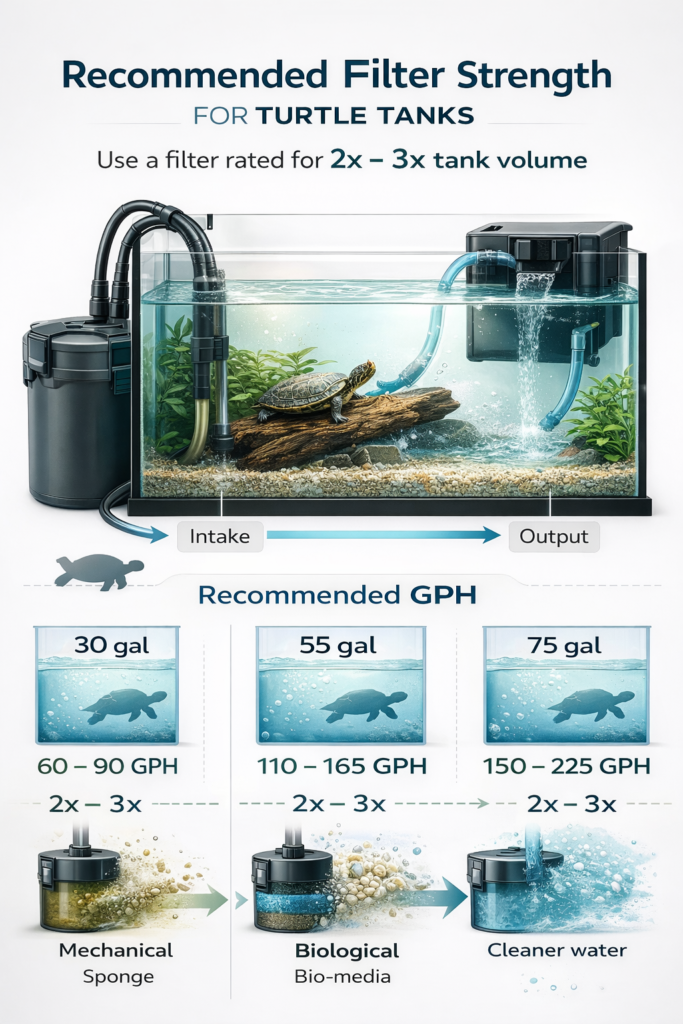
The Two to Three Times Tank Size Rule
Most experienced turtle keepers follow a simple rule buy a filter rated for at least two to three times your actual tank volume. This compensates for the heavier bioload turtles create.
For example if you run a seventy five gallon tank choosing a canister filter rated for one hundred fifty gallons provides the media capacity and flow strength necessary for long term stability. This is one reason many serious keepers research the best canister filter for turtle tanks rather than choosing basic hang on back models. Larger canister systems provide more space for biological media and stronger mechanical waste removal.
Mechanical and Biological Filtration Both Matter
Flow rate alone does not determine filter strength. Media capacity is equally important. Mechanical filtration traps solid debris while biological filtration houses beneficial bacteria that convert ammonia into nitrite and then nitrate.
Canister filters are often preferred because they combine high GPH with large media chambers. This allows more beneficial bacteria to grow which stabilizes water chemistry and reduces the frequency of emergency water changes. When comparing options for the best canister filter for turtle tanks it is important to evaluate both flow rate and internal media volume.
Can You Overfilter a Turtle Tank
Many new turtle owners worry about excessive filtration. In reality adult turtles benefit from strong filtration. Increased turnover improves oxygen exchange and helps maintain stable parameters. The only situation where flow may need adjustment is with very small hatchlings that struggle against strong currents. In those cases output can be redirected without reducing filtration capacity.
Strong filtration is almost always safer than weak filtration especially as turtles grow larger and produce more waste.
Matching Filter Strength to Turtle Size
A three inch juvenile produces far less waste than a seven inch adult red eared slider. Planning filtration based on current size often leads to underpowered systems within a year. It is smarter to calculate based on adult shell length and expected tank upgrades.
If you keep multiple turtles bioload increases dramatically and filtration strength should increase accordingly. Many owners upgrading tanks from fifty gallons to seventy five or one hundred gallons quickly realize that investing early in the best canister filter for turtle tanks prevents repeated upgrades later.
Signs Your Filter Is Not Strong Enough
There are clear indicators that your current system lacks power. Water becomes cloudy within a few days of cleaning. Strong odor returns quickly. Ammonia or nitrite appear during testing. Visible debris accumulates along the bottom. Algae growth increases despite controlled lighting.
If these symptoms occur consistently your tank likely needs higher turnover and greater media capacity rather than more frequent deep cleaning.
Final Thoughts on Choosing the Right Strength
To summarize turtle tanks require stronger filtration than fish tanks because of heavy bioload and waste production. Aim for eight to ten times turnover per hour and choose a filter rated for two to three times your tank volume. Plan around adult turtle size and prioritize media capacity alongside GPH.
Strong filtration keeps water clear reduces odor prevents ammonia spikes and supports long term shell health. Choosing correctly at the beginning will reduce maintenance stress and improve overall tank stability.
Frequently Asked Questions
What GPH is good for a turtle tank
A good rule is eight to ten times tank volume per hour. A fifty gallon turtle tank should aim for at least four hundred GPH for reliable performance.
Is a hang on back filter strong enough for turtles
For small juveniles it may work temporarily but adult turtles usually require larger canister systems with higher media capacity and flow rate.
Can filtration be too strong for turtles
For adult turtles strong filtration is rarely a problem. Flow can be redirected if current becomes excessive but higher turnover generally improves water quality.
How often should I change water in a properly filtered turtle tank
With correct filtration and stable parameters partial water changes every two to three weeks are common though this varies based on bioload and feeding habits.
Why does my turtle tank get cloudy so quickly
Cloudiness is often caused by insufficient filtration strength heavy feeding or an incomplete nitrogen cycle. Testing ammonia and nitrite levels can confirm whether biological filtration is stable.


