
Turtles may look similar at first glance, but not all turtles live or behave the same way. One of the most important distinctions in the turtle world is whether a turtle lives in freshwater, on land, or in the ocean. Understanding the differences between the turtles that live in water and land is essential for education, conservation, and responsible pet ownership. Each type has evolved unique physical traits, behaviors, and survival strategies suited to its environment.
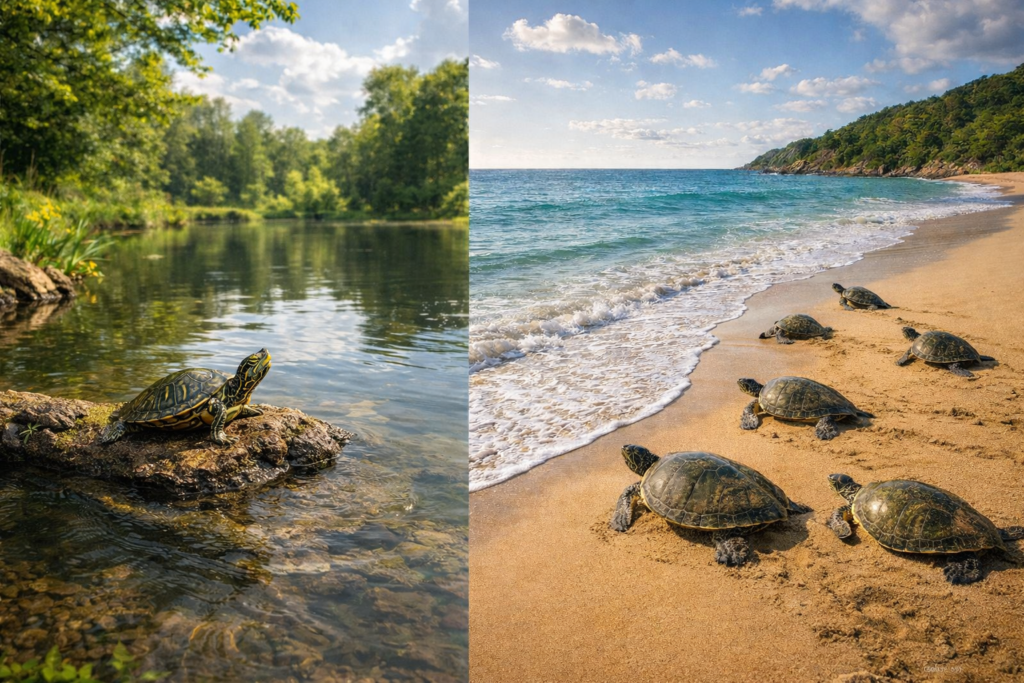
This article breaks down these three major turtle categories in a simple, easy-to-understand way.
Freshwater Turtles
Freshwater turtles live in ponds, rivers, lakes, marshes, and wetlands. They are the most common type of turtle encountered by people and the most commonly kept as pets.
These turtles spend most of their lives in water but must climb onto dry surfaces to bask. Basking helps regulate body temperature and allows turtles to absorb UVB light, which is essential for shell health.
Physical traits of freshwater turtles include flatter shells for swimming, webbed feet, and streamlined bodies. Common freshwater turtle species include Red-Eared Sliders, Painted Turtles, Snapping Turtles, Musk Turtles, and Cooters.
Freshwater turtles are usually omnivores. Juveniles eat more protein such as insects and small fish, while adults consume more plant material.
Land Turtles (Tortoises)
Land turtles, more commonly known as tortoises, live entirely on land. Unlike freshwater turtles, tortoises cannot swim and should never be placed in deep water.
Tortoises have thick, dome-shaped shells and strong, elephant-like legs designed for walking on dry terrain. Their movement is slow but steady, and their shells offer excellent protection from predators.
Most tortoises are herbivores. Their diet consists mainly of grasses, leaves, weeds, and vegetables. Popular land turtle species include the Sulcata Tortoise, Russian Tortoise, Greek Tortoise, and Desert Tortoise.
Tortoises are known for their long lifespans. Some species can live for several decades, and a few have been known to live over a hundred years.
Sea Turtles
Sea turtles are marine reptiles that spend almost their entire lives in the ocean. They come ashore only to lay eggs on beaches.
Unlike freshwater and land turtles, sea turtles have flippers instead of feet. Their lightweight shells and powerful front flippers allow them to swim long distances across open oceans.
There are seven recognized species of sea turtles, including the Green Sea Turtle, Leatherback Sea Turtle, Loggerhead Sea Turtle, Hawksbill Sea Turtle, and Olive Ridley Sea Turtle.
Sea turtle diets vary by species. Some feed on seagrass and algae, while others eat jellyfish, crustaceans, or sponges.
Key Differences Between the Three Types
Habitat:
Freshwater turtles live in inland water bodies. Land turtles live on dry land. Sea turtles live in oceans.
Movement:
Freshwater turtles swim and walk. Land turtles walk only. Sea turtles are built for swimming.
Diet:
Freshwater turtles are mostly omnivorous. Land turtles are primarily herbivores. Sea turtles have specialized diets depending on species.
Shell Shape:
Freshwater turtles have flatter shells. Land turtles have dome-shaped shells. Sea turtles have streamlined shells for swimming.
Why These Differences Matter
Understanding turtle types helps prevent common mistakes, such as keeping a land turtle in water or misunderstanding the needs of a freshwater turtle.
It also helps conservation efforts. Sea turtles face threats like plastic pollution and habitat loss, while freshwater turtles are affected by water pollution and wetland destruction.
Freshwater, land and sea turtles may belong to the same ancient reptile family, but they live very different lives. Each type has adapted perfectly to its environment over millions of years.
Learning these differences not only deepens appreciation for turtles but also encourages responsible care and protection of these remarkable animals.


