Turtle Tank Filtration Guide (2026): What Actually Keeps Water Crystal Clear
Most turtle tank filtration problems are not caused by the turtle, but by using a filter that is too weak. All the types of turtles produce far more waste than fish, and without proper filtration, the water quickly becomes cloudy and difficult to maintain.
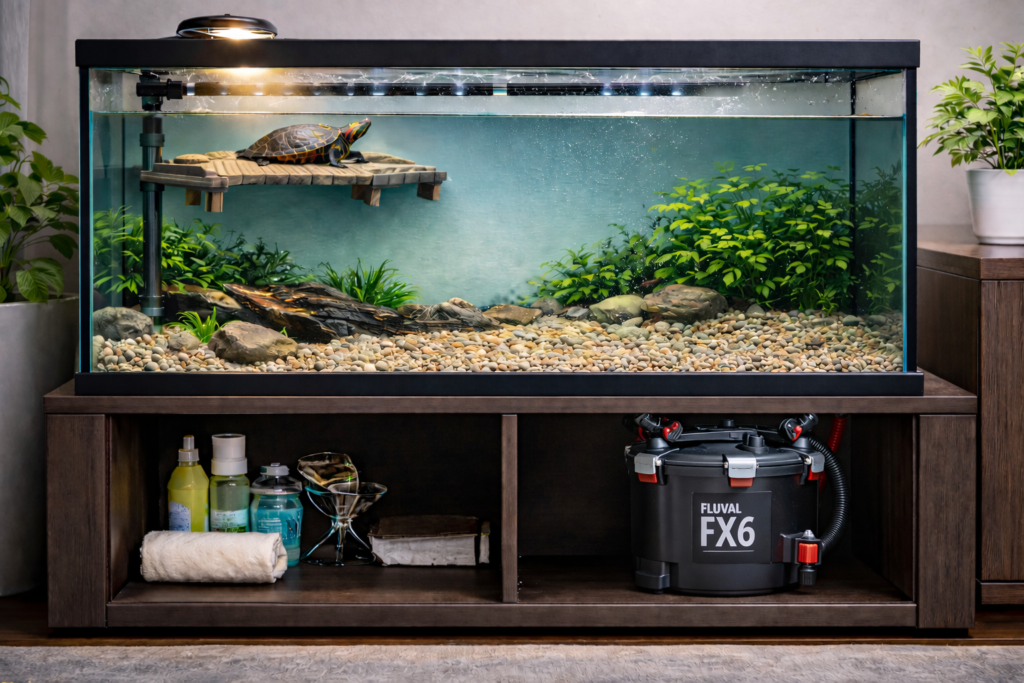
If you’ve ever struggled with cloudy water, strong odors, or constant maintenance in your turtle tank, the real issue is almost always filtration.
Turtles are messy. They eat protein-heavy diets, produce large solid waste, and create far more bioload than most fish. That means turtle tank filtration isn’t just important, it’s the foundation of a healthy, stable aquatic setup.
👉 If you are choosing a filter, this best canister filters for turtle tanks guide breaks down the most reliable options for different tank sizes.
Explore Turtle Tank Filtration (Quick Navigation)
Whether you’re just getting started or trying to fix dirty water issues, use this guide to jump straight to the exact solution you need.
Just Getting Started (Start Here First)
Do Turtles Need a Filter in Their Tank? Complete Beginner Guide
New to turtle care? This explains why filtration is non-negotiable and what happens without it.
What Size Filter for Baby Turtle Tank? Complete Beginner Guide
Avoid beginner mistakes by choosing the right filter size from day one.
Choosing the Right Filter (Most Important Step)
Best Filter for Turtle Tank (Complete Guide + Top Picks)
Compare the best filters based on tank size, waste load, and performance.
If you’re planning to buy a filter, start here first.
Best Filter for 75 Gallon Turtle Tank (2026): What Actually Works
Real recommendations for one of the most common turtle tank sizes.
Best Filter for Snapping Turtle (2026 Guide) – Expert Picks for Heavy Waste Tanks
Built specifically for turtles that produce extreme waste.
How Strong Should a Turtle Tank Filter Be
Learn how to calculate the correct flow rate so your tank actually stays clean.
Filter Types Explained (What Actually Works)
Internal Filters for Turtle Tanks: Are They Enough for Proper Filtration?
Understand the limitations before you rely on internal filters.
Hang-On-Back Filters for Turtle Tanks (Pros, Cons & Better Options)
When they work, when they fail, and better alternatives.
Setup and Performance Optimization
How to Set Up a Canister Filter for a Turtle Tank Properly (Avoid Costly Mistakes)
Set it up right the first time and avoid weak flow or dirty water issues.
Best Filter Media for Turtle Tanks (What Actually Works)
The exact media setup that keeps water crystal clear longer.
Fix Common Turtle Tank Problems
Why Does My Turtle Tank Get Dirty So Fast? (And How to Fix It)
Quick fixes for cloudy water, bad smell, and constant dirt buildup.
If your water looks bad, start here.
Maintenance and Long Term Care
How Often to Clean Turtle Canister Filter (2026 Guide for Clear Water)
A simple schedule to keep your filter running efficiently without overcleaning.
What Actually Fixed My Turtle Tank Water
For a long time, I thought my problem was not cleaning the tank enough.
No matter what I did, the water in my turtle tank kept turning cloudy. I would do partial water changes every few days, clean the tank more often than I probably should have, and still within a short time, the water would lose clarity again. There was also a slight smell that kept coming back, which made the whole setup frustrating to manage.
At one point, I started thinking maybe I was overfeeding or doing something wrong with the water itself. So I reduced feeding, changed the water more carefully, and even adjusted how often I cleaned the tank. But nothing really solved the core issue. The tank would look clean for a day or two, and then everything would repeat.
The turning point came when I stopped focusing on cleaning and started looking at filtration instead.
I realized that the filter I was using was rated close to my tank size, which works fine for fish, but not for turtles. Turtles produce a lot more waste, and the filter simply could not keep up with it. It was not a maintenance problem, it was a capacity problem.
So I upgraded to a stronger filter that was rated well above my tank size and made sure it had proper mechanical and biological media inside.
The difference was immediate.
The water stayed clear for much longer, the smell almost disappeared, and I no longer had to constantly clean the tank. Maintenance became predictable instead of frustrating, and the whole setup felt stable for the first time.
Looking back, the mistake was trying to fix a filtration problem with more cleaning. Once I fixed the filtration, everything else fell into place.
If there is one thing I learned from this, it is that a strong filtration setup is not optional for turtle tanks. It is the foundation of everything.
What is the best filtration for a turtle tank?
The best filtration for a turtle tank is a powerful canister filter with strong mechanical and biological media. Turtles produce heavy waste, so filters should be rated for at least two to three times the tank size to keep water clean. If you are choosing a filter, I highly recommend checking this detailed guide on filter strength.
How strong should a turtle tank filter be?
A turtle tank filter should handle at least eight to ten times the tank volume per hour. This higher flow rate helps remove waste efficiently and prevents cloudy water.
Why does my turtle tank get dirty so fast?
Turtle tanks get dirty quickly because turtles produce more waste than fish and often tear food apart. Without strong filtration, waste builds up and causes cloudy water and odor.
Do Turtles Really Need a Filter?
If you’re setting up a turtle tank for the first time, one of the most common questions you’ll ask is:
Do turtles really need a filter? Check our Complete Beginner guide
You might have seen videos of turtles in plastic tubs or outdoor ponds without obvious filtration systems. So it’s natural to wonder whether a filter is truly necessary — or just an optional upgrade. For larger setups, here is a complete 75 gallon turtle tank setup guide.
The short answer is this: if you are keeping a turtle indoors in a standard aquarium setup, proper turtle tank filtration is not optional. It is essential.
But to understand why, we need to look at how turtles live, how they produce waste, and what happens inside the water of an enclosed tank.
Best overall filters for your Turtle tank:
- Fluval FX6 High Performance Aquarium Filter, Canister Filter for Aquariums up to 400 Gal.
- Fluval 407 Perfomance Canister Filter for Aquariums up to 100 Gallons
- Penn-Plax Cascade All-in-One Aquarium Canister Filter – for Tanks Up to 100 Gallons (265 GPH) – Cascade 1000
- SunSun Canister Filters (Budget-Friendly)303B
Best Types of Filters for Turtle Tanks (Detailed Comparison)
Before choosing a filter, it’s important to understand that not all aquarium filters are built the same. Turtle tanks produce significantly more waste than fish tanks, so choosing the right type of filter makes a huge difference in water clarity and maintenance.
| Filter Type | How It Works | Best For | Pros | Cons | My Recommendation |
|---|---|---|---|---|---|
| Canister Filter | External unit that pulls water through multiple filtration media (mechanical, biological, chemical) | Medium to large turtle tanks | Very strong filtration, large media capacity, keeps water clean longer | Expensive, more complex setup | ✅ Best overall choice for turtles |
| Hang-on-Back (HOB) Filter | Hangs on tank edge and filters water through cartridges | Small to medium tanks | Easy to install, affordable, decent performance | Limited capacity, struggles with heavy waste | ⚠️ Only for smaller or temporary setups |
| Internal Filter | Placed inside tank and circulates water through sponge/media | Small tanks or temporary use | Cheap, compact, easy to use | Weak filtration, clogs quickly with turtle waste | ❌ Not ideal for turtles long-term |
| Sponge Filter | Uses air pump to draw water through sponge for biological filtration | Hatchlings or hospital tanks | Gentle flow, good for bacteria growth | Very weak cleaning power, doesn’t remove debris well | ⚠️ Only for baby turtles |
| Undergravel Filter | Filters water through substrate using uplift tubes | Low-bioload tanks | Hidden system, simple design | Hard to clean, ineffective for turtles | ❌ Not recommended |
Why Turtles Are Much Messier Than Fish
Many beginners assume turtles are similar to aquarium fish when it comes to water care. That’s a mistake.
Turtles are extremely messy animals.
They eat protein-heavy foods like pellets, insects, shrimp, and sometimes vegetables. When they eat, they often tear food apart, leaving small particles floating in the water. On top of that, they produce large amounts of solid waste compared to fish of similar size. To learn about the best turtle food, please read our guide to the best turtle food for health growth & clean water.
All of this waste breaks down into ammonia.
Ammonia is highly toxic. Even small amounts can irritate a turtle’s eyes, skin, and respiratory system. Prolonged exposure can weaken their immune system and make them more vulnerable to infections and shell problems.
Without proper turtle tank filtration, ammonia levels rise quickly and sometimes within just a few days.
Clear Water Does Not Mean Clean Water
One of the biggest misconceptions in turtle care is that if the water looks clear, it must be safe.
Unfortunately, ammonia and nitrites are invisible.
You can have crystal-clear water that is chemically toxic.
This is where turtle tank filtration becomes critical. A good filtration system does more than remove visible debris. It supports the biological processes that keep the water chemically stable.
What Happens If You Don’t Use a Filter?
If you try to run a turtle tank without filtration, here’s what typically happens:
The water becomes cloudy within days.
A strong odor develops.
Ammonia builds up quickly.
You are forced to do full water changes frequently.
At first, you might think frequent full water changes solve the problem. But in reality, this creates another issue.
When you constantly replace all the water, beneficial bacteria never get a chance to establish themselves. Without beneficial bacteria, the nitrogen cycle cannot stabilize. That means ammonia spikes happen repeatedly.
Instead of solving the problem, you’re trapped in a cycle of temporary fixes.
Proper turtle tank filtration allows the tank to develop a stable biological ecosystem.
Understanding the Nitrogen Cycle
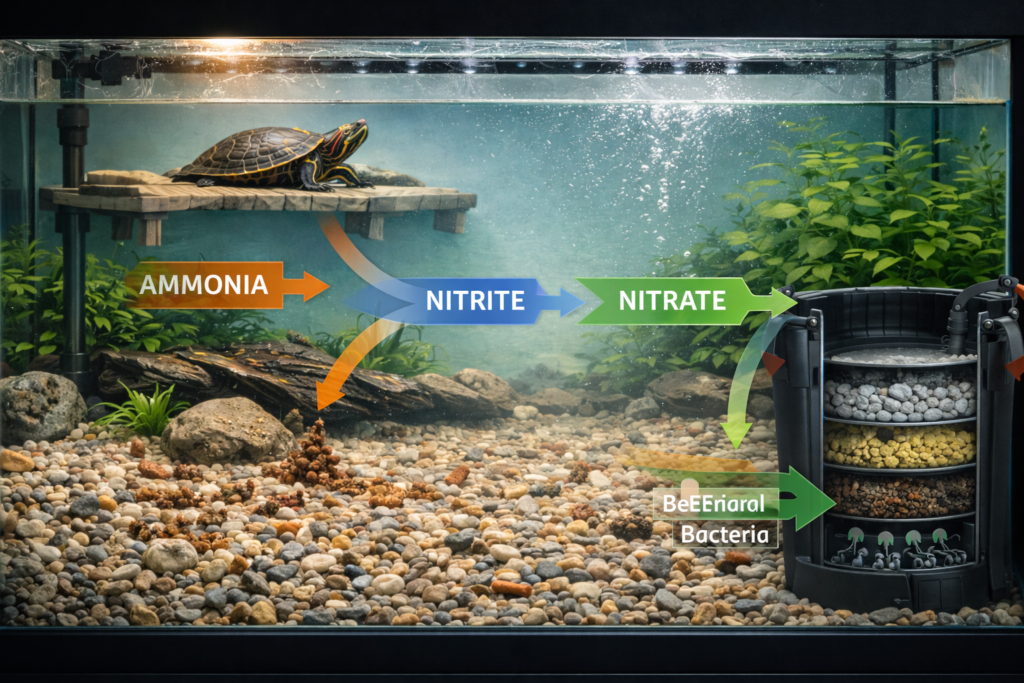
The nitrogen cycle is the foundation of healthy turtle tank filtration.
Here’s how it works:
When your turtle produces waste, it releases ammonia into the water. Beneficial bacteria convert ammonia into nitrite. Then another type of bacteria converts nitrite into nitrate.
Ammonia is highly toxic.
Nitrite is also toxic.
Nitrate is much less harmful and can be controlled with regular partial water changes.
Your filter provides the surface area where these beneficial bacteria live. Without a filter, there is very limited space for bacteria to colonize, which slows down or prevents the nitrogen cycle from working efficiently.
That is why filtration is not just about cleanliness. It is about biological balance.
Can Turtles Survive Without a Filter?
Technically, yes — but only temporarily and under specific conditions.
In outdoor ponds, natural plants, sunlight, large water volume, and ecosystem balance help maintain water quality. In small plastic tubs, some owners change water daily to compensate.
But an indoor aquarium is a closed system.
There is no natural ecosystem buffering waste. The tank relies entirely on mechanical and biological filtration to remain stable.
If you want your turtle to thrive rather than just survive, turtle tank filtration is necessary.
Best Canister Filters of 2026
- Fluval FX6 High Performance Aquarium Filter, Canister Filter for Aquariums up to 400 Gal.
- Fluval 407 Perfomance Canister Filter for Aquariums up to 100 Gallons
- Penn-Plax Cascade All-in-One Aquarium Canister Filter – for Tanks Up to 100 Gallons (265 GPH) – Cascade 1000
- SunSun Canister Filters (Budget-Friendly)303B
Health Problems Linked to Poor Filtration
Inadequate filtration often leads to:
Shell rot, to learn more about this health hazards, please do read our complete guide to shell rot in pet turtles, cause, symptoms and remedies.
Soft shell issues
Eye infections
Respiratory infections
Skin irritation
Lethargy
Many of these problems trace back to poor water quality.
Turtles spend a significant portion of their lives in water. If that water is dirty or chemically unstable, their health suffers over time. In order to understand if your turtle is healthy or to identify any unusual behavior changes, please read our Complete guide to turtle behavior.
Good filtration dramatically reduces these risks.
Why Turtle Filters Must Be Stronger Than Fish Filters
Another common mistake is buying a filter rated for the exact size of the tank.
For fish, this might work.
For turtles, it usually does not.
Because turtles produce more waste, they require stronger filtration. Most experienced keepers recommend choosing a filter rated for at least 2 to 3 times your tank size.
For example:
If you have a 40 gallon turtle tank, look for a filter rated for 80 to 120 gallons.
This higher capacity ensures better waste removal and stronger biological filtration.
Strong turtle tank filtration reduces maintenance, improves water clarity, and creates a healthier environment overall.
What About Baby Turtles?
Some owners assume baby turtles don’t need filtration because they are small.
But baby turtles are just as messy relative to their size. In fact, because they are often kept in smaller tanks, waste can build up even faster.
The key difference is managing water flow. Baby turtles may need gentler output, but they still require effective biological filtration.
Skipping filtration at the hatchling stage often leads to water quality problems very quickly.
The Real Benefit: Less Stress for You and Your Turtle
Proper turtle tank filtration does more than protect your turtle’s health. It also makes your life easier.
With a strong filter:
Water stays clear longer.
You perform fewer emergency water changes.
Odor is reduced.
Maintenance becomes predictable.
Instead of constantly fighting dirty water, you maintain a stable system.
That stability is better for your turtle and far less stressful for you.
If you are keeping your turtle in an indoor aquarium, a filter is not optional equipment. It is one of the most important parts of the entire setup.
Turtle tank filtration:
Controls toxic ammonia
Supports beneficial bacteria
Maintains stable water chemistry
Reduces disease risk
Improves overall tank cleanliness
Without it, you are constantly battling water quality issues.
With it, you create a balanced, healthy aquatic environment where your turtle can grow, bask, eat, and thrive long term.
If you are serious about responsible turtle care, investing in proper filtration should be at the top of your priority list.
“Want to see the best-performing canister filters ranked by tank size?
Why Turtle Tanks Get Dirty So Fast (And How Proper Turtle Tank Filtration Fixes It)
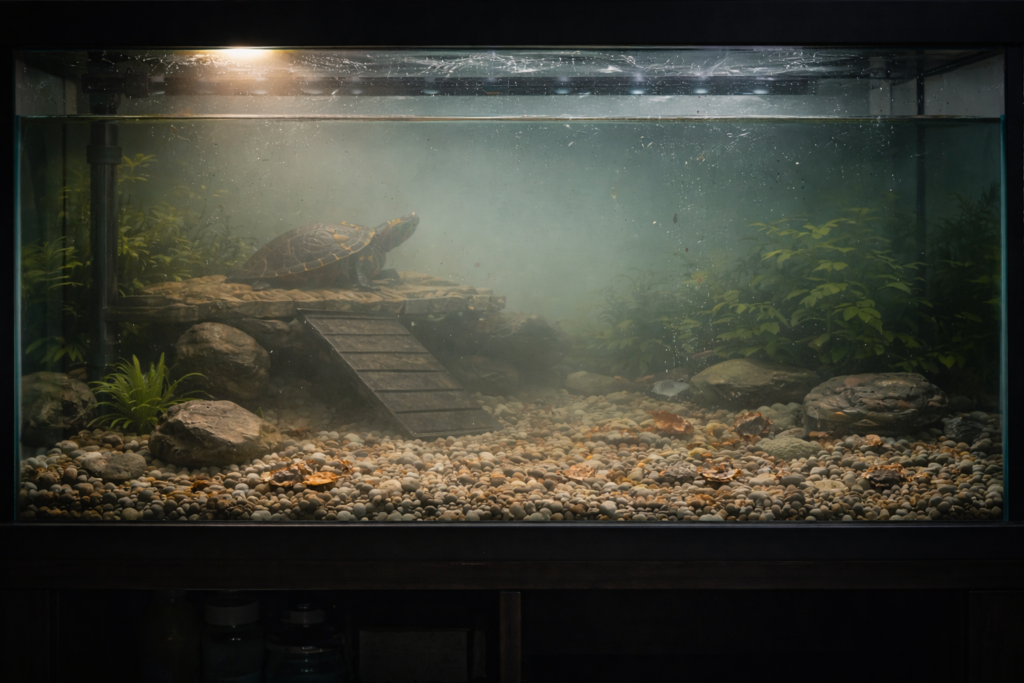
If you’ve ever owned a turtle e.g. a Red Eared Slider, you’ve probably noticed something frustrating.
You clean the tank.
The water looks crystal clear.
Two days later… it’s cloudy again.
So what’s going on?
Why do turtle tanks get dirty so fast compared to fish tanks?
The answer lies in biology, feeding habits, tank size, and most importantly, proper turtle tank filtration. Once you understand what’s actually happening inside the water, the problem becomes much easier to control.
Let’s break it down.
1. Turtles Produce More Waste Than Fish
The biggest reason turtle tanks get dirty quickly is simple:
Turtles are messy.
Unlike fish, turtles are reptiles that eat solid, protein-heavy food. Pellets, insects, shrimp, leafy greens — all of these create debris when turtles bite, tear, and chew.
They don’t nibble neatly. They rip food apart.
Small particles float around the tank and eventually sink, where they begin to decompose.
On top of that, turtles produce large solid waste. Compared to fish of a similar size, turtles generate significantly more bioload.
Bioload refers to the total amount of waste produced in a tank.
Higher bioload means faster ammonia buildup.
And that’s where turtle tank filtration becomes critical.
2. Protein-Heavy Diet = Faster Ammonia Spikes
Turtles eat a lot of protein, especially when young.
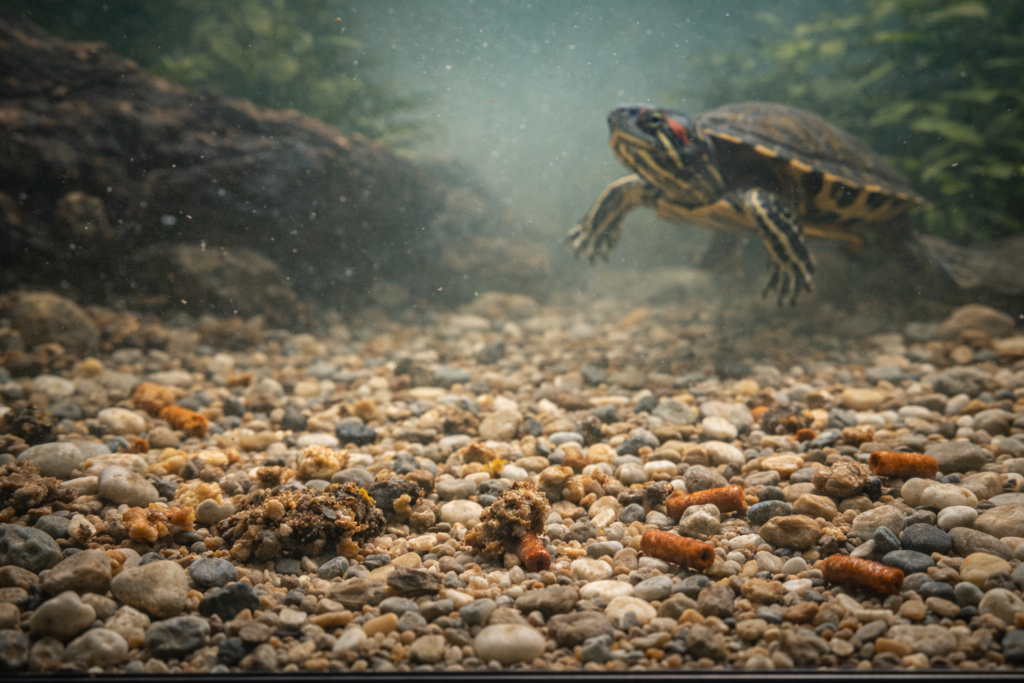
Protein breaks down into ammonia when digested and excreted. Ammonia is highly toxic in aquatic environments. Even small amounts can irritate your turtle’s eyes and skin.
When waste and uneaten food break down in the tank, ammonia levels rise rapidly.
If your filtration system isn’t strong enough to process that waste, you’ll see:
Cloudy water
Strong odor
Bacterial bloom
Algae growth
All within days.
Strong turtle tank filtration helps convert ammonia into safer compounds through the nitrogen cycle. Weak filtration allows ammonia to accumulate.
3. Uneaten Food Sits and Rotts
Another common issue is overfeeding.
Many turtle owners feed more than necessary, especially with hatchlings. Turtles may leave pieces of food behind, and those leftovers sink into corners of the tank.
Once food begins decomposing, it fuels bacteria growth and releases even more ammonia.
If your filter lacks sufficient mechanical filtration (sponges and pads that physically trap debris), those particles continue circulating in the water.
That’s why turtle tank filtration needs both:
Mechanical filtration to remove debris
Biological filtration to process dissolved waste
Without both, the tank gets dirty quickly.
4. Tanks Are Often Too Small
Small tanks get dirty faster.
It’s simple math.
A 20-gallon tank with one turtle has less water volume to dilute waste than a 75-gallon tank with the same turtle.
Many beginners underestimate how large turtles grow and start with undersized tanks. In small tanks:
Ammonia concentrates quickly
Waste accumulates faster
Filters get overwhelmed
Even a decent filter can struggle if the tank volume is too small for the turtle.
This is why experienced keepers often recommend over-sizing both the tank and the filtration system.
5. Inadequate Filter Power
One of the most common mistakes in turtle keeping is using a filter rated for the exact tank size.
For example, using a 40-gallon-rated filter in a 40-gallon turtle tank.
For fish, that might work but for turtles, it usually doesn’t.
Because turtles produce heavier waste loads, most setups require filtration rated for 2 to 3 times the tank size.
If your filter is underpowered, it simply cannot keep up with:
Solid debris
Ammonia conversion
Water circulation
Upgrading turtle tank filtration often immediately improves water clarity and odor control.
6. Poor Biological Filtration
Biological filtration is what stabilizes water chemistry.
Beneficial bacteria live in filter media and convert:
Ammonia → Nitrite → Nitrate
If your filter doesn’t have enough biological media, or if you clean it improperly, the nitrogen cycle struggles.
Common mistakes include:
Rinsing filter media under tap water
Replacing all media at once
Turning the filter off for extended periods
These actions kill beneficial bacteria.
When the bacterial colony crashes, ammonia spikes again, making the tank appear dirty almost overnight.
Proper turtle tank filtration depends on maintaining healthy bacterial colonies.
7. Lack of Water Circulation
Dead spots in the tank allow debris to settle and accumulate.
If water circulation is weak, waste builds up in corners, under decorations, or behind basking platforms.
Strong filtration improves circulation, which keeps particles suspended long enough to be captured by mechanical media.
Better circulation also prevents stagnant zones where bacteria can multiply.
8. Bacterial Bloom After Cleaning
Have you ever done a full water change and then noticed the water turning cloudy within a day?
That’s often a bacterial bloom.
When you replace all the water, you remove much of the beneficial bacteria. The tank then goes through a mini-cycle, causing cloudy water as bacteria rapidly multiply.
Instead of full water changes, partial water changes combined with stable turtle tank filtration create better long-term stability.
9. Algae Growth and Light Exposure
If your tank receives direct sunlight or excessive lighting, algae can grow rapidly.
Algae feeds on nitrates, which are the end product of the nitrogen cycle.
If your filtration system is not strong enough to manage nitrate levels, algae blooms can make the tank appear dirty even when the water is chemically stable.
Balancing lighting, feeding, and filtration prevents this issue.
How Proper Turtle Tank Filtration Solves the Problem
When filtration is correctly sized and maintained, several improvements happen:
Debris gets trapped quickly
Ammonia is converted efficiently
Water circulation increases
Odor is reduced
Maintenance becomes predictable
A properly sized canister filter or high-capacity system dramatically reduces how quickly a turtle tank gets dirty.
Instead of cleaning every few days, you may only need partial water changes every one to two weeks, depending on tank size and turtle growth.
Practical Tips to Keep Your Turtle Tank Cleaner Longer
Here are immediate steps you can take:
Feed your turtle in a separate container if possible
Avoid overfeeding
Choose a filter rated for 2–3 times your tank size
Clean mechanical media regularly
Rinse biological media only in tank water
Perform partial, not full, water changes
Increase tank size as your turtle grows
These adjustments significantly improve water clarity and stability.
Turtle tanks get dirty quickly because turtles are heavy producers of waste in a closed aquatic system.
It’s not because you’re doing something wrong.
It’s because turtles require stronger systems than many beginners realize.
The solution is not constant full water changes.
The solution is proper turtle tank filtration that can handle the bioload.
Once your filtration matches your turtle’s waste production, the difference is immediate.
Clearer water.
Less odor.
Healthier turtle.
Less stress for you.
Understanding why the tank gets dirty is the first step. Upgrading and maintaining your filtration system is what keeps it clean long term.
Understanding the 3 Types of Turtle Tank Filtration (Mechanical, Biological & Chemical)
When people talk about turtle tank filtration, they often focus on the filter itself — canister, hang-on-back, internal, and so on.
But the real secret to clean, healthy water isn’t just the filter type.
It’s understanding the three core forms of filtration happening inside your system:
Mechanical filtration
Biological filtration
Chemical filtration
If even one of these is weak or missing, your tank can quickly become unstable.
In this guide, we’ll break down exactly how each type works, why it matters for turtles specifically, and how to balance them properly.
Why Turtle Tank Filtration Must Be Stronger Than Fish Tanks
Before we dive into the three types, it’s important to understand one thing.
Turtles produce significantly more waste than fish. They eat protein-heavy diets, tear apart food and create large solid waste.
This means turtle tank filtration must handle:
Visible debris
Dissolved toxins
Heavy bioload
That’s why understanding filtration types is critical — especially for turtle keepers.
1. Mechanical Filtration – Removing Physical Waste
Mechanical filtration is the most visible part of turtle tank filtration.
It’s responsible for removing:
Uneaten food
Solid waste
Floating debris
Particles in the water
When your water looks clear, mechanical filtration is doing its job.
How Mechanical Filtration Works
Inside your filter, water passes through sponges, pads, or filter floss.
These materials physically trap debris as water flows through them.
Think of it like a strainer catching food scraps in a sink.
If mechanical filtration is weak:
Water becomes cloudy
Debris floats around the tank
Waste settles in corners
For turtles, strong mechanical filtration is especially important because they generate more solid waste than fish.
Common Mechanical Filtration Mistakes
• Using thin, low-quality sponges
• Not cleaning mechanical media regularly
• Choosing underpowered filters
Mechanical media clogs over time. If it’s not rinsed regularly (in tank water, not tap water), water flow slows down and filtration efficiency drops.
For turtles, mechanical media often needs cleaning more frequently than in fish tanks.
2. Biological Filtration – The Heart of the Nitrogen Cycle
If mechanical filtration keeps water looking clean, biological filtration keeps it chemically safe.
This is the most important part of turtle tank filtration.
What Is Biological Filtration?
Biological filtration refers to beneficial bacteria that grow inside your filter media.
These bacteria process toxic waste through the nitrogen cycle:
Ammonia → Nitrite → Nitrate
Ammonia comes from:
Turtle waste
Uneaten food
Decaying organic matter
Ammonia is highly toxic.
Beneficial bacteria convert ammonia into nitrite, which is also toxic. Then a second type of bacteria converts nitrite into nitrate, which is much less harmful and controlled with partial water changes.
Without strong biological filtration, ammonia spikes quickly — especially in turtle tanks.
Where Do Beneficial Bacteria Live?
They grow on surfaces inside your filter, particularly in:
Ceramic rings
Bio balls
Porous media
Sponges
The more surface area your filter has, the larger the bacterial colony it can support.
That’s one reason canister filters are popular for turtle tank filtration — they hold large amounts of biological media.
How Biological Filtration Gets Destroyed
Many beginners accidentally crash their biological filtration by:
Rinsing media under tap water
Replacing all filter media at once
Doing constant full water changes
Turning off the filter for extended periods
Tap water contains chlorine, which kills beneficial bacteria.
To preserve biological filtration:
Always rinse media in tank water during cleaning.
Stable biological filtration is what makes your tank truly healthy.
3. Chemical Filtration – Optional but Useful
Chemical filtration is the third component of turtle tank filtration.
Unlike mechanical and biological filtration, chemical filtration is not always necessary — but it can be helpful in certain situations.
What Is Chemical Filtration?
Chemical filtration uses specialized media to remove dissolved substances from the water.
Common chemical media include:
Activated carbon
Ammonia-removing resins
Phosphate removers
Activated carbon is the most commonly used chemical media.
It removes:
Odors
Discoloration
Certain dissolved impurities
When Is Chemical Filtration Useful?
Chemical filtration can help when:
You need to remove medication after treatment
The water smells bad
The water appears tinted
You want extra polishing
However, chemical media becomes exhausted over time and must be replaced regularly.
It should never replace mechanical or biological filtration — only support them.
Balancing the Three Types of Turtle Tank Filtration
A strong turtle tank filtration system balances all three types.
Mechanical filtration removes visible waste.
Biological filtration stabilizes water chemistry.
Chemical filtration improves clarity and removes dissolved compounds.
If one is weak, the system struggles.
For turtles, the priority order usually looks like this:
- Biological filtration
- Mechanical filtration
- Chemical filtration
Because turtles produce heavy waste loads, biological capacity is critical.
Why Filter Type Matters
Different filters support these three types differently.
For example:
Internal filters often provide limited biological media.
Hang-on-back filters offer moderate capacity.
Canister filters usually provide the largest media volume.
The more media your system holds, the stronger your turtle tank filtration will be — especially for medium to large tanks.
This is why experienced keepers often recommend oversized filtration.
Signs Your Filtration Balance Is Off
If mechanical filtration is weak:
Water looks cloudy.
If biological filtration is weak:
Ammonia spikes.
Turtle shows stress.
Water smells.
If chemical filtration is exhausted:
Water looks slightly yellow.
Odor returns.
Understanding these signs helps you troubleshoot quickly.
Turtle tank filtration is not just about choosing a powerful filter.
It’s about understanding how mechanical, biological, and chemical filtration work together to create a stable aquatic environment.
Mechanical filtration keeps water visibly clean.
Biological filtration protects your turtle from toxic waste.
Chemical filtration fine-tunes water clarity and odor control.
When all three are balanced properly, your turtle tank becomes easier to maintain, healthier, and far more stable long term.
If you want cleaner water and fewer problems, mastering these three types of turtle tank filtration is one of the most important steps you can take as a turtle owner.
👉Learn more about the optimized turtle filtration systems
Types of Filters for Turtle Tanks (Which One Is Best for Proper Turtle Tank Filtration?)
When setting up an aquarium, many beginners assume any filter will work as long as it matches the tank size.
With fish, that might be true.
With turtles, it’s different.
Because turtles produce significantly more waste, choosing the right filter type is critical for strong and stable turtle tank filtration. The wrong filter leads to cloudy water, odor, ammonia spikes, and constant maintenance.
In this guide, we’ll break down the main types of filters used in turtle tanks, how they work, and which ones are best depending on tank size and turtle species.
Why Filter Type Matters More for Turtles
Before diving into the options, it’s important to understand why turtles demand stronger filtration.
Eat protein-heavy diets
Tear apart food
Produce large solid waste
Create high bioload
That means your filtration system must handle both mechanical waste removal and strong biological filtration.
Some filter types simply cannot keep up — especially in medium to large turtle tanks.
Now let’s look at the most common options.
1. Canister Filters
Canister filters are widely considered the gold standard for turtle tank filtration, especially for tanks above 40 gallons.
How Canister Filters Work
A canister filter sits outside the tank, usually underneath it in the cabinet. Water is pulled from the aquarium through intake tubing, passes through multiple layers of media inside the canister, and then returns to the tank.
Because they are larger units, canister filters can hold significant amounts of:
Mechanical media (sponges and pads)
Biological media (ceramic rings, bio balls)
Chemical media (activated carbon)
Advantages of Canister Filters
Large media capacity
Excellent biological filtration
Strong mechanical waste removal
Quiet operation
Hidden outside the tank
For turtle tank filtration, biological capacity is extremely important. Canister filters provide far more surface area for beneficial bacteria compared to smaller filter types.
Budget Filters for your Turtle Tank:
- Fluval FX6 High Performance Aquarium Filter, Canister Filter for Aquariums up to 400 Gal.
- Fluval 407 Perfomance Canister Filter for Aquariums up to 100 Gallons
- Penn-Plax Cascade All-in-One Aquarium Canister Filter – for Tanks Up to 100 Gallons (265 GPH) – Cascade 1000
- SunSun Canister Filters (Budget-Friendly)303B
Disadvantages of Canister Filters
Higher upfront cost
More complex to set up
Heavier maintenance when cleaning
However, for medium to large turtle tanks, the benefits typically outweigh the drawbacks.
2. Hang-On-Back (HOB) Filters
Hang-on-back filters are one of the most common aquarium filters on the market.
They hang on the rim of the tank and pull water up through a cartridge system before returning it via a waterfall-style output.
Advantages of HOB Filters
Affordable
Easy to install
Easy to maintain
Good for small tanks
For small turtle tanks or hatchlings, HOB filters can sometimes provide adequate turtle tank filtration — if sized properly.
Limitations of HOB Filters for Turtles
Limited biological media space
Often use disposable cartridges
May struggle with heavy bioload
Can become noisy over time
Because turtles produce more waste than fish, many standard HOB filters quickly become overwhelmed in tanks larger than 30–40 gallons.
Some upgraded HOB models with larger media baskets can perform better, but they still generally cannot match the capacity of a canister filter.
3. Internal Filters
Internal filters sit directly inside the tank and are fully submerged.
They typically combine a small pump with sponge or cartridge-based media.
Advantages of Internal Filters
Low cost
Compact design
Simple installation
Suitable for temporary setups
For very small tanks or quarantine tanks, internal filters can provide basic turtle tank filtration.
Limitations of Internal Filters
Limited media capacity
Visible inside the tank
Often weak biological filtration
Easily overwhelmed in larger setups
Because turtles create heavy waste loads, internal filters are usually not recommended for long-term primary filtration in standard turtle aquariums.
They are best used for:
Small hatchling tanks
Temporary enclosures
Hospital tanks
4. Sponge Filters
Sponge filters use air pumps to pull water through a porous sponge where mechanical and biological filtration occur.
They are common in fish breeding tanks.
Can Sponge Filters Work for Turtles?
In most cases, no — at least not as the sole filtration system.
Sponge filters provide excellent biological filtration but very limited mechanical waste removal. Since turtles produce visible solid waste, sponge filters alone are typically insufficient for proper turtle tank filtration.
However, they can be used as supplemental biological support alongside stronger primary filters.
5. Sump Filtration Systems
Sump systems are advanced filtration setups usually found in large aquariums.
Water flows from the tank into a separate sump chamber (often below the tank), where multiple filtration stages occur before being pumped back up.
When Are Sumps Useful?
Large custom turtle tanks
75+ gallon setups
High-end builds
Sumps provide massive biological and mechanical filtration capacity and are highly customizable.
However, they require more technical knowledge and space.
For most home turtle keepers, canister filters are the more practical solution.
Choosing the Right Filter for Your Turtle Tank
The best filter type depends primarily on tank size and turtle size.
For tanks under 30 gallons a high-capacity HOB or strong internal filter may work temporarily. For tanks 40–75 gallons
A quality canister filter is strongly recommended and for tanks over 75 gallons large canister filters or sump systems are ideal.
Regardless of filter type, remember this key rule:
Choose a filter rated for at least 2 to 3 times your tank size.
This ensures your turtle tank filtration can handle the heavy bioload.
Why Canister Filters Are Often Recommended
When you compare all filter types side by side, canister filters usually provide:
The highest biological capacity
The strongest mechanical filtration
The best long-term stability
Because turtles create such heavy waste loads, most experienced keepers eventually upgrade to canister filtration — even if they start with something smaller.
It reduces maintenance frequency, improves water clarity, and stabilizes the nitrogen cycle more effectively.
Recommended Filters for your Turtle Tank:
- Fluval FX6 High Performance Aquarium Filter, Canister Filter for Aquariums up to 400 Gal.
- Fluval 407 Perfomance Canister Filter for Aquariums up to 100 Gallons
- Penn-Plax Cascade All-in-One Aquarium Canister Filter – for Tanks Up to 100 Gallons (265 GPH) – Cascade 1000
- SunSun Canister Filters (Budget-Friendly)303B
Common Filter Selection Mistakes
Buying a filter rated exactly for tank size
Underestimating turtle growth
Choosing the cheapest option available
Ignoring bio-logical media capacity
Replacing cartridges too frequently
Avoiding these mistakes significantly improves turtle tank filtration performance.
There are several types of filters available for turtle tanks, but not all of them are equally effective.
Turtles require stronger filtration than fish because of their high waste production and protein-heavy diet.
For small or temporary setups, HOB or internal filters may work.
For medium to large tanks, canister filters provide the most reliable and powerful turtle tank filtration.
Choosing the right filter type from the beginning saves you time, money, and frustration — and most importantly, creates a healthier environment for your turtle.
Canister Filters
Canister Filters for Turtle Tanks (Are They the Best for Turtle Tank Filtration?)
If you’ve spent any time researching turtle tank filtration, you’ve probably noticed one thing:
Most experienced turtle keepers recommend canister filters.
But why?
Are they really better than hang-on-back or internal filters? Or are they just more expensive?
The truth is, when it comes to managing heavy waste loads and maintaining stable water conditions, canister filters are often the most effective solution for medium to large turtle tanks.
Let’s break down exactly why.
What Is a Canister Filter?
A canister filter is an external filtration unit that sits outside the aquarium, usually underneath the tank.
Water is pulled from the aquarium through an intake tube, flows through multiple layers of filter media inside the canister, and then is returned to the tank through an output tube.
Unlike smaller filters, canister systems are sealed units that hold a large amount of media. This is one of the biggest advantages for turtle tank filtration.
Why Turtles Need Stronger Filtration
Before understanding why canister filters work so well, it’s important to understand the problem they solve.
Turtles:
Produce large solid waste
Eat protein-heavy foods
Create high ammonia levels
Have heavy bioload compared to fish
Because of this, turtle tank filtration must be powerful enough to handle:
Mechanical debris removal
Biological ammonia conversion
Consistent water circulation
Many smaller filters simply cannot keep up.
The Three Filtration Stages Inside a Canister Filter
One reason canister filters excel at turtle tank filtration is that they support all three types of filtration effectively.
1. Mechanical Filtration
Water first passes through coarse and fine sponges that trap debris and solid waste.
Since turtles create visible waste, strong mechanical filtration is critical. Canister filters usually include multiple sponge layers, increasing debris capture.
2. Biological Filtration
After debris is removed, water flows through biological media such as ceramic rings or bio balls.
These materials provide large surface areas for beneficial bacteria to colonize.
Beneficial bacteria convert:
Ammonia → Nitrite → Nitrate
Because canister filters hold large volumes of media, they support stronger biological filtration compared to many HOB or internal filters.
This is especially important for maintaining stable turtle tank filtration in larger tanks.
3. Chemical Filtration (Optional)
Many canister filters also allow space for activated carbon or other chemical media.
While not always necessary, chemical filtration can help remove odors or discoloration.
The key advantage is flexibility — you can customize media based on your tank’s needs.
Advantages of Canister Filters for Turtle Tank Filtration
Here are the main reasons turtle keepers prefer canister filters:
Large Media Capacity
More media means stronger biological filtration. For turtles, this is extremely important due to heavy waste production.
Strong Water Flow
Canister filters typically have higher flow rates, which improves:
Water circulation
Debris suspension
Oxygenation
Waste capture
Proper circulation prevents dead spots where waste can accumulate.
Less Visible Equipment
Because the filter sits outside the tank, only the intake and output tubes are visible. This keeps the aquarium looking cleaner and less cluttered.
Quieter Operation
High-quality canister filters operate quietly compared to many HOB filters that create waterfall noise.
Better Long-Term Stability
When properly sized, canister filters provide stable turtle tank filtration that reduces frequent water changes and emergency cleanings.
Disadvantages to Consider
While canister filters are powerful, they do have downsides.
Higher Initial Cost
They are more expensive upfront compared to HOB or internal filters.
However, many turtle keepers find they save money long term by reducing maintenance issues.
More Complex Setup
Priming hoses and assembling media baskets can be intimidating for beginners.
But once installed, maintenance becomes routine.
Heavier Maintenance Sessions
Because they hold more media, cleaning canister filters can take longer. However, cleaning is usually needed less frequently than smaller filters.
What Tank Size Requires a Canister Filter?
As a general rule:
Tanks 40 gallons and above benefit greatly from canister filtration.
For tanks under 30 gallons, a strong HOB filter may work temporarily. But as turtles grow, upgrading becomes necessary.
Remember the golden rule of turtle tank filtration:
Choose a filter rated for at least 2 to 3 times your tank size.
For example:
A 40-gallon turtle tank should ideally use a filter rated for 80 to 120 gallons.
This ensures the filter can handle the heavy bioload.
Are Canister Filters Too Strong for Turtles?
Some beginners worry that strong filters may create excessive water flow.
Flow strength and filtration capacity are not the same thing.
If the current appears too strong, you can:
Adjust the output direction
Use a spray bar
Add decorations to break flow
It is generally better to have strong biological filtration and adjust flow than to under-filter the tank.
How Often Should You Clean a Canister Filter?
Cleaning frequency depends on tank size, turtle size, and feeding habits.
Typically:
Mechanical media may need rinsing every 2–4 weeks.
Biological media should only be rinsed gently in tank water when necessary.
Never rinse biological media in tap water, as chlorine kills beneficial bacteria and weakens turtle tank filtration.
Signs You Need to Upgrade to a Canister Filter
Water becomes cloudy quickly
Strong odor persists
Frequent ammonia spikes
Filter struggles to keep up with debris
You perform constant full water changes
These signs indicate your current system may be underpowered.
Upgrading to a properly sized canister filter often dramatically improves water clarity and stability.
When it comes to reliable, long-term turtle tank filtration, canister filters are often the best solution for medium to large tanks.
They offer:
Strong mechanical filtration
Large biological media capacity
Customizable filtration stages
Improved water circulation
Greater long-term stability
While they require a higher upfront investment and more complex setup, they provide powerful performance that matches the heavy waste production of turtles.
If you’re serious about maintaining clear water, reducing ammonia spikes, and creating a healthier aquatic environment, a properly sized canister filter is one of the best upgrades you can make.
We have listed down all the best Canister filters for turtle tanks below.
Hang-On-Back Filters for Turtles (Are They Enough for Proper Turtle Tank Filtration?)
If you’re setting up a turtle tank for the first time, a hang-on-back filter is probably one of the first options you’ll see.
They’re affordable, easy to install and they’re widely available.
But here’s the real question:
Are hang-on-back filters actually strong enough for proper turtle tank filtration?
The answer depends on your tank size, turtle size, and expectations.
Let’s break it down clearly so you can decide whether a HOB filter is the right choice for your setup.
What Is a Hang-On-Back (HOB) Filter?
A hang-on-back filter, often called a HOB filter, is a filtration unit that hangs on the rim of your aquarium.
It works by:
Pulling water up through an intake tube
Passing it through filter media
Returning the water via a small waterfall-style outlet
Because they sit outside the tank (but not underneath like canister filters), they are compact and beginner-friendly.
For many fish tanks, HOB filters are more than enough.
For turtle tank filtration, it’s a bit more complicated.
Why Turtles Challenge HOB Filters
Turtles produce significantly more waste than fish.
They:
Eat protein-heavy diets
Tear food apart
Create solid waste
Generate high ammonia levels
This creates what’s called a heavy bioload.
Bioload refers to how much waste your tank produces relative to water volume.
Since HOB filters typically have limited media capacity, they can struggle in tanks with heavy bioload — especially as turtles grow.
That’s why tank size becomes critical when choosing this filter type.
How Hang-On-Back Filters Handle Turtle Tank Filtration
Like all filters, HOB systems attempt to provide three types of filtration:
Mechanical
Biological
Chemical
Let’s examine how well they perform in each category.
Mechanical Filtration in HOB Filters
HOB filters are generally decent at mechanical filtration.
They use cartridges or sponges to trap debris and visible waste.
For small turtles or lightly stocked tanks, this can work reasonably well.
However, because turtles produce larger solid waste, cartridges can clog quickly. Once clogged, water flow decreases and filtration efficiency drops.
Frequent maintenance becomes necessary.
Biological Filtration in HOB Filters
This is where most HOB filters struggle with turtle tank filtration.
Many basic HOB models use disposable cartridges that contain limited biological media.
That means there is less surface area for beneficial bacteria to colonize.
Without strong biological filtration, ammonia and nitrite spikes become more likely — especially in tanks above 30–40 gallons.
Some higher-end HOB filters offer larger media baskets where you can add ceramic rings or additional biological media. These perform significantly better than entry-level cartridge-only models.
Chemical Filtration in HOB Filters
Many HOB filters include activated carbon in their cartridges.
Carbon helps remove odor and discoloration, but it does not replace mechanical or biological filtration.
Carbon also becomes exhausted over time and must be replaced.
While useful, chemical filtration should never be relied on as the primary defense in turtle tank filtration.
When HOB Filters Can Work for Turtles
There are situations where hang-on-back filters are acceptable.
Small Hatchling Tanks
In tanks under 20–30 gallons with baby turtles, a strong HOB filter rated for double the tank size may work temporarily.
However, turtles grow quickly, and filtration needs increase rapidly.
Budget-Conscious Setups
If you are starting on a tight budget, a high-capacity HOB filter can serve as an entry point. Just make sure:
It is rated for at least 2–3 times the tank size.
You avoid disposable-only cartridge systems if possible.
You monitor ammonia levels regularly.
Supplemental Filtration
Some turtle keepers use a HOB filter alongside a canister filter to increase mechanical removal and circulation.
In this case, the HOB acts as a support system rather than the primary filtration unit.
When HOB Filters Are Not Enough
For tanks 40 gallons and above, most standard HOB filters struggle to keep up.
Signs your HOB filter may be underpowered include:
Water becomes cloudy within days
Strong odor develops
Frequent ammonia spikes
Constant need for full water changes
Filter flow weakens quickly
These are common indicators that turtle tank filtration capacity is insufficient.
Upgrading to a canister filter often solves these issues immediately.
Common Mistakes with HOB Filters
Choosing a filter rated exactly for tank size
Relying solely on disposable cartridges
Not cleaning clogged mechanical media
Underestimating turtle growth
Overfeeding
Because turtles are messy, underpowered HOB systems get overwhelmed quickly.
If you decide to use a HOB filter, oversizing is critical.
For example:
For a 40-gallon turtle tank, consider a HOB filter rated for at least 75–100 gallons.
Even then, performance may decline as your turtle grows larger.
Advantages of Hang-On-Back Filters
Despite their limitations, HOB filters do have advantages.
Affordable
Easy to install
Simple maintenance
Compact design
Good for beginners
They are far less intimidating than canister filters and do not require hoses or cabinet space.
For new turtle owners, this simplicity can be appealing.
Disadvantages for Turtle Tank Filtration
Limited biological media capacity
Cartridge dependency in many models
Frequent clogging with turtle waste
Less powerful than canister systems
May struggle in medium to large tanks
Because turtles create heavy waste loads, biological capacity is often the limiting factor.
Should You Choose a HOB Filter for Your Turtle?
If you have:
A small hatchling tank
A temporary enclosure
A quarantine setup
A tight budget
A strong, oversized HOB filter can work.
If you have:
A 40+ gallon tank
A growing juvenile turtle
A large adult turtle
Persistent water quality issues
A canister filter is generally a better long-term solution for stable turtle tank filtration.
Hang-on-back filters are not useless for turtle tanks — but they are often underestimated and underpowered for long-term turtle care.
For small setups, they can work when properly sized.
For medium to large tanks, their limited biological capacity often leads to water clarity and ammonia issues.
Proper turtle tank filtration requires matching filter capacity to turtle waste production.
If your goal is long-term stability, fewer water changes, and better water quality, upgrading beyond basic HOB systems is often necessary as your turtle grows.
Choosing the right filtration system early can save you time, stress, and repeated upgrades later.
What Size Filter Does a Turtle Tank Need?
One of the biggest mistakes new turtle owners make is choosing a filter rated exactly for their tank size.
For fish, that might work.
For turtles, it usually doesn’t.
Because turtles produce significantly more waste, proper turtle tank filtration requires stronger capacity than most beginners expect.
The Golden Rule: 2–3 Times Tank Size
When selecting a filter for a turtle tank, you should choose one rated for at least 2 to 3 times your tank’s actual water volume.
Here’s what that means in practice:
If you have a 40-gallon turtle tank → choose a filter rated for 80–120 gallons.
If you have a 75-gallon tank → choose a filter rated for 150+ gallons.
Why?
Turtles create heavy bioload. They produce large solid waste and release significant ammonia due to their protein-rich diet. A filter rated only for your tank size will likely struggle to keep up.
Oversizing your filter improves mechanical waste removal and increases biological media capacity — both essential for stable turtle tank filtration.
Understanding GPH (Gallons Per Hour)
Another factor to consider is GPH, or gallons per hour.
GPH measures how much water the filter moves per hour. For turtles, aim for a turnover rate of at least 4–6 times the tank volume per hour.
For example:
40-gallon tank → look for 200–300+ GPH
75-gallon tank → look for 400–500+ GPH
Keep in mind that real-world flow rates are often lower once media becomes slightly dirty. That’s another reason oversizing helps.
Does a Stronger Filter Stress Turtles?
Many beginners worry that a powerful filter will create too much current.
In most cases, this is manageable.
You can:
Use a spray bar
Aim the output toward the glass
Add decorations to break flow
It’s usually better to have strong biological filtration and adjust water movement than to under-filter the tank.
Tank Size and Turtle Growth
Another key consideration is growth.
Baby turtles grow quickly. A filter that works for a hatchling may become underpowered within months.
Choosing a larger filter from the start prevents constant upgrades and improves long-term turtle tank filtration stability.
If you remember one thing, let it be this:
Never match your filter to your tank size — oversize it.
Strong turtle tank filtration depends on mechanical capacity, biological surface area, and adequate water turnover.
Choosing a filter rated for 2–3 times your tank volume creates cleaner water, fewer ammonia spikes, and a healthier environment for your turtle long term.
Can You Overfilter a Turtle Tank?
If you’ve been researching turtle tank filtration, you’ve probably seen the advice to “oversize your filter.”
But that naturally leads to another question:
Can you overfilter a turtle tank?
The short answer is: in most cases, no — you can’t truly overfilter in terms of biological capacity. But you can create too much water flow if you’re not careful.
Let’s break down the difference.
Filtration Capacity vs Water Flow
When people worry about overfiltering, they usually confuse two things:
Filtration strength (biological capacity)
Water current (flow force)
These are not the same.
A larger filter increases biological media capacity, which means more surface area for beneficial bacteria. More bacteria equals better ammonia and nitrite control.
For turtle tank filtration, higher biological capacity is almost always beneficial because turtles produce heavy waste.
You cannot “over-biologically filter” a turtle tank. More beneficial bacteria simply create a more stable system.
When Can Flow Become a Problem?
While biological overfiltration isn’t an issue, excessive current can stress your turtle if:
The water movement is extremely strong
Your turtle struggles to swim
The turtle avoids certain areas of the tank
This is more common in small tanks using very powerful pumps.
However, flow problems are usually easy to fix.
How to Reduce Strong Current
If your filter feels too strong, you can:
Use a spray bar to distribute output evenly
Aim the output toward the glass wall
Position decorations or driftwood to break up flow
Lower the water return height
These adjustments allow you to maintain strong turtle tank filtration without creating a stressful swimming environment.
Why Oversizing Is Usually Safer
Underfiltration causes:
Ammonia spikes
Cloudy water
Strong odor
Frequent maintenance
Oversizing your filter improves:
Biological stability
Mechanical waste removal
Long-term water clarity
For turtles, stronger filtration is typically safer than weaker filtration.
You generally cannot overfilter a turtle tank in terms of biological capacity. More filtration means more stability.
The only real concern is excessive water flow — and that can easily be adjusted without reducing filtration strength.
When it comes to turtle tank filtration, it’s far better to slightly oversize your system than to risk underpowered equipment struggling to keep up with your turtle’s waste production.
Best Filter Based on Tank Size
Choosing the right filter isn’t just about brand — it’s about matching filtration power to tank volume and turtle size.
Because turtles produce heavy waste, proper turtle tank filtration requires stronger capacity than a typical fish tank of the same size.
Here’s a simple breakdown to help you choose the right filter based on tank size.
20–30 Gallon Turtle Tanks
This size is common for hatchlings or temporary setups.
For tanks in this range:
Choose a filter rated for at least 40–75 gallons.
Aim for 150–250+ GPH flow rate.
A high-capacity hang-on-back filter may work short term, but as your turtle grows, waste production increases quickly. Oversizing early prevents constant upgrades.
If possible, a small canister filter is a more stable long-term solution.
40–55 Gallon Turtle Tanks
This is where filtration becomes more serious.
For tanks in this range:
Choose a filter rated for 80–150 gallons.
Aim for 300–450+ GPH.
At this size, many basic HOB filters begin to struggle with turtle waste. A quality canister filter is strongly recommended for stable turtle tank filtration.
This size range is common for juvenile turtles, and bioload increases rapidly.
75 Gallon Turtle Tanks
For 75-gallon setups:
Choose a filter rated for 150–200+ gallons.
Aim for 400–600+ GPH.
At this level, canister filters are typically the best choice. Large biological media capacity is critical for processing ammonia effectively.
Some keepers even run dual filtration systems for added stability.
100+ Gallon Turtle Tanks
Large adult turtles often require tanks over 100 gallons.
For these setups:
Choose filters rated for 200+ gallons.
Consider high-capacity canister filters or sump systems.
Strong mechanical and biological filtration becomes essential to prevent ammonia spikes and excessive maintenance.
The Golden Rule
No matter the tank size:
Choose a filter rated for 2–3 times your tank volume.
This ensures your turtle tank filtration can handle heavy bioload and reduces frequent water changes.
Remember, turtles grow quickly. Buying slightly oversized filtration now saves money and frustration later.
Best Filter for 20–40 Gallon Turtle Tank (Top Picks for Proper Turtle Tank Filtration)
If you’re keeping a turtle in a 20–40 gallon tank — especially a hatchling or juvenile — choosing the right filter makes a huge difference in water quality, odor control, and overall health.
Because turtles produce heavy waste, turtle tank filtration needs to be stronger than just “tank size rated” — especially in this volume.
This guide walks you through the best filter options for this specific range and how to pick the right one.
Why This Tank Size Is Special
20–40 gallon tanks are common for:
• Baby turtles
• Temporary setups
• Growth transition tanks
These tanks still generate heavy waste relative to water volume. That means:
✔ Clear water
✔ Stable ammonia levels
✔ Less frequent cleaning
Requires filtration that’s powerful enough and gentle for smaller turtles.
What to Look for in Turtle Tank Filtration (20–40 Gallon)
Here’s a quick checklist:
Filter Power
• Rated for at least 60–75 gallons
• Turnover of ~200–300+ GPH
→ This helps keep ammonia and debris under control
Biological Capacity
• Large media volume for beneficial bacteria
• Supports nitrogen cycle
Mechanical Strength
• Can catch solid waste quickly
• Helps prevent frequent clogging
Ease of Cleaning
• Sponge or easily accessible media
• Gentle bacteria maintenance
🥇 Best Filter Types for 20–40 Gallon Turtle Tanks
✅ 1. Small Canister Filters (Top Choice)
Canister filters are often the best long-term solution for this size range.
Why they work well:
• More media volume → stronger biological filtration
• Better mechanical waste capture
• Customizable media baskets (sponges, ceramics, carbon)
When to choose a canister:
• You want long-term stability
• Your turtle will grow quickly
• You want fewer water changes
Even a small canister rated for 75–100 gallons will outperform a basic HOB in this range.
👍 2. High-Capacity Hang-On-Back (HOB) Filters
HOB filters can work well — if they’re oversized — and sized correctly for turtles.
When using a HOB for 20–40 gallon tanks, make sure it is:
• Rated for 60–90+ gallons
• Has space for adding ceramic or sponge media
• Easy to access for frequent cleaning
HOB filters are easier to install and maintain, but they have:
⚠ Limited biological media
⚠ Can clog faster with turtle waste
Still, for small tanks or transitional growth setups, a quality oversized HOB is a solid choice.
🔁 3. Supplemental Sponge Filters (Optional)
Sponge filters alone are usually not enough as primary filtration.
However, when paired with a canister or HOB, they:
✔ Increase biological capacity
✔ Improve water clarity
✔ Support stable ammonia control
Used together, sponge filters strengthen your overall turtle tank filtration system.
Quick Picks by Scenario
Long-Term (Strongest Overall): → Canister rated 75–100+ gallons
Budget / Beginner Option: → HOB rated 60–90+ gallons with added media
Supplemental Boost: → Sponge filter + primary canister or HOB
For a 20–40 gallon turtle tank, the key to success is not just “right size” — it’s oversizing and biological capacity.
Turtles generate heavy waste. That means:
✔ More media surface area
✔ Better mechanical removal
✔ Higher turnover
Oversized filtration means fewer ammonia spikes, less cloudy water, and a healthier turtle.
Proper turtle tank filtration isn’t optional — it’s one of the most important parts of your setup.
Best Filter for 40–75 Gallon Turtle Tank (Serious Turtle Tank Filtration Guide)
Once your turtle reaches adulthood, a 75+ gallon tank is often the minimum recommended size. At this level, filtration is no longer just about clarity — it’s about stability and waste management at scale.
Large turtles produce serious waste. That means turtle tank filtration must be powerful, consistent, and biologically robust.
This is where heavy-duty systems become essential.
Why 75+ Gallon Tanks Need Stronger Filtration
In large tanks:
• Turtles are fully grown
• Feeding volume increases
• Waste output is high
• Ammonia production rises significantly
Although there is more water volume to dilute waste, adult turtles generate enough bioload to overwhelm standard filters quickly.
Matching tank size alone is not enough.
The Filtration Rule for 75+ Gallons
For tanks 75 gallons and above:
✔ Choose filters rated for 150–250+ gallons
✔ Aim for 500–800+ GPH turnover
✔ Prioritize large biological media capacity
Oversizing is not optional here — it’s necessary for stable turtle tank filtration.
For a breakdown and detailed guidelines, check our complete guide on Best Filter for 75 Gallon Turtle Tank (2026)
🥇 Best Option: High-Capacity Canister Filters
For most 75+ gallon setups, large canister filters are the most practical solution.
They provide:
• Massive biological media space
• Strong mechanical debris capture
• Excellent long-term stability
• Adjustable flow options
Some keepers run a single large canister rated well above tank size. Others prefer running two medium-to-large canisters for redundancy and added stability.
Dual filtration reduces risk if one system needs maintenance.
🥈 Advanced Option: Sump Systems
For very large or custom turtle tanks (100+ gallons), sump filtration is another powerful option.
Sumps offer:
• Huge media capacity
• Customizable filtration stages
• Strong water circulation
• Easy media access
However, they require more space, plumbing, and setup knowledge.
For most home turtle keepers, oversized canister filters remain the most practical and effective solution.
Signs Your Filtration Is Underpowered
In large tanks, underfiltration shows up as:
• Persistent odor
• Cloudy water returning quickly
• Elevated ammonia or nitrite
• Excess debris accumulation
• Frequent deep cleanings
Upgrading biological capacity usually solves these issues quickly.
For 75+ gallon turtle tanks, filtration must scale with turtle size and waste production.
Strong turtle tank filtration at this level means:
✔ Oversized capacity
✔ High GPH turnover
✔ Large biological media volume
✔ Reliable long-term performance
Investing in powerful filtration now protects your turtle’s health and dramatically reduces maintenance headaches.
When dealing with adult turtles, stronger is almost always better.
Best Filter for 75+ Gallon Turtle Tanks (Heavy-Duty Turtle Tank Filtration Guide)
Once your turtle reaches adulthood, a 75+ gallon tank is often the minimum recommended size. At this level, filtration is no longer just about clarity — it’s about stability and waste management at scale.
Large turtles produce serious waste. That means turtle tank filtration must be powerful, consistent, and biologically robust.
This is where heavy-duty systems become essential.
Why 75+ Gallon Tanks Need Stronger Filtration
In large tanks:
• Turtles are fully grown
• Feeding volume increases
• Waste output is high
• Ammonia production rises significantly
Although there is more water volume to dilute waste, adult turtles generate enough bioload to overwhelm standard filters quickly.
Matching tank size alone is not enough.
The Filtration Rule for 75+ Gallons
For tanks 75 gallons and above:
✔ Choose filters rated for 150–250+ gallons
✔ Aim for 500–800+ GPH turnover
✔ Prioritize large biological media capacity
Oversizing is not optional here — it’s necessary for stable turtle tank filtration.
🥇 Best Option: High-Capacity Canister Filters
For most 75+ gallon setups, large canister filters are the most practical solution.
They provide:
• Massive biological media space
• Strong mechanical debris capture
• Excellent long-term stability
• Adjustable flow options
Some keepers run a single large canister rated well above tank size. Others prefer running two medium-to-large canisters for redundancy and added stability.
Dual filtration reduces risk if one system needs maintenance.
🥈 Advanced Option: Sump Systems
For very large or custom turtle tanks (100+ gallons), sump filtration is another powerful option.
Sumps offer:
• Huge media capacity
• Customizable filtration stages
• Strong water circulation
• Easy media access
However, they require more space, plumbing, and setup knowledge.
For most home turtle keepers, oversized canister filters remain the most practical and effective solution.
Signs Your Filtration Is Underpowered
In large tanks, underfiltration shows up as:
• Persistent odor
• Cloudy water returning quickly
• Elevated ammonia or nitrite
• Excess debris accumulation
• Frequent deep cleanings
Upgrading biological capacity usually solves these issues quickly.
For 75+ gallon turtle tanks, filtration must scale with turtle size and waste production.
Strong turtle tank filtration at this level means:
✔ Oversized capacity
✔ High GPH turnover
✔ Large biological media volume
✔ Reliable long-term performance
Investing in powerful filtration now protects your turtle’s health and dramatically reduces maintenance headaches.
When dealing with adult turtles, stronger is almost always better.
Best Filter for Baby Turtle Tanks (Safe & Effective Turtle Tank Filtration for Hatchlings)
Baby turtles may be small, but they are just as messy as adults — sometimes even more relative to their tank size.
Because hatchlings are usually kept in smaller tanks, waste builds up quickly. That makes proper turtle tank filtration extremely important from the very beginning.
The key is balancing strong biological filtration with gentle water flow.
Why Baby Turtles Still Need Strong Filtration
Many beginners assume small turtles produce small waste.
In reality:
• Hatchlings eat protein-heavy diets
• They shred food
• They grow quickly
• Ammonia builds up fast in small tanks
Since baby turtles are often kept in 10–30 gallon tanks, water volume is limited. That means toxins concentrate faster.
Strong biological filtration is critical — even at this stage.
What to Look for in a Baby Turtle Filter
When choosing filtration for hatchlings, focus on:
✔ Filter rated for 2–3 times tank size
✔ Gentle adjustable flow
✔ Strong biological media capacity
✔ Easy maintenance access
Oversizing is still important, but flow control becomes equally important.
🥇 Best Option: Small Canister Filters
For long-term stability, a small canister filter rated for 60–100 gallons works extremely well for baby turtle tanks.
Benefits include:
• Strong biological filtration
• Customizable media
• Better waste processing
• Reduced ammonia spikes
If the flow seems strong, use a spray bar or direct output toward the tank wall to soften the current.
This provides powerful turtle tank filtration without stressing the hatchling.
👍 Good Alternative: Oversized HOB Filter
A high-capacity hang-on-back filter can also work in small hatchling tanks — if properly sized.
Choose a HOB rated well above tank size and avoid small cartridge-only systems with minimal biological media.
However, as the turtle grows, you may need to upgrade sooner than expected.
⚠ What to Avoid
• Tiny internal filters with limited media
• Filters rated exactly for tank size
• Systems with no adjustable flow
• Skipping filtration entirely
Even baby turtles require stable biological filtration to prevent ammonia spikes.
The best filter for baby turtle tanks is one that prioritizes biological stability while maintaining gentle water movement.
Strong turtle tank filtration at the hatchling stage:
✔ Prevents ammonia buildup
✔ Supports healthy growth
✔ Reduces disease risk
✔ Makes maintenance easier
Starting with slightly oversized, high-quality filtration prevents early water quality issues and saves you from constant upgrades as your turtle grows.
Best Budget Turtle Tank Filter Options (Affordable Turtle Tank Filtration That Actually Works)
Setting up a turtle tank can get expensive quickly. Between the tank, basking dock, UVB lighting, and heater, filtration is often where beginners try to save money.
The problem?
Turtles produce heavy waste. Weak filtration leads to cloudy water, odor, and constant maintenance.
The goal isn’t the cheapest filter — it’s the best value for reliable turtle tank filtration.
Here’s how to approach budget-friendly options without sacrificing water quality.
What “Budget” Should Really Mean
A good budget filter should:
✔ Be rated for 2–3 times your tank size
✔ Provide solid biological media capacity
✔ Offer strong mechanical debris removal
✔ Be reliable long term
Avoid ultra-cheap filters rated exactly for your tank size. They often struggle with turtle waste and end up costing more in replacements and frustration.
🥇 Best Budget Long-Term Option: Entry-Level Canister Filters
If you’re serious about stable turtle tank filtration but working within a budget, entry-level canister filters are often the smartest investment.
Why?
• Larger biological media capacity
• Better mechanical waste removal
• Fewer water changes
• Longer lifespan
They may cost more upfront than small HOB filters, but they reduce long-term maintenance and ammonia problems.
If you want to see the most reliable options that balance performance and affordability, I’ve broken them down here:
Choosing the right model the first time prevents repeated upgrades.
👍 Budget Alternative: Oversized HOB Filters
For smaller tanks (20–30 gallons), a high-capacity hang-on-back filter can work if:
• It’s rated well above tank size
• You add extra sponge or ceramic media
• You’re prepared for more frequent cleaning
However, as turtles grow, these systems often become underpowered.
If your tank is 40 gallons or larger, skipping straight to a canister filter usually saves money long term.
⚠ What to Avoid
• Tiny internal filters with minimal media
• Cartridge-only systems with no upgrade options
• Filters rated exactly for tank size
• Extremely low GPH ratings
Underpowered systems lead to cloudy water, ammonia spikes, and constant stress.
Smart Budget Strategy
If your budget is tight:
- Oversize your filter from the start
- Prioritize biological capacity
- Avoid replacing disposable cartridges frequently
- Think long term, not short term
In most cases, investing once in a reliable canister filter is more affordable than upgrading multiple times.
If you’re comparing models and want a detailed breakdown of the most cost-effective options for different tank sizes, you can check them here:
Budget turtle tank filtration isn’t about spending the least — it’s about spending wisely.
Turtles create heavy waste, and stable filtration protects their health while reducing your maintenance workload.
Choose value, not just price.
A properly sized, well-chosen filter makes your tank cleaner, healthier, and far easier to manage long term.
How Often Should You Clean a Turtle Filter?
One of the most common mistakes turtle owners make is either cleaning their filter too often — or not often enough.
Proper turtle tank filtration depends not just on having a powerful filter, but maintaining it correctly. Clean it too aggressively, and you kill beneficial bacteria. Ignore it, and it clogs, reducing performance.
So what’s the right balance?
General Cleaning Schedule
For most turtle tanks:
Mechanical media (sponges, pads):
Every 2–4 weeks
Biological media (ceramic rings, bio balls):
Only when flow is reduced — usually every 2–3 months
Full canister cleaning:
Every 1–3 months depending on bioload
Turtles produce heavy waste, so mechanical media tends to clog faster than in fish tanks.
If your water flow weakens or debris builds up quickly, it’s time for maintenance.
The Most Important Rule
Never rinse biological media under tap water.
Tap water contains chlorine and chloramine, which kill beneficial bacteria. These bacteria are the foundation of stable turtle tank filtration because they convert toxic ammonia into safer compounds.
Instead:
• Rinse media gently in a bucket of tank water
• Never replace all biological media at once
• Avoid deep-cleaning everything in one session
Preserving bacteria keeps your nitrogen cycle stable.
Signs Your Filter Needs Cleaning
• Reduced water flow
• Increased debris in the tank
• Cloudy water returning quickly
• Strong odor
• Rising ammonia levels
If you notice these signs, check your mechanical media first. In many cases, it’s simply clogged and restricting circulation.
What Happens If You Clean Too Often?
Over-cleaning can:
• Crash beneficial bacteria colonies
• Cause ammonia spikes
• Lead to cloudy water
• Stress your turtle
Turtle tank filtration relies on stability. Cleaning too aggressively disrupts that balance.
What Happens If You Don’t Clean Enough?
Ignoring maintenance leads to:
• Reduced mechanical efficiency
• Waste buildup inside the filter
• Poor water circulation
• Increased strain on the motor
A clogged filter cannot process waste properly, even if it’s oversized.
A properly sized filter reduces how often you need deep cleanings, but regular light maintenance is still essential.
For healthy turtle tank filtration:
✔ Clean mechanical media every few weeks
✔ Protect biological media
✔ Avoid full media replacement
✔ Monitor flow rate and water clarity
The goal isn’t a spotless filter — it’s a stable ecosystem.
Consistent, balanced maintenance keeps your water clean and your turtle healthy long term.
Common Turtle Filtration Mistakes
Even experienced turtle owners sometimes struggle with water quality issues.
In most cases, the problem isn’t the turtle — it’s filtration mistakes.
Proper turtle tank filtration is the foundation of clean water and a healthy aquatic environment. Small errors in setup or maintenance can quickly lead to cloudy water, ammonia spikes, and unnecessary stress.
Here are the most common mistakes — and how to fix them.
1. Choosing a Filter Rated Exactly for Tank Size
This is the most common mistake.
A 40-gallon tank does not mean you should buy a filter rated for 40 gallons.
Turtles produce far more waste than fish. Always choose a filter rated for 2–3 times your tank size.
Undersized filtration leads to:
• Cloudy water
• Strong odor
• Frequent ammonia spikes
• Constant maintenance
Oversizing improves biological stability and reduces long-term problems.
2. Relying on Disposable Cartridges
Many beginner filters use replaceable cartridges that combine sponge and carbon.
The problem?
Replacing the cartridge removes beneficial bacteria — the backbone of turtle tank filtration.
Instead:
• Use reusable sponges
• Add ceramic rings or biological media
• Rinse media in tank water, not tap water
Stable bacteria colonies keep your nitrogen cycle intact.
3. Cleaning Too Aggressively
Over-cleaning can crash your biological filtration. Moreove, you can also go through my complete guide on how often you should clean your canister filter to learn the cleaning process.
Avoid:
• Rinsing media under tap water
• Replacing all media at once
• Doing full water changes constantly
These actions remove beneficial bacteria and can cause ammonia spikes.
Instead, perform partial water changes and gentle media rinsing.
4. Underestimating Turtle Growth
Many owners start with small tanks and small filters for baby turtles.
Within months, waste production increases dramatically.
If your turtle grows but your filter doesn’t upgrade with it, water quality declines quickly.
Plan ahead and size your turtle tank filtration for future growth.
5. Ignoring Flow Reduction
If water flow slows down, your filter is likely clogged.
Reduced flow means:
• Poor debris capture
• Weak biological processing
• Stagnant water zones
Monitor output strength and clean mechanical media regularly to maintain performance.
6. Overfeeding
Even the best filtration system can struggle if overfeeding is constant.
Excess food decomposes, raising ammonia levels and clogging filters.
Feed appropriately and remove uneaten food when possible.
Most turtle filtration problems come down to three things:
Undersizing
Over-cleaning
Under-maintaining
Strong, properly maintained turtle tank filtration creates stable water conditions, fewer health issues, and less work for you.
Avoid these common mistakes, and your tank will stay cleaner, clearer, and healthier long term.
Turtle owners often have similar questions when it comes to keeping their water clean and stable. Below are the most common concerns about turtle tank filtration, answered clearly and simply.
This article may contain affiliate links. As an Amazon Associate, I earn from qualifying purchases at no extra cost to you.
Frequently Asked Questions (FAQ):
Yes. Indoor turtle tanks require proper filtration to control ammonia, remove waste, and maintain stable water chemistry.
Without filtration, waste builds up quickly, leading to cloudy water, odor, and potential health problems. Turtles produce significantly more waste than fish, so filtration is not optional in enclosed aquarium setups.
As a general rule, choose a filter rated for 2–3 times your tank size.
For example:
• 40-gallon tank → filter rated for 80–120 gallons
• 75-gallon tank → filter rated for 150+ gallons
Strong biological capacity is critical for stable turtle tank filtration because turtles create heavy bioload.
Yes and in many cases, it’s a smart strategy.
Running two filters can:
• Increase biological stability
• Improve debris removal
• Provide backup if one unit fails
Many large turtle tank owners use dual canister filters or a canister combined with a HOB filter.
Technically, they can survive temporarily with frequent water changes.
However, without proper turtle tank filtration:
• Ammonia spikes are common
• Water becomes unstable
• Maintenance becomes constant
• Long-term health risks increase
For responsible turtle care, filtration is strongly recommended.
Not usually.
High biological capacity is beneficial. If water current feels too strong, you can:
• Use a spray bar
• Aim the output toward the glass
• Add decorations to break flow
Flow strength can be adjusted. Biological capacity should not be reduced.
Avoid replacing all filter media at once.
Mechanical media can be rinsed every 2–4 weeks in tank water.
Biological media should only be gently rinsed when necessary but never under tap water.
Maintaining beneficial bacteria is essential for stable turtle tank filtration
Cloudy water can result from:
• New tank cycling
• Bacterial bloom
• Underpowered filtration
• Overfeeding
• Clogged mechanical media
First, check flow rate and ammonia levels. In many cases, upgrading filtration capacity solves persistent cloudiness.
Turtle tank filtration can feel overwhelming at first, but most issues come down to:
✔ Proper sizing
✔ Strong biological capacity
✔ Consistent maintenance
✔ Avoiding over-cleaning
When filtration is matched correctly to tank size and turtle growth, water clarity improves, ammonia stays under control, and long-term maintenance becomes much easier.
A well-balanced filtration system is one of the most important investments you can make in your turtle’s health.


