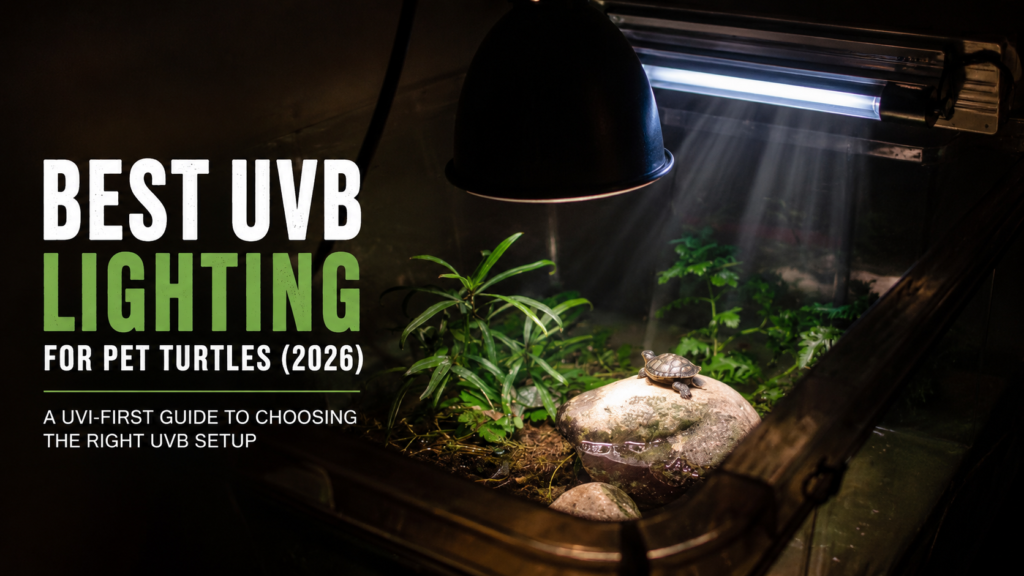
Best UVB Lighting for Pet Turtles (2026): A UVI-First Guide to Choosing the Right UVB Setup
This article may contain affiliate links. As an Amazon Associate, I earn from qualifying purchases at no extra cost to you.
If there’s one thing turtle owners often get wrong about lighting, it’s choosing a UVB bulb based on the number printed on the package.
A bulb labeled 5.0, 10.0, or 12% UVB may sound like a straightforward measurement of strength. It isn’t.
The more useful question is:
How much UVB is actually reaching my turtle where it basks?
That’s where UVI, or Ultraviolet Index, becomes important.
UVI measures the intensity of biologically relevant ultraviolet radiation at a particular location. The UV exposure your turtle receives depends on the complete lighting system: the bulb, reflector, distance, mounting position, screen or mesh, bulb age, and the location of the basking platform.
That means a powerful UVB bulb installed incorrectly can provide an unsuitable UV environment, while a properly positioned lower-output lamp may provide a more appropriate basking zone.
For indoor turtles, appropriate UVB is an important part of responsible husbandry. UVB supports vitamin D3 synthesis and calcium regulation, while natural unfiltered sunlight remains the best natural UV source when it can be provided safely.
So this guide takes a different approach.
Instead of asking:
“Which UVB bulb is strongest?”
we’re asking:
“Which lighting system can create an appropriate UV environment for my turtle?”
Looking for something specific? Start here:
| If you want to… | Read this guide |
|---|---|
| Understand how to create the right basking area | Turtle Basking Setup Guide |
| Set up a complete Red-Eared Slider habitat | Red-Eared Slider Tank Setup Guide |
| Choose the right tank before buying lighting | Best Turtle Tanks for Beginners |
| Determine the right tank size for your turtle | Turtle Tank Size Guide |
| Set up lighting for a large 75-gallon tank | 75 Gallon Turtle Tank Setup Guide |
What’s the Best UVB Light for a Pet Turtle?
For many medium and large indoor turtle enclosures, my preferred format is a quality linear T5 HO UVB system because it can provide broader UVB coverage across a basking area than a small compact bulb.
For this comparison, the Hygger Zoo T5 HO UVB 10.0 Combo Kit is our top T5 recommendation because it combines a T5 UVB tube, fixture, and reflector in one package and is available in multiple configurations.
The Zoo Med ReptiSun 10.0 Mini is our preferred compact option for smaller setups where a compact bulb makes more sense.
If you want a complete beginner-friendly package containing both UVB and basking heat, the Zoo Med Aquatic Turtle UVB & Heat Lighting Kit is the most convenient option of the five products reviewed here.
However, there is one important principle to remember:
The number printed on the UVB bulb is not the same thing as the UVI your turtle receives.
Your enclosure, reflector, mounting position, distance, mesh, basking platform, and turtle’s behavior all matter.
Best UVB Lighting for Pet Turtles: Comparison Table
The following five products are compared in this guide:
Best Overall T5 System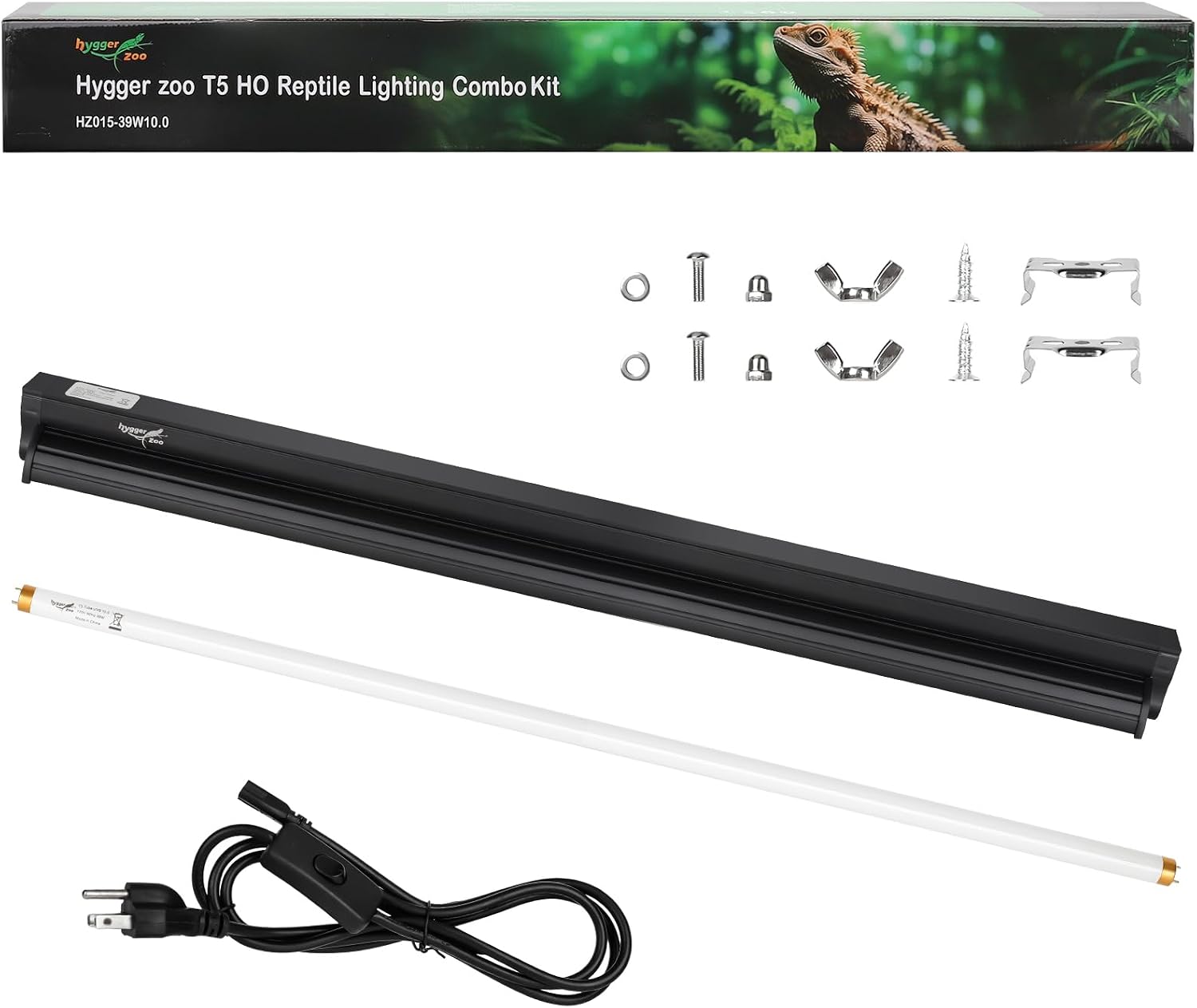 Hygger Zoo T5 HO UVB 10.0 |
Best Compact UVB Zoo Med ReptiSun 10.0 Mini |
Best Beginner Kit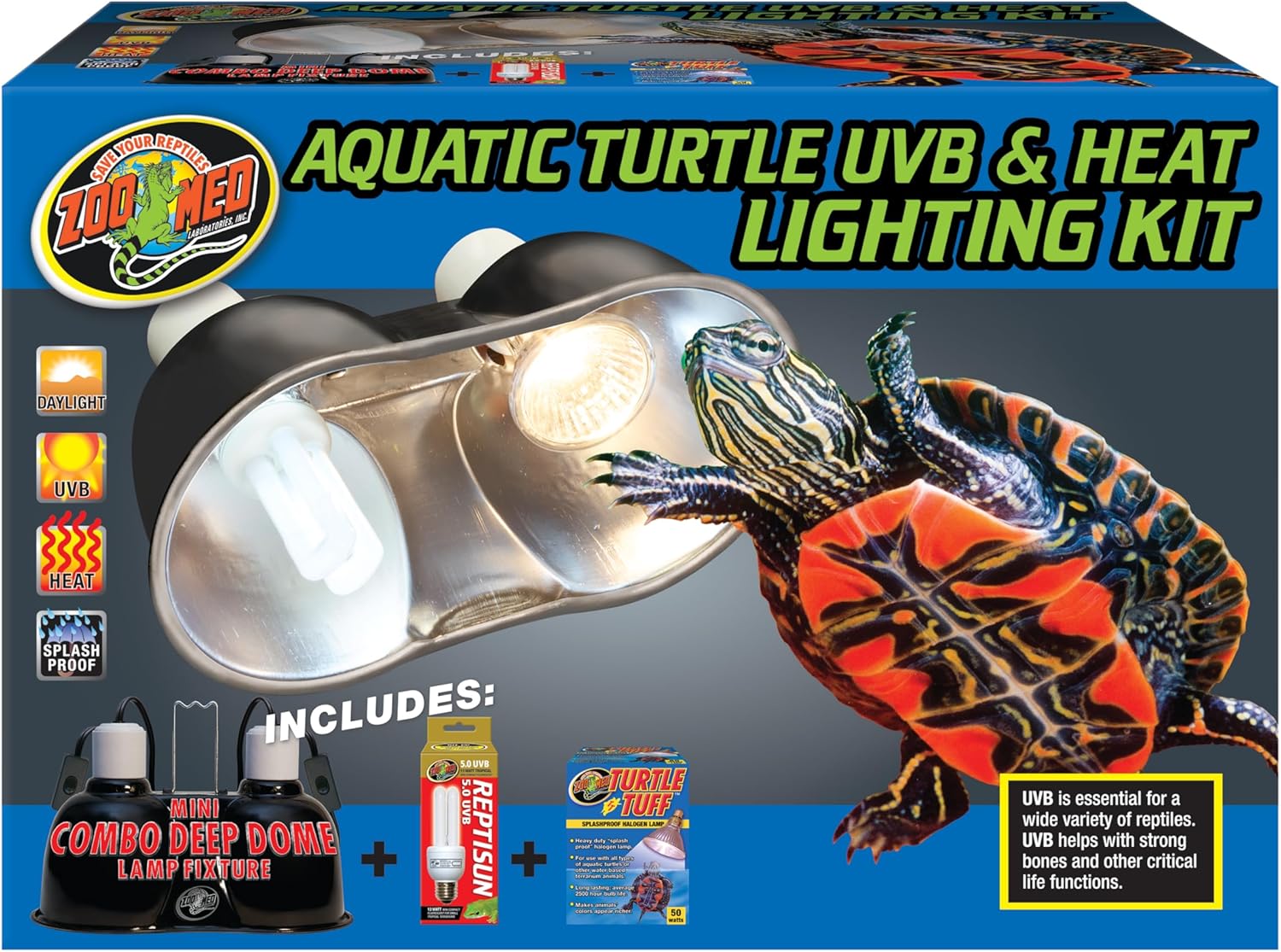
Zoo Med Aquatic Turtle |
Best 5.0 Compact Option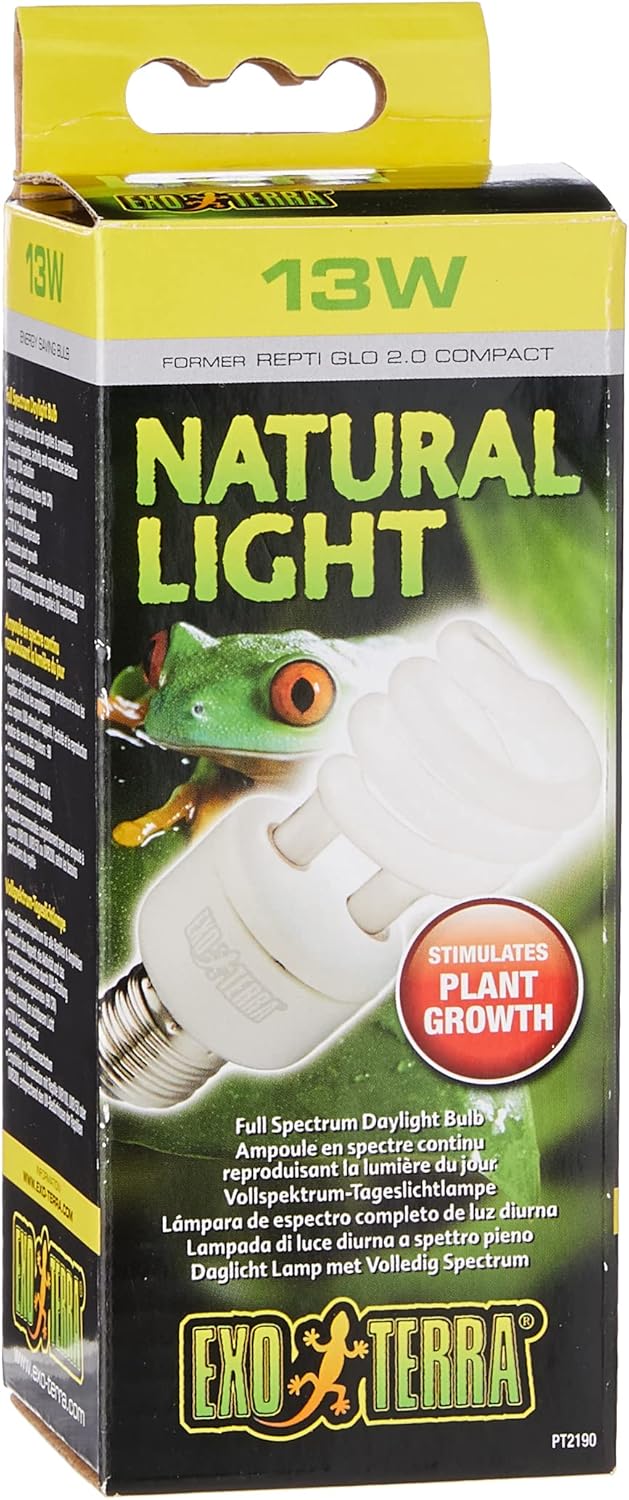 Exo Terra Repti-Glo 5.0 13W |
Not a Primary UVB Source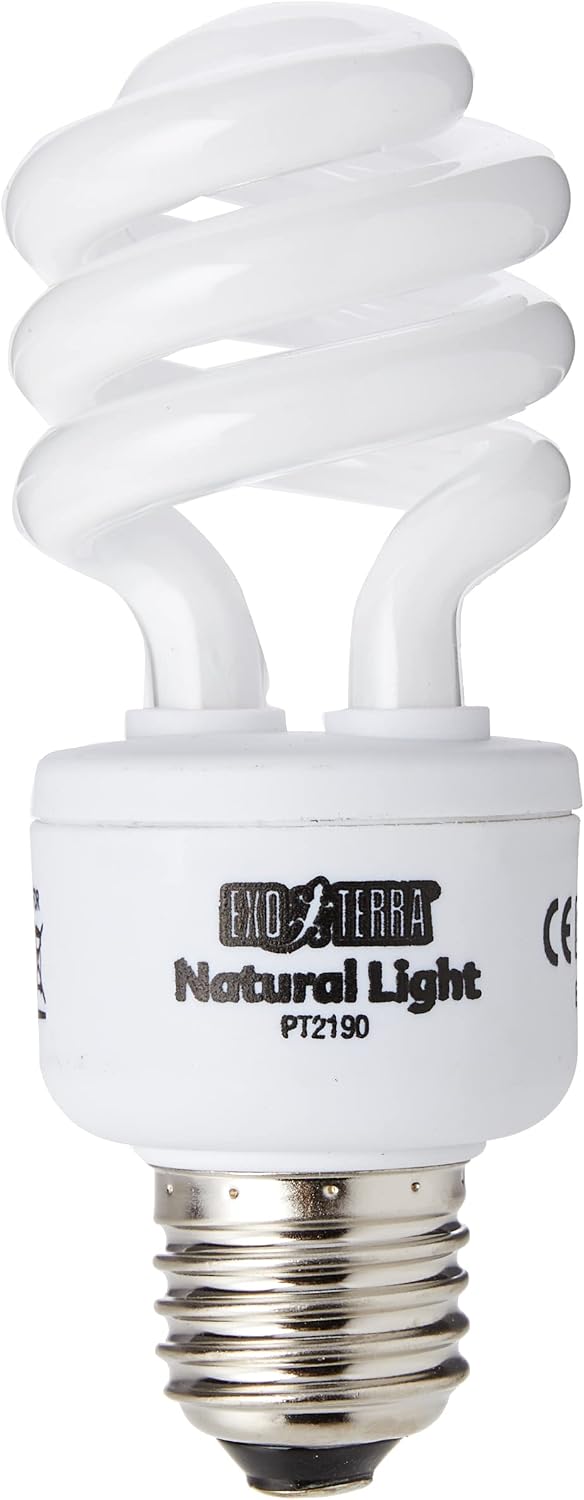 Exo Terra Repti-Glo 2.0 13W | |
|---|---|---|---|---|---|
| Type | Linear T5 HO | Compact UVB | UVB + Heat Kit | Compact UVB | Daylight |
| UVB | 10% | 10% | 5.0 | 5.0 | Low |
| Wattage | 8W / 24W / 39W* | 13W | 13W + 50W | 13W | 13W |
| Fixture Included | Yes | No | Yes | No | No |
| Heat Included | No | No | Yes | No | No |
| Coverage | Broad linear coverage | Concentrated | Limited | Limited | General lighting |
| Best For | Medium–large enclosures | Small setups | Beginners | Small/moderate setups | Supplemental lighting |
*Wattage and available lengths may vary by Hygger model.
Important: A higher UVB percentage does not automatically mean a better or safer setup. The actual UV environment at your turtle’s basking position depends on the complete lighting system and installation.
What Does UVB Actually Do for a Turtle?
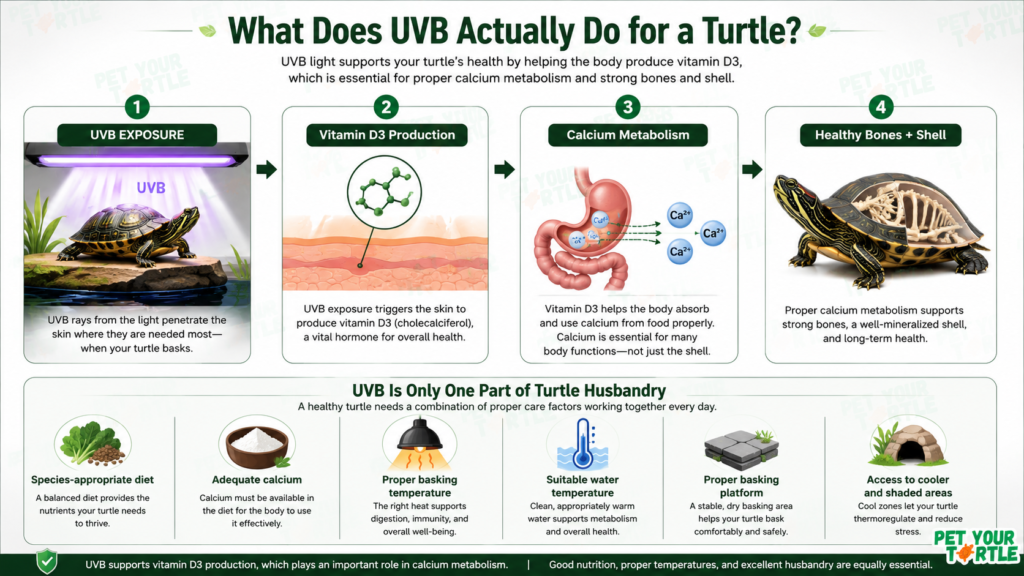
UVB is a portion of ultraviolet radiation that helps reptiles produce vitamin D3 in their skin.
Vitamin D3 plays an important role in calcium metabolism. Calcium is essential for normal skeletal development, muscle function, and shell mineralization.
Inadequate UVB can therefore contribute to problems with calcium metabolism and metabolic bone disease, particularly when combined with inadequate dietary calcium, inappropriate temperatures, or other husbandry problems.
But UVB isn’t a substitute for good nutrition.
Your turtle still needs:
- An appropriate species-specific diet
- Adequate calcium
- Appropriate basking temperatures
- Suitable water temperature
- A proper basking platform
- A normal day/night cycle
- Access to cooler and shaded areas
Good UVB is one part of a complete turtle husbandry system.
UVB, UVA, Visible Light, and Heat Are Different Things
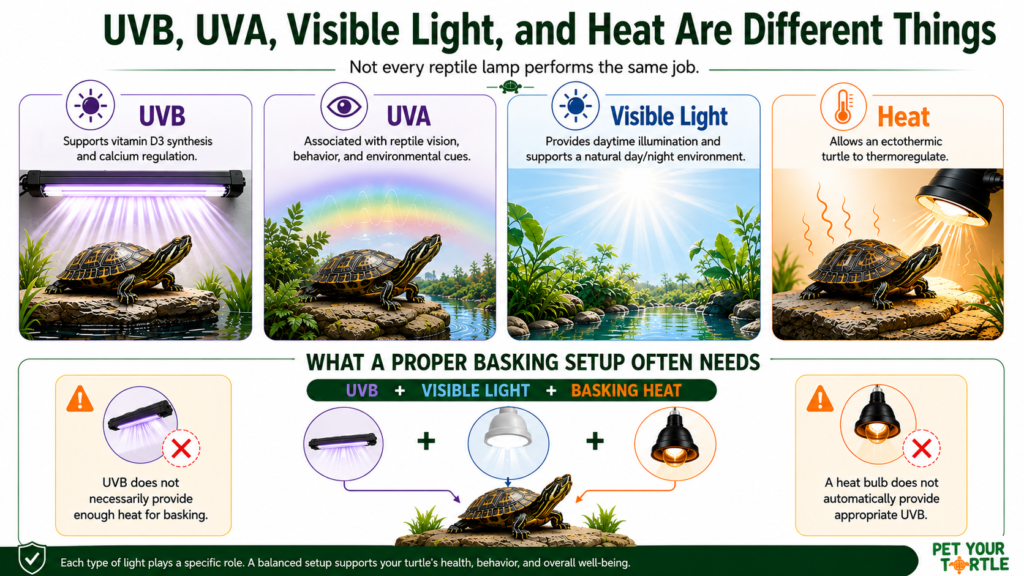
One of the easiest mistakes to make when shopping for turtle lighting is assuming that every reptile lamp performs the same job.
It doesn’t.
UVB
UVB supports vitamin D3 synthesis and calcium regulation.
UVA
UVA is a different part of the ultraviolet spectrum and is associated with reptile vision and behavior.
Visible Light
Visible light provides daytime illumination and contributes to a natural day/night environment.
Heat
Heat allows an ectothermic turtle to thermoregulate.
This means a proper basking setup often requires:
UVB + visible light + basking heat
A UVB bulb doesn’t necessarily provide enough heat to function as the basking heat source.
Likewise, a heat bulb doesn’t automatically provide appropriate UVB.
The Number on the Bulb Isn’t the Same as UVI
This is the most important concept in this guide.
You may see products labeled:
- 5.0 UVB
- 10.0 UVB
- 5% UVB
- 10% UVB
- High Output UVB
These labels describe the lamp’s design or output category.
They do not tell you exactly how much UV radiation your turtle receives at its basking position.
Think of the lighting system as:
Bulb → Reflector → Distance → Mesh → Basking Platform → Turtle
Every step can affect the final exposure.
A 10.0 bulb installed too far from the basking area may provide less UVB than you expect.
A high-output lamp installed too close may create an unnecessarily intense UV zone.
That’s why:
The goal isn’t maximum UVB.
The goal is appropriate UV exposure.
What Is UVI?
UVI stands for Ultraviolet Index.
It measures the intensity of biologically relevant ultraviolet radiation at a particular location.
For turtle keepers, the relevant location isn’t simply the bulb.
It’s:
The place where your turtle actually basks.
Your turtle doesn’t receive the UVB that exists inside the bulb.
It receives the radiation that reaches its body after traveling through the reflector and across a particular distance, and potentially through mesh or another barrier.
That’s why UVI is much more useful for evaluating a real enclosure than simply looking at a number printed on the packaging.
Why Distance Matters
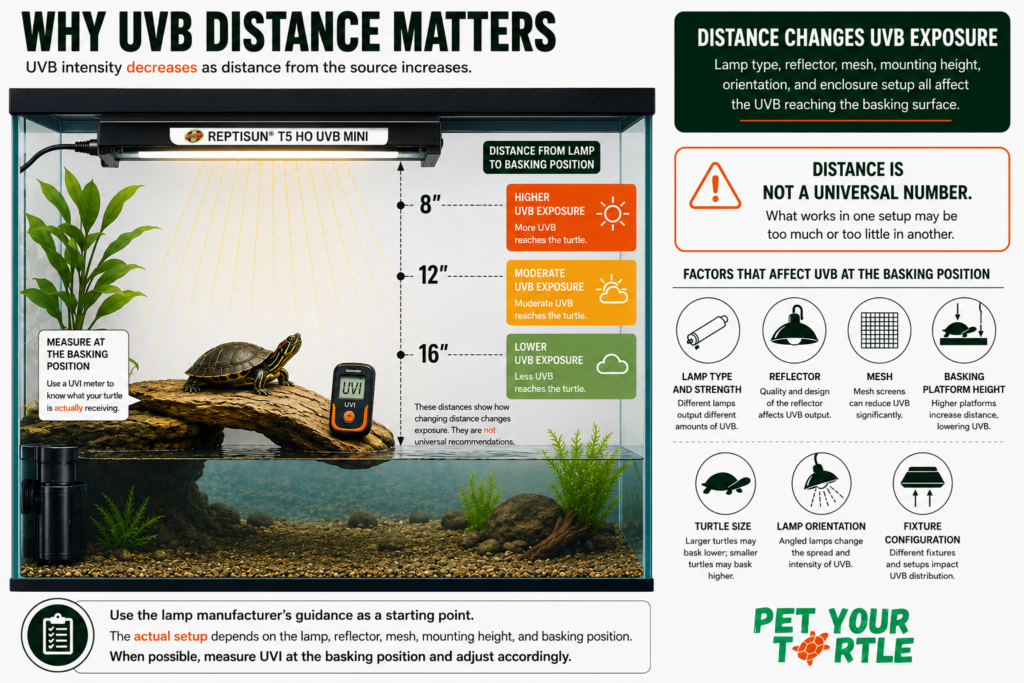
UVB intensity decreases as distance from the source increases.
That’s why there is no universal rule such as:
“Every turtle UVB bulb should be 10 inches away.”
Different lamps behave differently.
For example, the Hygger T5 HO system provides manufacturer guidance around an 8–12 inch starting range, while Zoo Med provides fixture-specific operating distances for the ReptiSun 10.0 Mini.
These should be treated as product-specific starting points, not universal turtle-lighting rules.
The actual distance in your enclosure should also account for:
- The reflector
- Mesh
- Basking platform height
- Turtle size
- Turtle behavior
- Lamp orientation
- Fixture configuration
If you can measure UVI at the basking position, you can verify what your turtle is actually receiving.
Should You Measure UVI?
If you want precision, yes.
A UV Index meter can help you measure the actual UV environment your turtle experiences.
You can measure:
- UVI at the basking position
- UVI at different points across a wide basking platform
- The effect of mesh
- The effect of changing lamp distance
- Changes in output over the life of a bulb
A UVI meter becomes particularly useful when:
- Using a high-output T5 HO lamp
- Mounting UVB above mesh
- Using a large basking platform
- Changing the lamp position
- Replacing a bulb
- Changing the reflector or fixture
Without a meter, you can still create a responsible setup by following the manufacturer’s instructions and species-specific husbandry guidance.
But there is an important distinction:
Without measuring UVI, you’re estimating the final exposure rather than verifying it.
What Is a Ferguson Zone?
The Ferguson Zone concept categorizes reptiles according to their natural UV exposure and basking behavior.
The important idea is simple:
Different reptiles naturally experience different UV environments.
A reptile that spends long periods basking in exposed sunlight may naturally experience a different UV environment from an animal that spends much of its time in shaded habitat.
For turtle keepers, the lesson isn’t to maximize UVB.
Instead, the goal is to create an appropriate UV gradient and provide access to shade.
Think:
Basking zone → Lower UV area → Shade
rather than:
UVB lamp → Entire enclosure
Why a UV Gradient Matters
A properly designed enclosure should allow your turtle to choose its level of exposure.
Your turtle should be able to:
- Bask under the UVB
- Move to a lower-UV area
- Move completely away from the UVB
- Access shade
This allows behavioral choice and helps prevent the turtle from being forced to remain under the UVB source.
This is one reason a linear T5 HO system can be useful for larger enclosures: it can distribute UVB across a broader basking area instead of concentrating everything into a tiny spot.
T5 HO vs Compact UVB
This is one of the most important equipment decisions you’ll make.
Linear T5 HO UVB
T5 HO systems use a long fluorescent UVB tube and dedicated reflector.
Their biggest advantage is coverage.
A linear tube can illuminate a much larger basking area than a small compact bulb.
Advantages
- Broad UVB coverage
- Better suited to large basking platforms
- Useful for medium and large enclosures
- Can create a broader UV gradient
- Dedicated reflector helps direct UVB
Disadvantages
- Higher initial cost
- Requires a dedicated fixture
- Installation requires planning
- Distance still matters
- Higher output isn’t automatically better
For many medium and large turtle enclosures, linear T5 HO is my preferred format.
Compact UVB Bulbs
Compact fluorescent UVB bulbs screw into compatible threaded fixtures.
They’re convenient and often less expensive than a complete T5 HO system.
Their main limitation is coverage.
Advantages
- Affordable
- Easy to install
- Useful for smaller enclosures
- Convenient for beginners
- Compatible with many dome-style fixtures
Disadvantages
- Smaller UVB coverage area
- More concentrated exposure
- Distance is critical
- Less suitable for wide basking platforms
- Usually requires a separate heat source
Best UVB Format by Enclosure Size
Small Setups
A compact UVB bulb can be practical if the turtle can reach the appropriate operating distance and has access to shade.
Medium Setups
Either format can work, but a linear T5 HO system becomes increasingly attractive when the basking area is broad.
Large Setups
A longer T5 HO system is generally my preferred approach, especially when the basking platform is wide.
Remember:
Tank volume alone doesn’t determine the right UVB system.
You should also consider:
- Basking platform size
- Distance to the lamp
- Lamp length
- Reflector
- Mesh
- Turtle species
- Basking behavior
Best UVB Lighting Products for Pet Turtles
1.
The Hygger Zoo T5 HO UVB Reptile Light Fixture + 10.0 UVB Bulb Combo Kit is our top choice among the five products because it uses a linear T5 HO format and includes the fixture and reflector.
Hygger offers multiple configurations of the system, allowing keepers to select a tube length appropriate for their enclosure.
The manufacturer specifies 10% UVB and 30% UVA and provides an approximately 8–12 inch starting installation range.
Why We Like It
The biggest advantage is coverage.
A linear T5 tube can distribute UVB across a much larger basking area than a small compact bulb.
The included reflector also helps direct the lamp’s output toward the enclosure.
Installation
Hygger recommends approximately 8–12 inches above the basking area as a starting point.
Don’t treat that range as a universal rule for every turtle.
If you have a UV meter, use it to evaluate the actual UVI at your turtle’s basking position.
Verdict
Best Overall T5 UVB System
For a medium or large turtle enclosure where you want broad UVB coverage without purchasing a fixture and tube separately, the Hygger is the strongest overall option among these five products.
2.
The Zoo Med ReptiSun 10.0 Mini Compact Fluorescent is a 13W compact UVB bulb designed for reptile enclosures where a screw-in UVB source is appropriate.
Zoo Med lists the lamp as providing 10% UVB and 30% UVA.
Manufacturer Distance Guidance
Zoo Med provides fixture-specific operating ranges rather than one universal distance.
For example, its guidance includes approximately:
- 5–8 inches with the Mini Deep Dome
- 6–9 inches with the ReptiSun Hood
Always check the instructions for the exact fixture you’re using.
Verdict
Best Compact UVB
If you have a smaller setup where a compact UVB bulb makes sense, the ReptiSun 10.0 Mini is our preferred compact option from this comparison.
3.
The Zoo Med Aquatic Turtle UVB & Heat Lighting Kit is designed to simplify the lighting setup for aquatic turtle keepers.
The kit includes:
- A Mini Combo Deep Dome fixture
- A 13W ReptiSun 5.0 Mini UVB bulb
- A 50W Repti Tuff Splashproof Halogen basking bulb
This makes it unique among the five products because it provides both UVB and basking heat in one package.
Important UVI Point
Don’t assume that because the product is marketed specifically for aquatic turtles, the included UVB configuration is automatically perfect for every turtle and enclosure.
The final UV environment still depends on:
- Species
- Basking behavior
- Distance
- Fixture
- Mesh
- Basking platform
Verdict
Best Beginner Starter Kit
If you’re starting from scratch and want a simple package containing both UVB and basking heat, this is the easiest option among the five.
4.
The Exo Terra Repti-Glo 5.0 Tropical Terrarium Lamp, 13W is a compact UVB bulb intended for tropical and subtropical reptile environments.
In newer Exo Terra product naming, the Repti-Glo 5.0 has been associated with the UVB100 range.
The important point for this comparison is that it represents the 5.0-class compact UVB category.
Verdict
Best 5.0 Compact Option
This is a reasonable compact UVB choice for setups where a moderate-output tropical-style lamp is appropriate.
However, don’t select it simply because your turtle is aquatic.
The actual UV environment remains the deciding factor.
5.
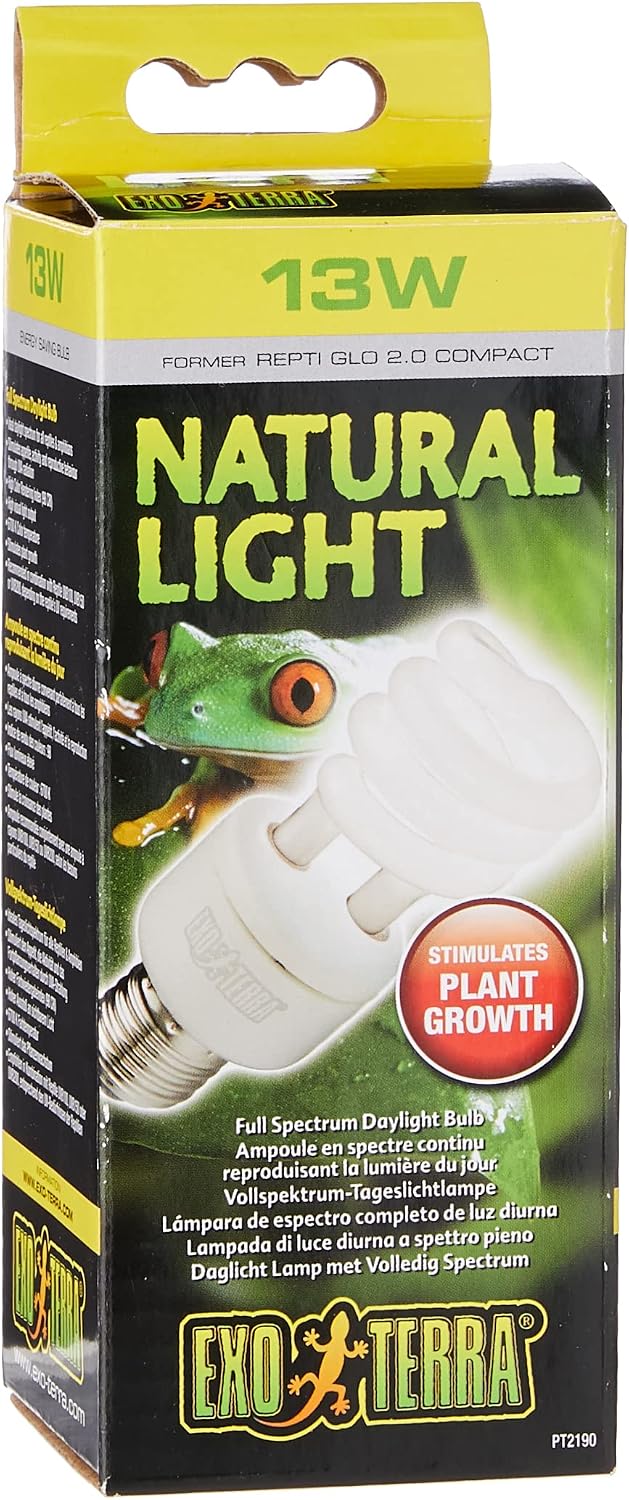
The Exo Terra Repti-Glo 2.0 13W is fundamentally different from the other four products. This product is associated with Exo Terra’s Natural Light daylight range and is primarily intended to provide visible-spectrum illumination rather than serve as the main UVB source.
It can be useful as supplemental daylight, particularly in planted or naturalistic enclosures.
Verdict
Not a Primary UVB Source
This is an important distinction.
A product can be a good reptile light without being a good primary UVB lamp.
For an indoor basking turtle, I would pair this type of daylight lamp with a dedicated UVB system rather than rely on it alone.
5.0 vs 10.0 UVB: Which Is Better?
This is where many turtle owners get confused.
5.0 UVB
Generally marketed for tropical or subtropical environments with moderate UV exposure.
10.0 UVB
Generally marketed as a higher-output UVB category.
But these numbers should not be treated as universal turtle requirements.
A 10.0 bulb isn’t automatically better.
A 5.0 bulb isn’t automatically inadequate.
What matters is the UV environment produced by the complete system.
So instead of asking:
“Is 10.0 better than 5.0?”
ask:
“What UVI does this setup produce where my turtle actually basks?”
Which of These Five Is Best for a Large Turtle Tank?
For a medium or large turtle enclosure, my pick is the Hygger Zoo T5 HO UVB 10.0.
Best for: Medium to large turtle enclosures
Why we like it:
Linear T5 HO design provides broader UVB coverage across larger basking areas.
A strong choice when coverage matters more than simply maximizing UVB output in one small spot.
For a medium or large turtle enclosure, I would choose:
Hygger Zoo T5 HO UVB 10.0
The main reason is the linear format and broader coverage. Compact bulbs produce UVB over a relatively small area.
A linear T5 HO system can cover a much larger basking platform. That doesn’t mean you should install the Hygger as close as possible. Because it is a higher-output linear system, positioning becomes especially important.
Follow the manufacturer’s starting guidance and, if possible, verify the resulting UVI.
Which Is Best for a Small Turtle Setup?
For a smaller setup where a compact bulb is practical:
Best for: Small turtle setups where a compact UVB source is practical
Why we like it:
Its compact design makes it useful when enclosure space is limited and a full-length T5 HO fixture isn’t practical.
What to know:
This is a 13W compact fluorescent UVB lamp, not a T5 HO linear lamp. Zoo Med rates it at 10% UVB and 30% UVA and recommends it for small habitats.
Our take:
A convenient option for a small setup, but its compact coverage is more limited than a linear T5 HO system. For larger basking areas, I’d choose a properly sized linear T5 HO setup instead.
Which Is Best for Beginners?
Best for: Beginners who want a simple UVB + basking-heat starter setup
Why we like it:
It combines the essential lighting components in one package: a UVB bulb, basking heat bulb, and dual-lamp fixture.
Our take:
A convenient starting point for new turtle keepers, especially when you want to avoid buying the UVB lamp, heat bulb, and fixture separately.
It’s the easiest starting point because the package includes:
- UVB
- Basking heat
- Fixture
However, “all-in-one” doesn’t mean “install anywhere.”
The basking platform still needs to be positioned correctly, and the turtle needs access to cooler and lower-UV areas.
Which Product Should Not Be Used as Primary UVB?
Exo Terra Repti-Glo 2.0
Not because it is a bad product.
It’s simply designed for a different purpose.
It is better viewed as a supplemental daylight source, not the primary UVB system for an indoor basking turtle.
How to Position a Turtle UVB Lamp
Don’t use a universal distance.
Instead, follow this process.
Step 1: Identify the Exact Bulb
Know the manufacturer and exact model.
Step 2: Read the Manufacturer’s Instructions
Use model-specific guidance rather than copying a generic internet distance.
Step 3: Measure the Real Basking Distance
Measure from the UVB-producing portion of the lamp to the approximate position of your turtle’s body while basking.
Step 4: Account for Mesh
If the lamp is mounted above a screen, the mesh becomes part of the UVB path.
Step 5: Consider the Reflector
The reflector is part of the complete lighting system.
Step 6: Measure UVI if Possible
This is the best way to verify the actual exposure.
Step 7: Provide Shade
Your turtle must be able to move away from the UV-rich area.
Can UVB Pass Through Glass?
Don’t rely on UVB passing through ordinary glass or acrylic.
These materials can filter out much of the useful UVB.
If your turtle aquarium has a glass lid, don’t simply place the UVB lamp on top and assume the turtle is receiving normal UVB exposure.
The UVB lamp needs an appropriate path to the basking area.
What About Mesh Screens?
Mesh doesn’t necessarily eliminate UVB.
However, it can reduce the amount of UVB reaching your turtle.
The effect depends on factors such as:
- Mesh material
- Mesh thickness
- Hole size
- Lamp position
- Reflector
- Distance
This is another reason measured UVI is preferable to simply copying a distance from another turtle enclosure.
UVB and Heat Should Work Together
Your turtle should have a basking area where appropriate heat and UV exposure overlap.
A good setup generally provides:
Warm basking area + appropriate UVB
along with:
Cooler area + lower UV exposure
and:
Shade/retreat
This allows your turtle to regulate both body temperature and UV exposure.
How Long Should Turtle UVB Stay On?
There isn’t one photoperiod that applies perfectly to every turtle species.
Natural photoperiods vary according to species and geography.
For many indoor turtle setups, 10–12 hours of daytime lighting is a practical starting point.
The most important thing is consistency.
A timer is much more reliable than manually switching the lights on and off every day.
When Should You Replace a UVB Bulb?
UVB output can decline even while the bulb continues producing visible light.
That means:
A bulb turning on does not prove that it is still producing the same UVB output.
Replacement schedules vary between products.
Some manufacturers recommend replacement around 6–12 months, while others provide longer service-life guidance for specific lamps.
If you don’t have a UV meter, follow the manufacturer’s replacement schedule.
If you do have a UV meter, you can monitor output over time.
Simple habit
When you install a new bulb:
Write the installation date on it.
Common UVB Mistakes Turtle Owners Make
1. Buying the Strongest Bulb
More UVB isn’t automatically better.
The goal is appropriate exposure.
2. Choosing Only by 5.0 vs 10.0
Those numbers don’t tell you the final UVI.
3. Installing the Lamp Too Far Away
UVB intensity decreases with distance.
4. Installing It Too Close
Higher output doesn’t mean the lamp should be placed as close as possible.
5. Putting UVB Through Glass
Glass can block useful UVB.
6. Ignoring Mesh
Mesh can reduce UV exposure.
7. Ignoring the Reflector
The reflector affects how effectively UVB is directed toward the basking area.
8. Keeping a Bulb Indefinitely
Visible light can continue after UVB output declines.
9. Providing No Shade
Your turtle needs somewhere to retreat from the UVB.
10. Treating UVB and Heat as the Same Thing
A UVB lamp may provide little useful basking heat.
11. Judging UVB by Amazon Reviews
Customer reviews can tell you about packaging, installation, and reliability.
They cannot tell you whether the lamp creates the appropriate UVI for your turtle’s basking position.
Do All Pet Turtles Need the Same UVB?
No.
Different turtle species have different natural basking behaviors and patterns of sunlight exposure.
When choosing UVB, consider:
- Species
- Basking behavior
- Natural habitat
- Exposure to open sunlight
- Enclosure height
- Basking platform
- Lamp type
- Distance
- Reflector
- Mesh
- Shade availability
This is why I don’t recommend simply giving every turtle the same UVB bulb.
The right UVB system is the one that creates an appropriate environment for that particular turtle.
What About Red-Eared Sliders?
Red-eared sliders are active basking aquatic turtles and are one of the most common pet turtle species.
Research involving red-eared sliders has found that supplemental UV exposure can increase circulating vitamin D metabolites compared with turtles without supplemental UV exposure.
That provides useful turtle-specific evidence supporting appropriate UV exposure for indoor sliders.
But the conclusion shouldn’t be:
“Every slider needs the strongest UVB lamp.”
The better conclusion is:
Indoor sliders should have an appropriately designed UVB and basking environment.
Can Natural Sunlight Replace Artificial UVB?
Unfiltered natural sunlight is an excellent source of UV radiation.
However, sunlight through a window is not equivalent to outdoor sunlight because glass filters much of the useful UVB.
Safe outdoor exposure also requires:
- Shade
- Predator protection
- Escape prevention
- Temperature management
- Safe surfaces
- Protection from overheating
A turtle kept safely outdoors with meaningful natural sunlight has very different UVB circumstances from a turtle housed entirely indoors.
Can I Use a UVB Bulb Without a Heat Bulb?
Usually, you should think of UVB and heat as separate functions.
A dedicated UVB bulb may provide little useful basking heat.
Your turtle still needs an appropriate basking temperature.
A typical setup may therefore contain:
UVB lamp
Basking heat lamp
Basking platform
Cool/shaded area
The Zoo Med Aquatic Turtle UVB & Heat Lighting Kit is different because it includes both a 13W ReptiSun 5.0 UVB bulb and a 50W basking heat bulb.
Is 10.0 UVB Better Than 5.0?
Not automatically.
A 10.0 label doesn’t tell you the final UV exposure.
A 5.0 bulb positioned appropriately can be more suitable than a 10.0 bulb positioned incorrectly.
Likewise, a 10.0 compact bulb may not be the best solution for a large basking platform where a linear T5 HO system can provide broader coverage.
Choose the system, not the number.
Is T5 HO Better Than a Compact UVB Bulb?
For many medium and large enclosures, I prefer T5 HO because it can provide broader coverage.
Compact bulbs remain useful for smaller setups.
Compact UVB makes sense when:
- The enclosure is small
- The basking platform is narrow
- A dome fixture is already available
- The turtle can reach the correct distance
T5 HO makes sense when:
- The enclosure is medium or large
- The basking platform is wide
- Broader UVB coverage is desirable
- You want a longer UV gradient
How We Rank UVB Lighting at PetYourTurtle
At PetYourTurtle, we don’t rank UVB products simply by the number printed on the bulb or by customer star ratings.
We consider:
- UVB technology
- Coverage
- Manufacturer specifications
- Operating distance
- Reflector design
- Mounting options
- Screen/mesh considerations
- Suitability for turtle enclosures
- Replacement requirements
- Value
- Availability of technical information
Most importantly, we ask:
Can this product realistically be used to create an appropriate UV environment for a turtle?
Where measured UVI information is available, actual UV exposure is more useful than marketing labels.
Customer reviews can help evaluate installation, packaging, and reliability, but they cannot determine whether a lamp produces the correct UVI for a specific turtle enclosure.
Our Final Recommendations
Best Overall T5 UVB System
Hygger Zoo T5 HO UVB 10.0
Best suited to medium and large turtle enclosures where broad linear UVB coverage is desirable.
Best Compact UVB
Zoo Med ReptiSun 10.0 Mini
Best suited to smaller setups where a compact UVB bulb is appropriate.
Best Beginner Starter Kit
Zoo Med Aquatic Turtle UVB & Heat Lighting Kit
Best for beginners who want UVB, basking heat, and a fixture in one package.
Best 5.0 Compact Option
Exo Terra Repti-Glo 5.0 13W
A useful compact 5.0-class UVB option for setups where moderate UV output is appropriate.
Best Supplemental Daylight
Exo Terra Repti-Glo 2.0 13W
Useful for visible/daylight illumination but not recommended as the primary UVB source for an indoor basking turtle.
The Bottom Line
Choosing turtle UVB lighting shouldn’t begin with:
“Should I buy a 5.0 or 10.0?”
It should begin with:
“What UV environment does my turtle need, and can this complete lighting system provide it?”
That means considering:
Species
→ Basking behavior
→ Appropriate UV exposure
→ Lamp type
→ Reflector
→ Distance
→ Mesh
→ Basking platform
→ Shade
For medium and large enclosures, the Hygger Zoo T5 HO UVB 10.0 is our preferred product among these five because the linear format provides broader coverage and the fixture and reflector are included.
For smaller setups, the Zoo Med ReptiSun 10.0 Mini is our preferred compact option.
For beginners who want a complete heat-and-UVB package, the Zoo Med Aquatic Turtle UVB & Heat Lighting Kit is the simplest choice.
The Exo Terra Repti-Glo 5.0 remains a useful compact 5.0-class UVB option, while the Exo Terra Repti-Glo 2.0 is better viewed as a supplemental daylight lamp rather than a primary UVB source.
But regardless of which product you choose:
The number on the package is not the final answer.
The goal is an appropriate UV environment at the turtle’s basking position, combined with a usable UV gradient and access to shade.
Good turtle lighting isn’t about maximizing UVB. It’s about providing the right UVB, in the right place, at the right intensity, while allowing your turtle to move away from it.
Frequently Asked Questions
For indoor turtles that don’t receive meaningful unfiltered natural sunlight, providing appropriate UVB is an important part of responsible husbandry.
UVB supports vitamin D3 synthesis and calcium regulation and is particularly important for most chelonians.
Not necessarily.
The number alone doesn’t determine whether the exposure is appropriate.
Species, lamp type, reflector, distance, mesh, basking behavior, and the resulting UVI all matter.
There isn’t one UVI value that should be universally applied to every turtle.
Appropriate exposure depends on species, basking behavior, natural ecology, enclosure design, and the animal’s ability to move between different exposure levels.
Use species-specific husbandry guidance and Ferguson-zone principles rather than treating one number as universal.
You don’t absolutely need one, but it is one of the best tools for verifying the actual UV environment you’re creating.
It is particularly useful when using high-output lamps, large basking platforms, mesh screens, or when changing lamp position.
There is no universal distance.
Follow the manufacturer’s instructions for the exact bulb and fixture, account for mesh and mounting configuration, and measure from the UVB source to the turtle’s actual basking position.
Don’t rely on UVB passing through ordinary glass or acrylic.
These materials can filter out much of the useful UVB.
In most indoor basking setups, yes.
Having UVB and basking heat available around the same general basking area allows the turtle to receive UV exposure while voluntarily basking.
A consistent daytime schedule is appropriate for most indoor setups.
Around 10–12 hours is a practical starting point for many turtles, but species-specific photoperiod requirements should take priority.
Follow the manufacturer’s replacement schedule.
UVB output can decline while the bulb continues producing visible light.
If you have a UV meter, you can monitor the output over time. Otherwise, follow the manufacturer’s recommended replacement interval.
For many medium and large enclosures, a linear T5 HO system has an advantage because it can provide broader UVB coverage.
Compact bulbs remain useful for smaller setups.
No. The Repti-Glo 2.0/Natural Light type of lamp is better viewed as a visible-light/daylight source with low UVB output.
It should not be relied upon as the primary UVB source for an indoor basking turtle.
Not automatically.
The Hygger’s linear format gives it an advantage in coverage, particularly for larger basking platforms.
The ReptiSun 10.0 Mini is more convenient for smaller setups.
The correct choice depends on the enclosure and the UV environment you need to create.
Exo Terra has changed its product naming in some markets, with newer products associated with the UVB100 range.
If you’re purchasing the exact Repti-Glo 5.0 product, check the model number and current product listing carefully because older and newer naming can appear together.
About This Article
This guide combines manufacturer specifications, veterinary references, and reptile-lighting principles to explain how UVB should be selected for captive turtles.
Product names, specifications, pricing, and availability can change. Always verify the current manufacturer’s instructions before purchasing or installing a UVB system.
This article is educational and is not a substitute for veterinary advice. If your turtle has a soft shell, abnormal bone development, weakness, difficulty moving, or other signs potentially associated with metabolic bone disease, consult a reptile-experienced veterinarian.
As an Amazon Associate, PetYourTurtle earns from qualifying purchases at no additional cost to you.