
Turtle Respiratory Infection: Symptoms, Causes, Treatment & Prevention
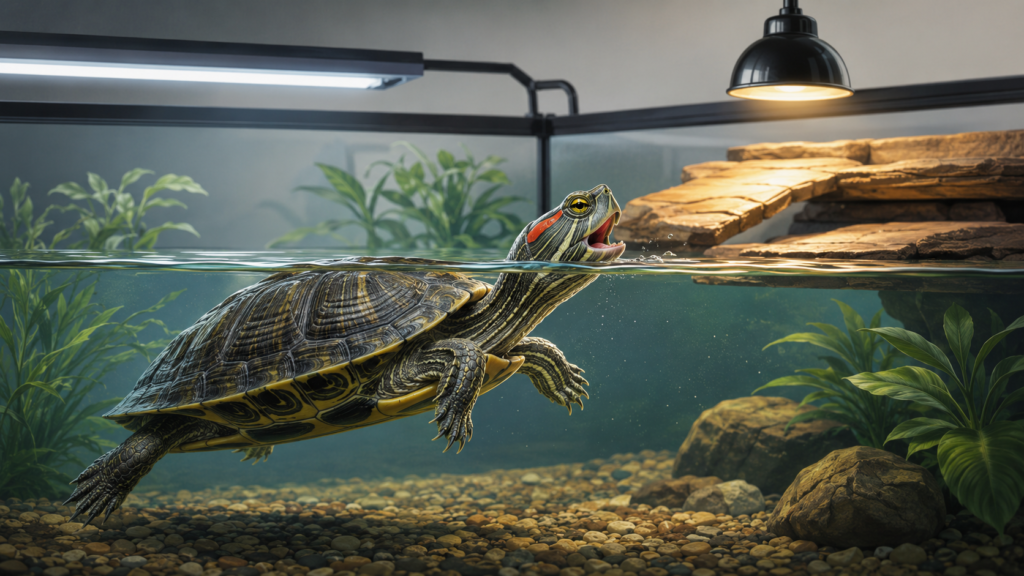
A turtle respiratory infection can be frightening to watch, especially when your turtle suddenly starts breathing differently, becomes unusually quiet, or stops showing interest in food.
You may notice your turtle stretching its neck, opening its mouth, making unusual breathing movements, producing bubbles or discharge, swimming differently, or spending much more time resting than usual. Sometimes the first signs are much less obvious. Your turtle may simply seem “off” before the more recognizable respiratory symptoms appear.
The important thing to understand is that breathing difficulty is a symptom, not a diagnosis.
Respiratory disease in turtles can have different underlying causes, including bacterial infections, other infectious organisms, unfavorable temperatures, poor husbandry, nutritional problems, and concurrent illness.
That means the goal shouldn’t simply be to find something that makes a turtle breathe normally again. The more important question is:
Why is my turtle having trouble breathing in the first place?
In this guide, we’ll walk through the symptoms of respiratory infection in turtles, what can cause respiratory problems, what you can check in your turtle’s environment, how veterinarians approach treatment, and which signs mean you shouldn’t wait.
Important: This article is educational and isn’t a substitute for veterinary diagnosis or treatment. If your turtle is having obvious difficulty breathing, repeatedly gasping, breathing with its mouth open, or becoming severely lethargic, seek veterinary care as soon as possible.
Related Turtle Care Guides
If you’re currently dealing with a turtle that may be sick, these guides can help you check the environmental factors that can contribute to overall turtle health:
- Turtle Water Temperature Guide — how to monitor and maintain appropriate water temperatures
- Turtle Basking Setup Guide — how to create a safe and effective basking area
- Best UVB Lighting for Pet Turtles — understanding UVB, positioning, distance, and replacement
- The Ultimate Guide to Turtle Tank Filtration — how filtration affects water quality and turtle health
- Turtle Tank Setup Guide — the major components of a healthy aquatic turtle habitat
- Turtle Feeding Guide — understanding appropriate nutrition and feeding
- Best Canister Filters for Turtle Tanks — choosing filtration for larger turtle habitats
What Is a Turtle Respiratory Infection?
When we talk about a turtle having a respiratory infection, we’re generally talking about disease affecting the respiratory tract, which can range from upper respiratory problems to infections involving the lungs.
Bacterial infections are an important cause of respiratory disease in reptiles, but they aren’t the only possibility. Respiratory problems can also be associated with fungal, viral, or parasitic disease, as well as environmental problems, poor sanitation, malnutrition, and other underlying health issues.
This is why I don’t recommend looking at one symptom and immediately deciding that your turtle has a particular infection.
For example, a turtle that isn’t eating could be experiencing a respiratory illness, but it could also have a temperature problem, stress, nutritional problems, another illness, or a completely different underlying issue.
The symptoms have to be considered together.
What Are the Signs of a Respiratory Infection in a Turtle?
The signs can vary considerably from one turtle to another.
Some turtles may initially show only behavioral changes, while others develop obvious breathing difficulty.
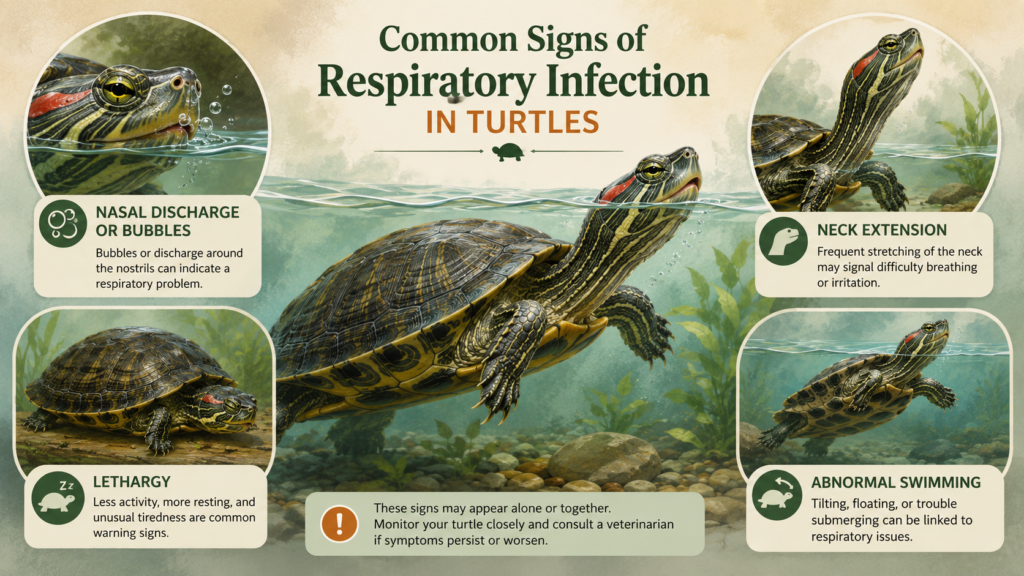
Common signs associated with respiratory disease in aquatic turtles include:
- Loss of appetite
- Lethargy
- Nasal discharge
- Mucus around the nose or mouth
- Bubbles around the nose, mouth, or eyes
- Wheezing
- Repeated neck extension
- Open-mouth breathing
- Gasping
- Difficulty breathing
- Abnormal swimming or floating
These signs are documented in veterinary references on aquatic turtle respiratory disease.
You don’t necessarily need to see all of them before becoming concerned.
In fact, one of the most useful things you can do as a turtle owner is learn what normal looks like for your individual turtle.
If your turtle normally swims actively, eats eagerly, basks regularly, and responds to you, a sudden change in those behaviors deserves attention.
Gasping and Open-Mouth Breathing
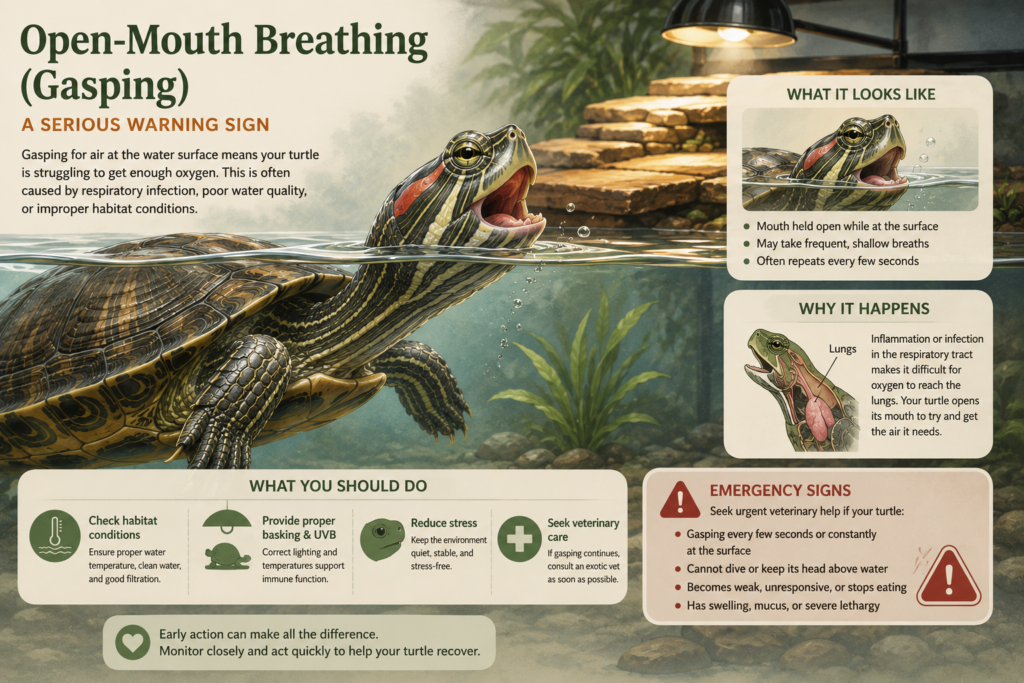
Repeated gasping is one of the respiratory symptoms that should immediately get your attention.
There are situations where a turtle may briefly open its mouth for reasons that aren’t necessarily respiratory disease. But repeated open-mouth breathing, obvious gasping, or visible effort when breathing is not something I would recommend ignoring.
Respiratory disease can make breathing difficult, and open-mouth breathing and gasping are recognized signs of respiratory illness in turtles.
If your turtle is repeatedly gasping, don’t spend days trying different home remedies while waiting to see whether the problem disappears.
Get veterinary advice.
Why Does My Turtle Stretch Its Neck While Breathing?
One of the things that can be particularly worrying for an owner is seeing a turtle repeatedly extend its neck forward or upward.
A turtle may occasionally stretch its neck for completely normal reasons, so a single movement doesn’t automatically mean something is wrong.
The concern is when the movement becomes repeated or unusual for your turtle, especially when it occurs alongside other symptoms.
For example:
- Neck extension plus gasping
- Neck extension plus open-mouth breathing
- Neck extension plus lethargy
- Neck extension plus loss of appetite
- Neck extension plus nasal discharge
Veterinary references list neck extension among the clinical signs associated with respiratory infections in aquatic turtles.
The important thing is to look at the pattern, not one isolated movement.
Nasal Discharge, Mucus and Bubbles
Another sign that can indicate a respiratory problem is unusual discharge.
You might see fluid or mucus around the nostrils, mouth, or eyes. Some turtles may develop bubbles around the nose or mouth.
Persistent discharge is more concerning when it occurs together with other symptoms such as lethargy, appetite loss, or breathing difficulty.
If you notice discharge, take a close look at your turtle’s overall condition rather than treating the discharge as an isolated problem.
Can a Respiratory Infection Make a Turtle Stop Eating?
Yes, it can.
But this is where it’s important not to confuse a symptom with the underlying disease.
Loss of appetite is a nonspecific sign of illness in turtles. A respiratory infection can cause appetite loss, but so can many other conditions.
If your turtle is not eating, the first question shouldn’t always be:
“What food will tempt it?”
Instead, ask:
“What else has changed?”
Is your turtle also:
- More lethargic?
- Breathing differently?
- Gasping?
- Swimming abnormally?
- Basking less?
- Producing discharge?
- Losing weight?
- Responding less than usual?
If appetite loss appears alongside respiratory symptoms, I would take the situation much more seriously than a turtle simply skipping an occasional meal.
If appetite is your primary concern, our guide to why turtles stop eating goes deeper into environmental, dietary, behavioral, and health-related causes.
Turtle Respiratory Infection and Lethargy
Lethargy can be one of the earliest signs that something isn’t right.
You may notice your turtle spending more time sitting still, swimming less, responding less to you, or losing interest in activities it normally enjoys.
The problem is that lethargy isn’t specific to respiratory infections.
It can occur with many illnesses and environmental problems.
That’s why the combination matters.
A turtle that is slightly less active for a day is different from one that is:
lethargic + not eating + breathing abnormally.
When several changes appear together, it’s time to stop looking at each symptom individually and consider the overall condition of the turtle.
Can Respiratory Disease Affect How a Turtle Swims?
It can.
One particularly concerning change is abnormal floating or swimming.
A turtle with significant respiratory disease, particularly pneumonia, may develop abnormal buoyancy because problems involving the lungs can affect how the turtle floats. VCA notes that pneumonia can result in abnormal tilting while swimming.
You may notice your turtle:
- Tilting consistently to one side
- Floating unusually high
- Struggling to submerge
- Having difficulty controlling buoyancy
- Swimming differently from normal
A persistent change in buoyancy is something I’d take seriously and discuss with a veterinarian.
What Causes Respiratory Infections in Turtles?
There usually isn’t one simple answer.
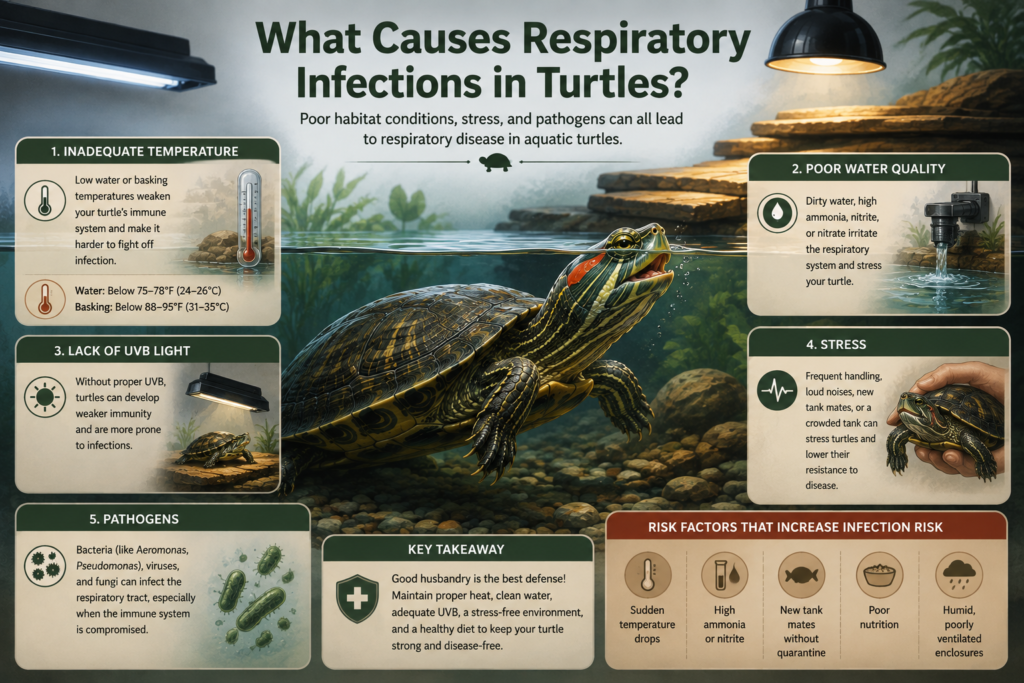
A respiratory infection can develop when infectious organisms take advantage of a turtle whose health or environmental conditions have made it more vulnerable.
That means the underlying problem may involve several factors at the same time.
Temperature
Temperature is one of the first things I’d check when a turtle develops respiratory symptoms.
Turtles are ectothermic, so their body functions are heavily influenced by their environment. Inappropriate environmental temperatures can contribute to respiratory disease and may impair normal immune function.
This doesn’t mean that every respiratory infection is caused by cold water.
It means that temperature is an important part of the overall picture.
If you’re unsure whether your turtle’s habitat is providing appropriate temperatures, start with our turtle water temperature guide.
Use actual thermometers rather than judging temperature by touch.
Water Quality
For an aquatic turtle, water quality is not a cosmetic issue.
Your turtle spends much of its life in that environment, and poor water conditions can contribute to an unhealthy habitat.
VCA specifically identifies inadequate filtration and poor environmental conditions as factors associated with respiratory infections in aquatic turtles.
If your turtle is sick, review:
- Water cleanliness
- Waste accumulation
- Filter performance
- Uneaten food
- Water changes
- Ammonia and nitrite where appropriate
- Overall maintenance
Our turtle tank water quality guide explains the fundamentals in greater detail.
And if filtration is where you’re struggling, our ultimate guide to turtle tank filtration explains how mechanical and biological filtration work together to manage waste.
Inadequate Filtration
Filtration isn’t just about making your aquarium look clean.
A properly sized and maintained filter helps manage waste and supports healthier water conditions.
If a turtle tank produces more waste than its filtration system can reasonably handle, water quality can deteriorate quickly.
If you’re considering upgrading your filtration, our guide to best canister filters for turtle tanks compares some of the options available for larger turtle habitats.
The goal isn’t simply to buy the biggest filter.
It’s to build a filtration system appropriate for the turtle, tank, bioload, and maintenance routine.
Poor Overall Husbandry
Respiratory problems can also be associated with broader husbandry issues.
That may include:
- Inappropriate temperatures
- Poor sanitation
- Poor water quality
- Inadequate nutrition
- Chronic environmental stress
- Other concurrent illnesses
Merck Veterinary Manual identifies unfavorable temperatures, unsanitary conditions, malnutrition, and concurrent disease among factors that can contribute to respiratory disease in reptiles.
This is one reason I don’t like the idea of treating a respiratory infection as if it were completely separate from the habitat.
If the environment is contributing to the problem, the environment needs attention too.
Can Poor Nutrition Contribute to Respiratory Problems?
Nutrition plays an important role in overall turtle health.
Vitamin A deficiency, for example, can produce changes affecting the respiratory tract and has been associated with problems such as swollen eyelids, appetite loss, lethargy, and chronic respiratory infections in turtles.
But there’s an important warning here.
Don’t start giving your turtle vitamin A simply because it has respiratory symptoms.
The same symptoms can have many causes, and excessive vitamin A can itself be harmful.
If you’re unsure whether your turtle is receiving appropriate nutrition, our turtle feeding guide covers the fundamentals of building a balanced feeding routine.
Is Every Turtle With Breathing Problems Infected?
No.
This is one of the most important distinctions in this entire article.
A turtle can have abnormal breathing without necessarily having a bacterial respiratory infection.
Respiratory disease in reptiles can have infectious and noninfectious causes, including bacterial, fungal, viral, parasitic, environmental, nutritional, and other underlying causes.
So if your turtle is breathing strangely, don’t automatically assume:
“My turtle needs antibiotics.”
The correct treatment depends on what’s actually causing the problem.
How Is a Turtle Respiratory Infection Diagnosed?
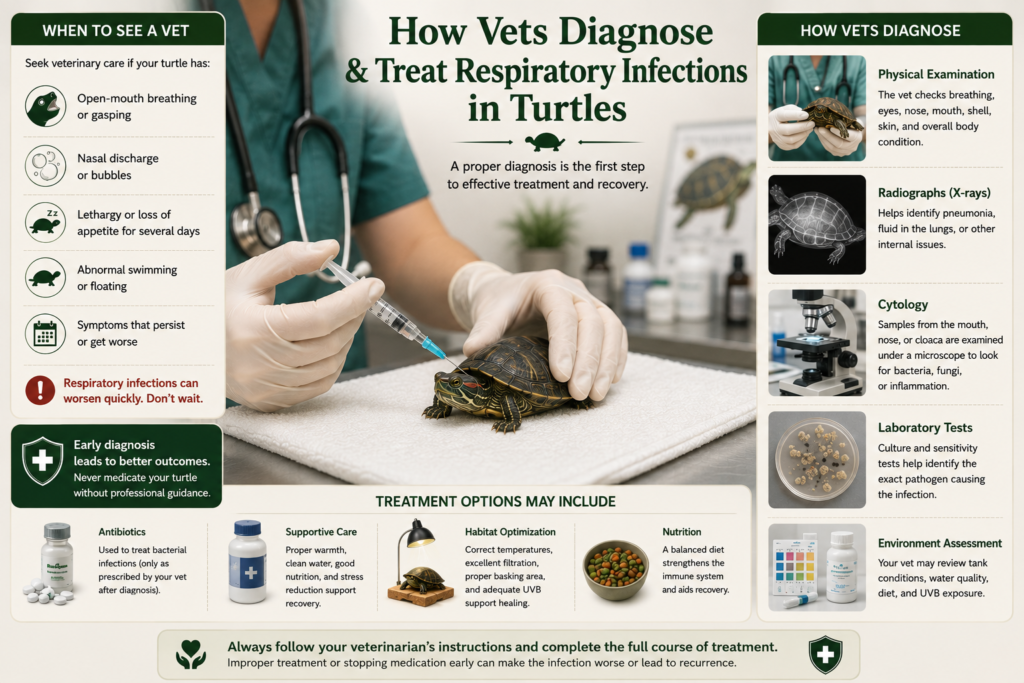
A veterinarian will usually begin by looking at the turtle’s history and performing a physical examination.
The history can be surprisingly important.
Things such as:
- How long symptoms have been present
- Recent changes to the habitat
- Temperature history
- Appetite changes
- Swimming behavior
- Previous illnesses
- Other animals in the enclosure
can all help provide context.
Depending on the turtle’s condition, a veterinarian may recommend additional testing.
Possible diagnostic tools include:
- Radiographs/X-rays
- Blood testing
- Cultures
- Other laboratory testing
VCA notes that radiographs, blood tests, and cultures may be used when evaluating respiratory infections in aquatic turtles.
The exact approach depends on the individual turtle.
How Are Respiratory Infections Treated?
Treatment depends on the underlying cause.
If a veterinarian determines that a bacterial infection is responsible, antibiotics may be prescribed.
But medication is only one part of treatment.
The turtle’s environment, hydration, nutrition, temperature, and overall condition may also need to be addressed.
Merck notes that treatment of reptile respiratory infections involves correcting environmental factors and using antimicrobial therapy when indicated.
VCA similarly notes that antibiotics are commonly used for respiratory infections in turtles and that severely affected turtles may require intensive supportive care.
Don’t self-medicate your turtle
This is particularly important.
Don’t use an antibiotic because another turtle owner used it.
Don’t calculate a dose based on a social media post.
Don’t assume a medication prescribed for another animal will be appropriate for your turtle.
The medication, dose, route, and duration need to be determined for the individual animal by an appropriate veterinarian.
What Supportive Care May Be Needed?
A turtle with respiratory disease may need more than medication. Treating the underlying problem is important, but keeping the turtle stable and supporting its basic needs can also be an important part of recovery.
Depending on the severity of the illness, veterinary-directed supportive care may include:
- Appropriate environmental temperatures
- Hydration
- Nutritional support
- Medication prescribed by a veterinarian
- Fluid therapy
- Assisted feeding when necessary
- Hospitalization for severely ill turtles
- Other intensive veterinary care
Veterinary references note that reptiles with respiratory infections should generally be maintained within the appropriate middle-to-upper portion of their species’ preferred temperature range, while severely affected turtles may require intensive care, fluid therapy, or assisted feeding.
One of the most important things you can do at home is maintain stable, appropriate environmental conditions rather than constantly changing the setup in response to every new symptom.
Your turtle basking setup guide can help you review whether the basking area itself is appropriate.
And if you’re unsure about your UVB system, our guide to best UVB lighting for pet turtles covers the factors that matter when choosing and positioning UVB.
What I Did to Support Gin During His Illness
While Gin was sick, I also developed a daily supportive-care routine around the treatment prescribed by his veterinarian.
This included carrot soaking, which I used regularly while his appetite was poor. I considered this part of my attempt to keep him supported while he wasn’t eating normally.
I want to make one thing very clear, though:
Carrot soaking was part of Gin’s personal supportive-care routine. It was not a treatment for his respiratory illness, and I wouldn’t present it as a proven cure or recommend it as a replacement for veterinary care.
I also used a steam-based supportive measure while monitoring Gin closely.
Again, this was something I personally tried during his illness. It should not be confused with veterinary nebulization, which is a controlled medical procedure that can be used in some reptile respiratory cases under professional direction. Merck Veterinary Manual describes nebulization with appropriate medications and saline as one possible component of treatment for reptile respiratory infections.
I would not recommend that turtle owners improvise a hot-steam treatment at home, particularly because excessive heat, humidity, or direct exposure to hot steam could create additional problems.
For Gin, these measures were simply part of the supportive routine I used while continuing his prescribed treatment and watching his breathing, appetite, activity, and overall behavior.
And eventually, those observations started giving me something I desperately needed:
small signs of improvement.
Should You Increase the Temperature When Your Turtle Is Sick?
Appropriate warmth can be important for sick reptiles.
Merck notes that reptiles with respiratory infections are generally maintained toward the middle-to-upper portion of their preferred optimal temperature range under appropriate veterinary care.
But this does not mean turning the tank into a sauna.
The correct temperature depends on the species, life stage, enclosure, and individual condition.
Use reliable thermometers and follow species-appropriate guidance rather than guessing.
Should You Dry Dock a Turtle With a Respiratory Infection?
Dry docking is frequently recommended in online turtle communities, but it isn’t automatically appropriate for every respiratory case.
Whether it is appropriate depends on the turtle’s:
- Species
- Hydration status
- Shell condition
- Ability to drink
- Overall health
- Veterinary treatment plan
Some situations may call for periods outside the water, while others require continued access to water.
For that reason, don’t treat prolonged dry docking as a universal cure for respiratory disease.
If your turtle is sick, ask your veterinarian whether dry docking is appropriate for that individual turtle.
What Should You Do If Your Turtle Isn’t Eating?
Loss of appetite can accompany respiratory disease, but the priority is to understand why the turtle isn’t eating.
If your turtle has stopped eating and is also showing breathing problems, don’t treat the situation as simply a feeding issue.
Look at the whole picture.
Is your turtle:
- Breathing normally?
- Alert?
- Basking?
- Swimming normally?
- Showing discharge?
- Gasping?
- Losing weight?
A seriously ill turtle may eventually require assisted feeding under veterinary supervision, but force-feeding should not be treated as a universal first response.
If you’re specifically dealing with appetite loss, our guide to why your turtle may stop eating can help you work through the possible causes.
When Is a Turtle Respiratory Infection an Emergency?
Some symptoms should make you act quickly.
If your turtle is repeatedly gasping or appears to be struggling to breathe, don’t wait for additional symptoms before taking the situation seriously.
I’d be particularly concerned about combinations such as:
- Repeated gasping
- Open-mouth breathing
- Significant neck extension
- Severe lethargy
- Nasal or oral discharge
- Persistent bubbles
- Abnormal swimming
- Significant changes in buoyancy
- Unresponsiveness
A turtle that is having obvious difficulty breathing needs veterinary attention.
And if abnormal breathing is accompanied by severe lethargy or abnormal swimming, I would consider that particularly concerning.
VCA recommends veterinary evaluation for turtles showing significant deviations from normal and notes that pneumonia can affect swimming and buoyancy.
What Can You Do While Waiting for Veterinary Care?
If professional care isn’t immediately available, the goal should be to support the turtle without making the situation worse.
Keep the environment stable and species-appropriate.
Check your temperatures with thermometers.
Keep the water clean.
Reduce unnecessary handling.
Observe the turtle closely.
And document what you’re seeing.
I would write down:
- When symptoms began
- When the turtle last ate
- Changes in breathing
- Changes in swimming
- Basking behavior
- Water temperature
- Basking temperature
- Recent habitat changes
- Any discharge
- Any medication already given
That information can be extremely useful when you eventually speak with a veterinarian.
Most importantly, don’t allow temporary improvement to convince you that the problem is definitely gone.
How Can You Help Prevent Respiratory Problems?
You can’t prevent every respiratory infection.
However, good husbandry can reduce avoidable stressors and support your turtle’s overall health.
Start with the fundamentals.
Provide appropriate temperatures and monitor them rather than guessing.
Give your turtle a dry, accessible basking area. Our turtle basking setup guide explains how the major components work together.
Provide appropriate UVB. Our best UVB lighting for pet turtles guide covers bulb type, positioning, distance, and replacement considerations.
Maintain excellent water quality through appropriate filtration and regular maintenance. Our ultimate guide to turtle tank filtration goes much deeper into building an effective filtration system.
Feed an appropriate, balanced diet. Our turtle feeding guide covers the basics.
And perhaps most importantly, observe your turtle regularly.
Watch how it eats.
Watch how it swims.
Watch how it basks.
Watch how it breathes.
When you know what normal looks like, abnormal behavior becomes much easier to recognize.
My Turtle Gin’s Experience
This subject became much more personal for me recently.
My turtle Gin went through a period where his breathing became the biggest concern.
At first, I was watching his overall behavior.
He became lethargic.
Then his appetite declined.
But as things progressed, I became much more focused on his breathing. I noticed throat and neck movements that concerned me, and there were moments when I worried about gasping.
His eyes also appeared swollen.
At that point, I wasn’t simply thinking:
“Why isn’t Gin eating?”
I was thinking:
“Why is Gin having difficulty breathing?”
I eventually took him to a veterinarian, who prescribed medication and gave me instructions for administering it.
The experience was frightening because there was no instant answer and no instant recovery.
I had to watch him closely, provide supportive care, continue the treatment plan, and look for small changes.
One of those small changes eventually gave me hope.
Gin wanted to bask.
Then, after several days without eating, he finally ate voluntarily.
But what made that moment particularly meaningful was that he didn’t gasp once while eating.
I’m not calling him fully recovered based on one good meal.
I’m continuing to monitor his breathing, appetite, activity, and overall behavior.
I’ve documented the full experience separately in Gin’s Recovery Journey, because I think there is value in showing what a real turtle illness looks like from an owner’s perspective without pretending that one turtle’s experience is a universal diagnosis or treatment plan.
Frequently Asked Questions
Common signs include lethargy, loss of appetite, nasal discharge, mucus or bubbles, wheezing, neck extension, open-mouth breathing, gasping, and abnormal swimming or floating.
Repeated gasping can indicate respiratory distress. Respiratory infection is one possible cause, but breathing difficulty can have other causes as well. A veterinarian should determine the underlying problem.
Repeated open-mouth breathing can be a sign of respiratory difficulty and should not be ignored, particularly when accompanied by lethargy, appetite loss, discharge, or gasping.
Inappropriate environmental temperatures can contribute to respiratory disease and may make reptiles more vulnerable to illness.
Poor environmental conditions and inadequate filtration can contribute to respiratory disease in aquatic turtles.
Respiratory illness can cause both appetite loss and lethargy, but those symptoms are not specific to respiratory infections. When appetite loss occurs together with breathing abnormalities, veterinary evaluation becomes particularly important.
Many turtles can recover when the underlying problem is identified and appropriately treated. However, severe or prolonged respiratory disease can become life-threatening, so early veterinary attention is important.
Only use antibiotics under appropriate veterinary guidance. Different respiratory problems can have different causes, and the correct medication, dose, route, and duration depend on the individual turtle.
Appropriate temperatures are important for sick reptiles, and veterinary references recommend maintaining reptiles with respiratory infections toward the middle-to-upper portion of their preferred optimal temperature range. That does not mean making the enclosure excessively hot. Use species-appropriate temperature guidance and follow veterinary recommendations.
Some infectious diseases can spread between animals, depending on the underlying cause. If you keep multiple turtles and one becomes sick, ask your veterinarian whether isolation and additional hygiene precautions are appropriate.
Final Thoughts
A turtle respiratory infection can begin with signs that are surprisingly easy to overlook. Your turtle may simply become quieter, spend more time resting, eat less, or behave differently before obvious breathing problems appear. That is why knowing your turtle’s normal behavior is so important.
If you notice repeated gasping, open-mouth breathing, neck extension, nasal discharge, bubbles, abnormal swimming, severe lethargy, or a sudden loss of appetite, don’t focus only on treating the symptom. Respiratory problems can have different underlying causes, and understanding what is actually happening is important before choosing a treatment.
Good husbandry matters too. Appropriate temperatures, clean water, effective filtration, proper UVB, a suitable basking area, and a balanced diet all contribute to your turtle’s overall health. But even excellent husbandry cannot prevent every illness.
My experience with Gin made this especially real for me. Watching him struggle with his breathing was frightening, and seeing his appetite disappear made the situation even more worrying. But watching him eventually eat again without gasping reminded me that recovery can sometimes begin with very small signs.
If your turtle is showing concerning respiratory symptoms, don’t wait for things to become severe. Observe carefully, maintain appropriate conditions, document changes, and seek veterinary help when needed.
Sometimes recognizing that something isn’t normal is the most important first step you can take.
Related Turtle Care Guides
- Turtle Water Temperature Guide — how to monitor and maintain appropriate water temperatures
- Turtle Basking Setup Guide — how to create a safe and effective basking area
- Best UVB Lighting for Pet Turtles — understanding UVB, positioning, distance, and replacement
- The Ultimate Guide to Turtle Tank Filtration — how filtration affects water quality and turtle health
- Turtle Tank Setup Guide — the major components of a healthy aquatic turtle habitat
- Turtle Feeding Guide — understanding appropriate nutrition and feeding
- Best Canister Filters for Turtle Tanks — choosing filtration for larger turtle habitats
Medical Disclaimer
This article provides general educational information about turtle respiratory disease and is not a substitute for veterinary diagnosis or treatment.
Respiratory symptoms can have different causes, and the same symptom may occur with different illnesses. Medication, including antibiotics or vitamin supplementation, should only be used under appropriate veterinary guidance.
Gin’s experience described in this article is a personal account and should not be interpreted as a diagnosis or treatment recommendation for another turtle.
If your turtle is having difficulty breathing, repeatedly gasping, breathing with its mouth open, producing significant discharge, becoming severely lethargic, or showing other serious changes from normal behavior, seek veterinary care as soon as possible.