
Why Is My Turtle Not Eating? Causes, Warning Signs & What to Do
One of the most worrying things you can see as a turtle owner is your turtle suddenly refusing food.
A turtle that normally rushes toward feeding time may suddenly ignore its favorite food. Sometimes it skips a meal and goes back to normal. Other times, the loss of appetite continues for several days and is accompanied by lethargy, unusual breathing, swollen eyes, changes in swimming, or other signs that something isn’t right.
So, why is your turtle not eating?
There isn’t always one simple answer.
A turtle may temporarily eat less because of inappropriate temperatures, environmental stress, changes in its habitat, or dietary issues. But appetite loss can also occur when a turtle is sick. In aquatic turtles, loss of appetite and lethargy are nonspecific signs that can accompany a variety of illnesses.
That’s why the most useful question isn’t simply:
“How can I make my turtle eat?”
It’s:
“Why has my turtle stopped eating?”
This guide explains the most common reasons, what you can check at home, which warning signs deserve particular attention, and when veterinary care is appropriate.
I’ll also share what happened with my own turtle, Gin, who recently stopped eating for several days and developed other concerning symptoms. His experience is documented separately in Gin’s Recovery Journal, where I’m recording the timeline and what happened as he recovers.
Before assuming your turtle has become a picky eater, make sure you’re offering an appropriate diet for its species and age.
Important: This article is for general educational purposes and isn’t a substitute for veterinary diagnosis or treatment. If your turtle isn’t eating and is also showing signs of illness, contact a veterinarian familiar with reptiles whenever possible.
Related Turtle Care Guides
If you’re troubleshooting your turtle’s appetite or overall health, these guides may help:
- Turtle Tank Setup Guide
- Turtle Water Temperature Guide
- Turtle Basking Setup Guide
- Best UVB Lighting for Pet Turtles
- The Ultimate Guide to Turtle Tank Filtration
- Turtle Food & Feeding Guide
- Turtle Respiratory Infection Symptoms
- Gin’s Recovery Journal
How Long Can a Turtle Go Without Eating?
There isn’t one number of days that is automatically safe for every turtle.
Age, species, size, health, temperature, season, diet, and the reason for the appetite loss can all affect how concerning the situation is.
A healthy adult turtle may naturally eat less frequently than a growing juvenile. So missing one meal doesn’t necessarily mean something is wrong.
The situation becomes more concerning when the refusal to eat is persistent or happens together with other changes.
For example:
- Your turtle suddenly becomes lethargic.
- It repeatedly refuses food.
- It is losing weight.
- Its eyes look swollen or abnormal.
- It develops nasal or oral discharge.
- Its breathing changes.
- It begins gasping or breathing with its mouth open.
- It swims abnormally.
- It stops basking normally.
VCA notes that lack of appetite and lethargy are common but nonspecific signs of illness in aquatic turtles.
So don’t focus only on the number of days.
Look at the whole picture.
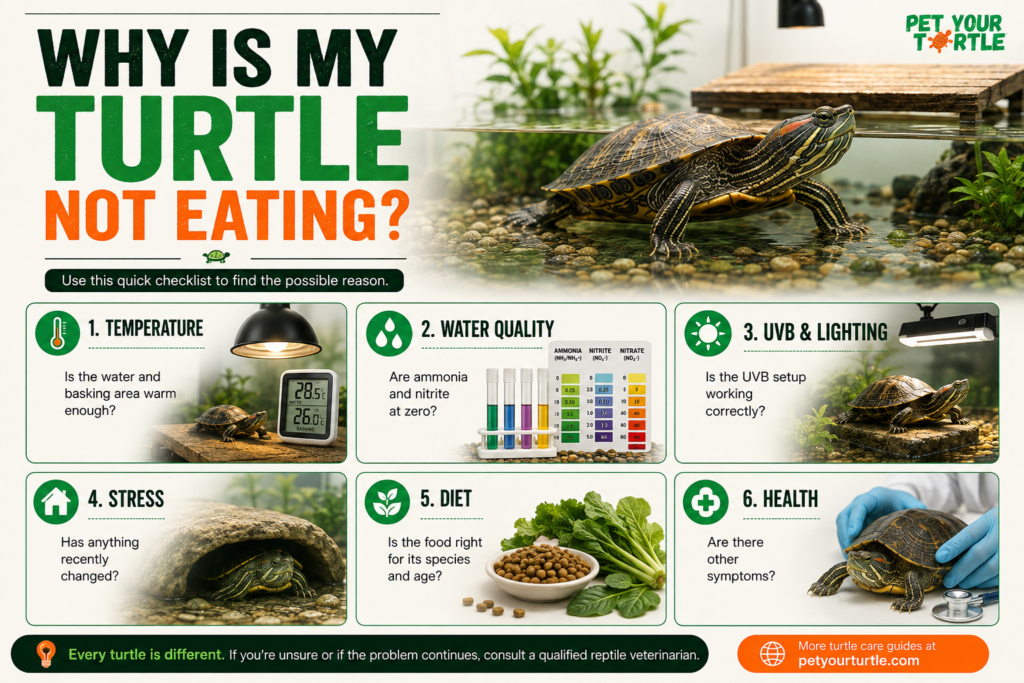
9 Common Reasons Your Turtle May Not Be Eating
1. The Water or Environment Is Too Cold
Temperature has a major influence on a turtle’s metabolism and activity.
Turtles are ectothermic, which means they rely on their surroundings to regulate their body temperature.
If the water is too cold for the species, your turtle may become less active and may stop eating.
VCA notes that sustained low temperatures can contribute to loss of appetite and may increase a turtle’s susceptibility to bacterial infections.
If you’re unsure whether your turtle’s water is in the appropriate range, start by checking your turtle water temperature rather than guessing based on how the water feels.
What to check
- Water temperature
- Basking temperature
- Ambient temperature
- Nighttime temperature
- Temperature stability throughout the day
A thermometer is much more reliable than simply touching the water.
2. The Basking Area Isn’t Appropriate
Aquatic turtles need more than warm water.
They need access to a suitable dry basking area where they can completely leave the water and warm themselves.
If the basking platform is difficult to reach, too small, unstable, or doesn’t provide appropriate conditions, your turtle may not be getting the environmental support it needs.
If you’re reviewing your setup, our turtle basking setup guide walks through the key components of a safe and effective basking area.
A proper basking area should allow the turtle to completely leave the water and should be paired with appropriate heat and UVB lighting.
3. Your Turtle Isn’t Getting Appropriate UVB
UVB is another important part of a turtle’s overall husbandry.
UVB exposure plays an important role in vitamin D3 production and calcium metabolism, which are essential for healthy shell and bone development.
If you’re unsure whether your lighting setup is appropriate, see our complete guide to best UVB lighting for pet turtles.
But remember that UVB isn’t a quick appetite stimulant.
If your turtle has already become sick, simply changing the bulb won’t necessarily solve the underlying problem.
The goal is to make sure the habitat provides the correct conditions before problems develop.
4. Stress Can Affect Appetite
Turtles can respond to environmental changes with changes in behavior and appetite.
Potential stressors include:
- Moving to a new enclosure
- Major changes to the habitat
- Excessive handling
- New tank mates
- Aggressive tank mates
- Excessive noise
- Lack of appropriate resting areas
- Sudden changes in routine
Think about what happened shortly before your turtle stopped eating.
Did anything change?
However, don’t automatically blame stress.
If your turtle is refusing food and showing other abnormal symptoms, illness needs to remain a possibility.
5. The Diet May Not Be Appropriate
Diet is an important part of turtle health.
The appropriate diet depends on factors such as species, age, and life stage.
An unbalanced diet can contribute to nutritional problems, while relying too heavily on treats can make it harder to provide appropriate nutrition.
If you’re unsure what your turtle should be eating, start with our complete guide to turtle food and feeding.
The goal isn’t simply to find one food that your turtle likes.
It’s to provide a nutritionally appropriate diet consistently.
And if a normally enthusiastic eater suddenly refuses even its favorite foods, don’t assume that changing brands or offering more treats will solve the problem.
A sudden appetite change can be a symptom rather than a food preference.
6. Poor Water Quality
Your aquatic turtle spends much of its life in its water, so water quality matters enormously.
Waste, uneaten food, and inadequate maintenance can contribute to poor water conditions.
A properly sized filter helps manage waste, while regular maintenance and water changes are necessary to keep the environment healthy.
If you’re trying to determine whether your turtle’s environment is contributing to the problem, start with our guide to turtle tank water quality.
And remember:
Clear water doesn’t necessarily mean healthy water.
If you’re unsure whether your filtration system is doing enough, our ultimate guide to turtle tank filtration explains how filtration works, what biological filtration does, and how to choose and maintain an appropriate system.
7. Illness or Infection
Sometimes a turtle stops eating because it is sick.
This is where appetite loss becomes much more concerning.
Aquatic turtles can develop a variety of medical problems, including Turtle respiratory disease, nutritional deficiencies, parasites, shell infections, abscesses, and other conditions.
The important thing to understand is that loss of appetite alone doesn’t tell you what the disease is.
Instead, look for additional symptoms.
Ask:
- Is my turtle lethargic?
- Is it breathing differently?
- Is there discharge?
- Are the eyes swollen?
- Is it swimming normally?
- Is it basking?
- Has it lost weight?
- Is there anything visibly abnormal?
The more symptoms you see together, the more important veterinary assessment becomes.
8. Respiratory Problems
Respiratory problems deserve particular attention because they can cause appetite loss alongside other obvious symptoms.
Possible warning signs include:
- Nasal discharge
- Mucus
- Bubbles around the nose or mouth
- Wheezing
- Neck extension
- Open-mouth breathing
- Gasping
- Lethargy
- Loss of appetite
These are recognized warning signs associated with respiratory disease in aquatic turtles.
If your turtle is showing these symptoms, don’t assume that improving the tank temperature alone will fix the problem.
If you’re seeing several of these signs together, read our guide to turtle respiratory infection symptoms and consider veterinary evaluation.
9. Eye Problems and Swollen Eyelids
Changes around the eyes can also be an important warning sign.
Swollen eyelids may occur for different reasons, including nutritional problems, infection, irritation, or other health conditions.
The important point is that swollen eyes shouldn’t automatically be treated as an isolated eye problem when your turtle is also refusing food or behaving abnormally.
If your turtle has swollen eyes together with lethargy or appetite loss, consider the bigger picture and seek professional advice where possible.
Turtle Not Eating and Lethargic: Is That More Serious?
Yes.
A turtle that skips one meal but remains active, alert, and otherwise normal is very different from a turtle that refuses food and becomes increasingly lethargic.
The combination of:
Not eating + lethargy
is more concerning than appetite loss alone.
And when you add:
Not eating + lethargy + breathing abnormalities
the situation deserves even more attention.
Turtles can display relatively nonspecific symptoms when they’re unwell, so changes from your turtle’s normal behavior are important to take seriously.
What Should You Check If Your Turtle Stops Eating?
Before assuming the worst, work through the basics.
Check the habitat
Verify:
- Water temperature
- Basking temperature
- UVB lighting
- Basking access
- Water quality
- Filtration
- Recent water changes
- Recent environmental changes
If you need to review your complete setup, our turtle tank setup guide can help you work through the major components systematically.
Check your turtle
Look for:
- Activity level
- Eye appearance
- Nasal discharge
- Mouth discharge
- Unusual breathing
- Gasping
- Swimming abnormalities
- Swelling
- Shell abnormalities
- Weight loss
Think about what changed
Ask yourself:
What happened before the appetite disappeared?
Did you:
- Move the turtle?
- Change the enclosure?
- Change the water?
- Change the food?
- Add another animal?
- Change the lighting?
- Change the temperature?
- Notice another symptom first?
The timeline can sometimes provide useful clues.
Should You Force-Feed a Turtle That Isn’t Eating?
This is one of the questions turtle owners ask most often.
The short answer is:
Don’t automatically force-feed a turtle simply because it has skipped food.
If the underlying problem hasn’t been identified, forcing food into the turtle doesn’t address the reason it stopped eating.
And if a turtle is seriously ill, veterinary-directed supportive care may be necessary.
This is particularly important if your turtle is also showing breathing problems.
Rather than immediately trying to force food into a sick turtle, focus first on understanding the underlying problem and getting appropriate veterinary advice.
If you want to understand the broader issue, see our guide on how to feed a sick turtle.
When Should You See a Veterinarian?
A turtle that briefly eats less but otherwise behaves normally may simply need careful observation and a review of its environment.
But veterinary attention becomes particularly important when appetite loss is accompanied by other abnormal signs.
Contact a veterinarian familiar with reptiles if you notice:
- Persistent refusal to eat
- Significant lethargy
- Gasping
- Open-mouth breathing
- Nasal discharge
- Mucus or bubbles
- Abnormal swimming
- Significant swelling
- Major weight loss
- Unresponsiveness
- Other sudden changes from normal behavior
VCA recommends veterinary evaluation when turtles deviate from their normal condition.
If there isn’t a reptile specialist nearby, contact local veterinary clinics and ask whether they treat turtles or reptiles.
My Turtle Gin Stopped Eating: What Happened?
This is where my own experience comes in.
Recently, my turtle Gin stopped eating.
It wasn’t simply one missed meal.
He went through a period of around four days without eating, and I was also becoming concerned about changes in his activity and breathing.
There were moments when I was genuinely frightened.
I was watching him constantly and trying to determine whether I was seeing a temporary change or something more serious.
I noticed concerning breathing-related behavior, including throat and neck movements, and there were moments when I worried about gasping.
His eyes also appeared swollen at one point.
I didn’t want to diagnose him myself.
Eventually, I took Gin to a veterinarian.
The veterinarian prescribed medication and gave me instructions for administering it.
I continued monitoring Gin closely and providing supportive care.
Then something happened that gave me hope.
Gin Ate Again
After several days without eating, Gin finally ate voluntarily.
And there was one detail that made the moment especially encouraging:
He didn’t gasp once while eating.
For me, that was a huge moment.
But I wasn’t going to assume he was suddenly cured.
One good meal doesn’t tell you everything.
Instead, I started looking for a trend.
Was he eating again?
Was his breathing staying normal?
Was his activity improving?
Was he basking?
Was he behaving more like himself?
Those are the things I’m continuing to monitor.
I’ve documented the experience in much greater detail in Gin’s Recovery Journal, including the timeline, the veterinary visit, treatment, difficult days, and the first signs of improvement.
Gin loves Zoo Med Aquatic Turtle food and Saki Hikari Turtle food two commercial pellet that offers all the necessary vitamins and minerals
What Gin’s Experience Taught Me About Turtle Care
The biggest lesson I took from Gin’s illness was how important it is to know your turtle’s normal behavior.
Before Gin became sick, I knew his habits without necessarily thinking about them.
I knew how he moved.
I knew how he responded to food.
I knew how active he normally was.
I knew what his normal behavior looked like.
When those things changed, I noticed.
That’s something every turtle owner can do.
You don’t need to be a veterinarian to notice that your turtle isn’t acting like itself.
You just need to pay attention.
And when something seems wrong, don’t wait until the symptoms become dramatic before taking the change seriously.
How to Help Prevent Appetite Problems
You can’t prevent every illness, but good husbandry can reduce avoidable problems and give your turtle the best chance of staying healthy.
Focus on the fundamentals.
Maintain appropriate temperatures
Use reliable thermometers and monitor both water and basking temperatures.
Provide proper UVB
Use an appropriate UVB setup for your turtle and enclosure. Our guide to best UVB lighting for pet turtles covers the major factors to consider when choosing and positioning UVB lighting.
Provide a suitable basking area
Your turtle should be able to completely leave the water and bask comfortably. Our turtle basking setup guide explains how to build an appropriate basking environment.
Maintain water quality
Use adequate filtration and perform appropriate routine maintenance. Our guide to turtle tank filtration goes deeper into mechanical, biological, and chemical filtration.
Feed an appropriate diet
Provide a diet appropriate for your turtle’s species and life stage. Our turtle feeding guide covers the fundamentals in greater detail.
Observe your turtle
Pay attention to appetite, activity, swimming, basking, breathing, eyes, shell condition, and overall behavior.
The goal isn’t to panic over every missed meal.
It’s to recognize when a small change becomes a pattern.
Frequently Asked Questions
There are many possible reasons, including inappropriate temperatures, environmental stress, dietary problems, poor husbandry, and illness. Appetite loss is a nonspecific symptom, so your turtle’s other behaviors and physical signs are important too.
There isn’t one safe number of days that applies to every turtle. Species, age, temperature, health, and the reason for appetite loss all matter. Persistent refusal to eat or appetite loss accompanied by other symptoms should be taken seriously.
Reduced activity and appetite can occur when environmental conditions aren’t appropriate or when a turtle is unwell. If your turtle is unusually lethargic rather than simply resting normally, check its habitat and consider veterinary evaluation.
Gasping or open-mouth breathing alongside appetite loss can be a sign of respiratory disease. Other warning signs can include nasal discharge, mucus, wheezing, and neck extension while breathing.
Don’t assume force-feeding is appropriate simply because your turtle isn’t eating. The underlying cause should be considered, and seriously ill turtles may require veterinary-directed supportive care.
Yes. Inappropriate temperatures can reduce activity and appetite. Sustained low temperatures may also increase susceptibility to illness.
If your turtle has persistent appetite loss, significant lethargy, breathing abnormalities, discharge, abnormal swimming, swelling, significant weight loss, or another noticeable deviation from normal behavior, veterinary evaluation is appropriate.
Final Thoughts
A turtle refusing food can sometimes be caused by something relatively simple, but it can also be an early sign that something is wrong.
That’s why I don’t think the best response is simply to search for a way to make your turtle eat.
Find out why it stopped eating.
Check the habitat.
Check the temperature.
Review the basking and UVB setup.
Look at water quality.
Consider recent changes.
Pay attention to the other symptoms.
And if your turtle is showing signs of illness, seek veterinary help rather than waiting for the problem to become severe.
My own turtle Gin reminded me of that.
After several frightening days, watching him voluntarily eat again without gasping was one of the most reassuring moments I’ve experienced as a turtle owner.
I’m still monitoring him.
And I’m still documenting everything.
Because sometimes the smallest improvement is worth paying attention to.
Medical Disclaimer
This article provides general educational information about turtle care and is not a substitute for veterinary diagnosis or treatment.
The information about Gin is a personal account of one turtle’s experience and should not be interpreted as a diagnosis or treatment recommendation for other turtles.
If your turtle is showing signs of illness, particularly breathing difficulty, severe lethargy, persistent appetite loss, or other significant changes from normal behavior, consult a veterinarian familiar with reptiles.